About The Author: Travis Baugh is a Digital Brand Marketing Manager for Bryant, where he creates clear, helpful content to guide homeowners through heating, cooling, and indoor air quality decisions. His goal is to empower readers with the knowledge they need to choose the right comfort solutions for their home—confidently and comfortably.
Heat Pump vs. Air Conditioner: Understanding the Difference
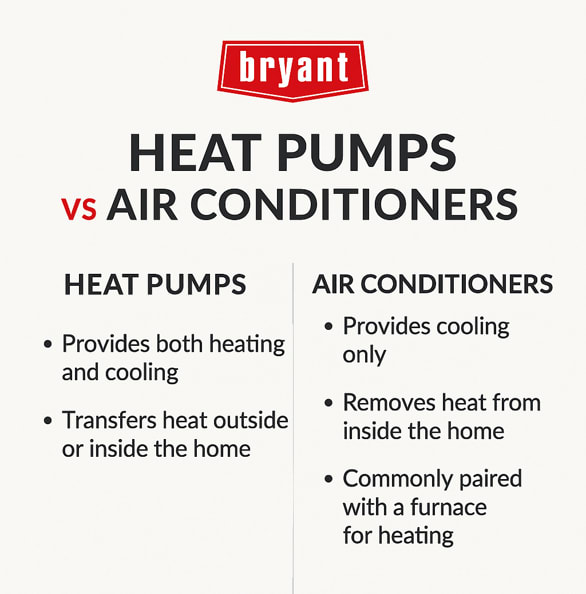
The primary difference between a heat pump and an air conditioner is that a heat pump provides both heating and cooling, while an air conditioner only cools. Deciding between a heat pump vs. air conditioner means evaluating your climate, existing HVAC setup, and desire for long-term energy efficiency. Both advanced systems offer reliable, quiet comfort, but a heat pump's dual functionality makes it an innovative investment for year-round climate control.
What Is a Heat Pump?
Heat pumps are innovative, all-in-one climate control systems that transfer thermal energy rather than generating it. In the summer, they function just like an air conditioner, moving heat from inside your home to the outdoors. However, in the winter, they reverse this process, extracting heat from the outside air (or ground) and transferring it indoors to keep you comfortably warm.
This smart functionality makes heat pumps an incredibly efficient choice for modern homes. Because they move heat rather than burn fuel to create it, they can offer significant energy savings compared to traditional furnaces or boilers. Learn more about what is a heat pump.
Types of Heat Pumps
- Air-source heat pumps: The most popular option, transferring heat between your home and the outside air for efficient, everyday comfort.
- Geothermal heat pumps: These utilize stable underground temperatures for exceptional efficiency and quiet operation in extreme climates.
- Air-to-water heat pumps: These transfer heat between the outdoor air and a home’s hydronic system, providing efficient heating and cooling through radiators, in-floor heating, or fan coils.

What Is Air Conditioning?
Air conditioners are specialized cooling systems dedicated to keeping your home comfortable and removing humidity during hot summer months. They circulate refrigerant through a closed-loop system, absorbing heat from indoor air at the evaporator coil and releasing it outside via the condenser coil. Learn more about how ACs work.
While they are highly effective and reliable at cooling, air conditioners do not provide heating. In colder months, a home with a central AC unit typically relies on a separate heating source, such as a furnace, to maintain an ideal indoor environment.
Common Air Conditioning Configurations
There are several types of air conditioners available, each designed for advanced performance in different applications.
- Central air conditioning: Delivers consistent cooling through ductwork to every room in your home.
- Ductless mini-split systems: Perfect for targeted cooling in homes without ductwork.
- Window or Portable Units: Cost-effective solutions for single-room cooling needs.
Heat Pump vs. Air Conditioner: Key Differences
When comparing heat pumps vs. air conditioners, the primary difference is their seasonal versatility. A heat pump is better suited for homeowners looking to replace both their heating and cooling systems, while an AC works best when paired with an existing, high-performing furnace.
- Functionality: An air conditioner cools only. A heat pump cools and heats by reversing the refrigerant cycle.
- Components: A heat pump includes a reversing valve, allowing it to switch the direction of refrigerant flow.
- Seasonality: Air conditioners are seasonal appliances used primarily in summer. Heat pumps are year-round solutions.
"The key difference in an air conditioner versus a heat pump is that a heat pump has a reversing valve, so it can take heat and energy from the outside and bring it inside the home to heat the home," Mike Lea, co-owner of Lea Heating & Air Conditioning in East Dundee, IL, said. "Believe it or not, when it's 30 below 0 outside, there's still heat and energy outside.”

Similarities Between Heat Pumps and Air Conditioners
Despite their differences, both systems share core technological characteristics that ensure your home stays comfortable, efficient, and reliable:
- Refrigerant Cycle: Both use refrigerant to transfer heat and remove humidity.
- Efficiency Ratings: Both are rated by SEER2 (Seasonal Energy Efficiency Ratio) and EER2, helping you compare cooling performance and energy savings.
- Components: Both utilize indoor evaporator coils and outdoor compressor/condenser units engineered for quiet operation.
- Maintenance: Both require regular AC maintenance, such as air filter replacement and coil cleaning, to breathe cleaner air and maintain peak performance.
“The simplest way I would describe the similarities is air conditioner and heat pump both transfer heat from inside your home and expel it to the exterior via the condensing fan motor on the air conditioner,” Mike Lea, co-owner of Lea Heating & Air Conditioning in East Dundee, IL, said.
Choosing the Right System for Your Home
Deciding between a heat pump and an air conditioner often comes down to your climate, existing equipment, and long-term energy goals.
When to Choose a Heat Pump
Heat pumps may be the right choice if you value energy-efficient heating and cooling and a reduced carbon footprint. In mild to moderate climates, a heat pump can handle 100% of your HVAC needs. Even in colder regions, modern cold climate heat pumps can now extract heat efficiently in freezing temperatures, reducing or eliminating the need for a backup furnace.
When to Choose an Air Conditioner
If your home already has a reliable, relatively new furnace, installing a central air conditioner may be the most cost-effective path. It allows you to add advanced cooling without paying for the heating capability you already possess.
Cost Comparison: Upfront Investment vs. Long-Term Savings
Heat pumps generally have a higher upfront installation cost than standalone air conditioners due to their advanced, dual-function technology. However, looking at the sticker price alone ignores the long-term value. Efficiency pays for itself over time.
- Operational Savings: Because they transfer heat rather than creating it, heat pumps can help lower monthly energy bills.
- Incentives: Rebates are often available for high-efficiency heat pumps, helping to offset the initial investment.
- Total Value: Investing in a heat pump is an investment in comfort and efficiency that pays dividends over the lifespan of the system.

Connect With A Bryant Expert
Ready to upgrade your comfort? Whether you need an AC installation or are ready to switch to a heat pump, a local Bryant dealer can assess your home and recommend the perfect solution.
Heat Pump vs AC FAQs
It depends on your local climate, A heat pump is more versatile than an AC because it provides both cooling and heating, making it ideal for year-round comfort, while an AC only cools.
Depending on the age of your current air conditioner, your local climate, and the available tax credits or rebates for the heat pump you have in mind, it may be worth replacing an AC with a heat pump.
Yes, modern heat pumps—especially high-efficiency or variable-speed models—are capable of effectively cool homes in 100°F weather, although performance may vary based on system size and home insulation.
An air conditioner generally has a lower upfront cost than a heat pump. However, a heat pump often provides lower monthly energy bills, offering better long-term value.
Yes, a heat pump can replace both your AC and furnace. Modern heat pumps provide effective cooling in summer and efficient heating in winter, serving as a complete, all-in-one HVAC solution.
Yes, modern cold-climate heat pumps are engineered to extract heat from outdoor air even in freezing temperatures (as low as -15°F or lower), keeping your home warm without a backup furnace.
Learn More About Air Conditioners
- Find out what is a split AC unit and an inverter air conditioner
- Discover the factors in choosing the best air conditioner
- Understand what size air conditioner you need
- Find out how long do AC units last
- Find out what temperature to set air conditioner in summer


