About The Author: Travis Baugh is a Digital Brand Marketing Manager for Bryant, where he creates clear, helpful content to guide homeowners through heating, cooling, and indoor air quality decisions. His goal is to empower readers with the knowledge they need to choose the right comfort solutions for their home—confidently and comfortably.
How Does an Air Conditioner (AC) Work?
An air conditioner works by removing heat and humidity from your indoor air and transferring it outside, leaving your home cool and comfortable. It relies on a continuous cycle of chemical refrigerant changing from liquid to gas to absorb heat indoors and release it outdoors. Understanding how AC works is the first step toward improving your home's comfort and energy efficiency.
Modern HVAC systems offer unparalleled technology and energy savings, turning the simple act of cooling into a seamless, quiet, and innovative experience.
The Basic AC Process Explained
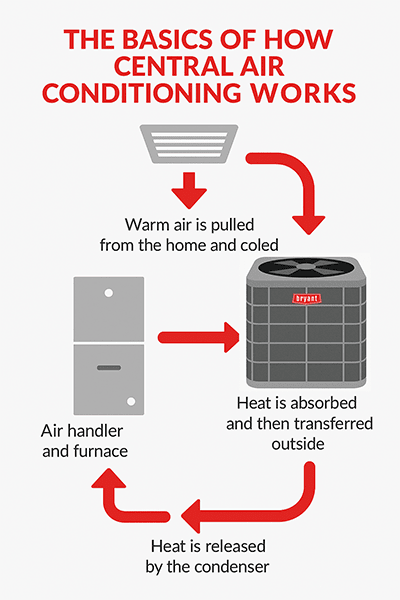
The basic air conditioning process involves drawing warm indoor air over cold refrigerant coils to absorb heat and moisture, then releasing that absorbed heat into the outdoor atmosphere. The result is cool, dehumidified air circulated back into your living space.
Air conditioning doesn't add cold air to your home—it removes heat. The process starts when warm indoor air is drawn into the system. A chemical refrigerant absorbs the heat and moisture from that air, then carries the unwanted heat to the outdoor unit, where it is released into the atmosphere.
This cycle is surprisingly similar to how a refrigerator keeps your food cold. Just as a fridge removes heat from its interior to keep groceries fresh, an AC removes heat from your rooms to keep you comfortable.
Mike Lea, co-owner of Lea Heating & Air Conditioning in East Dundee, IL, breaks down how an air conditioner works.
“Air conditioners cool a space by removing heat and humidity from the indoor air and transferring that air outside,” Mike Lea, co-owner of Lea Heating & Air Conditioning in East Dundee, IL, said. “The simple definition is a heat transfer process by mechanical means."
Mark Lea, co-owner of Lea Heating & Air Conditioning, likens it to a refrigerator.
"You're not pumping cold air into the refrigerator," Lea said. "You're taking the space inside the refrigerator and removing the heat and the humidity to lower the temperature.”
Refrigerants absorb heat from the indoor air and carry it to the outdoor unit to be released. As the refrigerant circulates, it changes between a liquid and a gas, continuously absorbing and releasing heat. This air conditioning cycle is fundamental to maintaining your home's temperature and is a key factor in the efficiency of modern air conditioners.
As refrigerant circulates, it continuously shifts between liquid and gas states, absorbing and releasing heat. Proper airflow is equally essential—balanced airflow ensures cool air is distributed evenly throughout your home, preventing hot spots and helping reduce energy consumption. This efficiency can also extend how long your AC units last.
What is the Air Conditioning Cycle?
The air conditioning cycle—also known as the refrigeration cycle—is a continuous four-step process of evaporation, compression, condensation, and expansion that relies on refrigerant to remove heat from your home. Each step plays a specific role in maintaining a reliably comfortable indoor environment.
- Evaporation: In the evaporator coil (located indoors), liquid refrigerant absorbs heat from your home's air and evaporates into a low-pressure gas. As air passes over the cool coils, its temperature drops.
- Compression: The gaseous AC refrigerant moves to the compressor, which is the heart of the system. The compressor pressurizes the gas, raising its temperature significantly.
- Condensation: The hot, high-pressure gas travels to the condenser coil (located outdoors), where it releases heat into the outdoor air with help from a fan. As it cools, it transforms back into a high-pressure liquid.
- Expansion: The liquid refrigerant passes through an expansion valve, which lowers its pressure and temperature. Now a cool, low-pressure liquid, it returns to the evaporator coil to restart the cycle.
Bryant split AC units are engineered with advanced technology to optimize this cycle, which can result in lower energy use and reduced cooling bills.
What Are the Main Components of an AC System?
The main components of a central air conditioning system include the compressor, condenser, evaporator coil, and expansion valve. These four parts work together to cycle refrigerant and cool your home.
- Compressor: Often called the heart of the system, the compressor pumps refrigerant through the closed loop. It pressurizes the refrigerant gas, preparing it to release heat outside.
- Condenser: Located in the outdoor unit, the condenser coil is where the hot refrigerant gas releases its heat into the surrounding air and condenses back into a liquid.
- Evaporator: Situated inside your home, the evaporator coil absorbs heat from indoor air as refrigerant evaporates, cooling the air that is then circulated back into your living space.
- Expansion Valve: This component regulates the flow of refrigerant into the evaporator, reducing its pressure and temperature to ensure the system operates efficiently.
How Do You Maintain an Air Conditioner?
You can maintain an air conditioner and ensure its long-term reliability by changing air filters monthly, clearing outdoor debris, checking drain lines, and scheduling annual professional tune-ups. These simple tasks can make a measurable difference in performance and efficiency.
- Change Air Filters: Swap out filters every month during peak summer usage to maintain airflow and air quality. Learn how to change air filters and how often to change air filters.
- Clear Debris: Keep the area around your outdoor condenser unit free of leaves, dirt, and overgrown grass.
- Check Drain Lines: Ensure the condensate drain line is clear to prevent water backups and humidity issues.
- Schedule Professional Tune-Ups: An annual AC tune-up by a certified technician can catch small issues before they become expensive AC repairs, protecting your investment in comfort.
Connect With A Bryant Dealer On Air Conditioners
If you still have questions about how an air conditioner works, your local Bryant dealer is ready to help. Bryant dealers can provide expert advice on system operation, efficiency ratings, and the best options for your AC installation and air conditioning service needs.

FAQs on How AC Works
An air conditioner circulates refrigerant through a closed loop, where it absorbs heat from indoor air at the evaporator coil, compresses the heated refrigerant, releases the heat outside via the condenser coil, and then cycles the cooled refrigerant back indoors. A blower fan pushes the cooled air through ducts or directly into the room.
An AC cools a room by removing heat and humidity from indoor air using refrigerant and then returning the cooled, dehumidified air back into the space through a fan system.
Most home air conditioners recirculate indoor air rather than pulling in air from outside; they cool the existing indoor air rather than introducing fresh outdoor air.
Refrigerant is the essential fluid that moves heat. Without it, your AC cannot absorb heat from inside or release it outside, making the system unable to cool your home.
When warm air hits the cold evaporator coil, moisture in the air condenses into liquid water (like a cold drink sweating on a hot day). This water is collected and drained away, lowering your home's humidity.
Energy efficiency is important because it reduces your monthly energy bills and minimizes environmental impact. By utilizing advanced technology, modern units cool your home more effectively using less power.
A smart thermostat improves your AC's operation by learning your schedule and automatically adjusting temperatures for optimal energy efficiency. This seamless smart home integration helps reduce your energy bills while maintaining consistent comfort.
The main difference is that a heat pump can provide both heating and cooling, while an air conditioner only provides cooling. Both systems use similar technology to cool your home, but a heat pump can reverse the flow of refrigerant to transfer heat indoors during colder months. Learn more about heat pumps vs. air conditioners.
The cost to run an air conditioner depends on the system size, efficiency rating, local electricity rates, and how often it operates. On average, running a central AC system can cost $50 to $250 or more per month during the cooling season, with higher-efficiency systems typically using less energy.
An AC running but not cooling could be caused by issues such as a dirty air filter, blocked airflow, low refrigerant, a frozen evaporator coil, or a problem with the compressor or electrical components. Check that your filter is clean and your thermostat is set correctly, but contact an HVAC professional if the problem continues.
Learn More About Air Conditioners
- Find out what is an inverter air conditioner
- Explore and AC replacement
- Discover what size air conditioner you need
- Find out how long do AC units last?
- Discover the difference in a heat pump vs air conditioner
- Find out what temperature to set air conditioner in summer


