About The Author: Travis Baugh is a Digital Brand Marketing Manager for Bryant, where he creates clear, helpful content to guide homeowners through heating, cooling, and indoor air quality decisions. His goal is to empower readers with the knowledge they need to choose the right comfort solutions for their home—confidently and comfortably.
What Size AC Unit Do I Need? Homeowner Guide to AC Sizing
The right size AC unit is determined by a professional Manual J load calculation — not square footage alone. This assessment measures your home's unique cooling requirements in BTUs, accounting for insulation, windows, ceiling height, climate, and more.
Choosing the correct air air conditioner size is crucial for consistent comfort, energy efficiency, and long-term system performance. An AC unit that's too small will run constantly without effectively cooling your space. One that's too large will cycle on and off too frequently (short cycling), fail to control humidity, and waste energy. This guide breaks down what you need to know to make a confident, informed decision.
How Do I Determine the Right AC Size for My Home?
The right AC size goes beyond basic square-footage estimates — it requires calculating your home's full thermal profile. Whether you are replacing an air conditioner or installing a new air conditioner, understanding your home's specific cooling load is the first step toward lasting comfort and reliable performance.
Why Is a Professional Manual J Calculation Essential?
A Manual J calculation is the industry-standard method for determining a home's precise heating and cooling load. Performed by a licensed HVAC contractor, it evaluates critical structural details that a simple square footage estimate cannot capture:
Performed by a licensed HVAC contractor, it evaluates critical structural details that a simple square footage estimate cannot capture:
- Insulation levels: How effectively your home retains cool air
- Window orientation: How much solar heat enters your rooms
- Roof type: Darker roofs absorb significantly more heat than lighter ones
- Local climate: The peak temperatures your system must reliably handle
Mike Lea, co-owner of Lea Heating & Air Conditioning, calls this calculation "the only right way to size an air conditioner."
"The primary goal of utilizing the manual load calculator is to avoid undersizing or oversizing an air conditioning unit," Lea says. "Oversizing or undersizing the unit can lead to higher energy bills and less comfort in the house."
BTU Calculation: How Many BTUs Per Square Foot Do I Need?
As a starting point, most homes need approximately 20 to 60 BTUs per square foot for cooling — though the exact figure depends on your climate zone, insulation quality, and sun exposure.
Use your region as a general guide:
- Cool climates: ~20–30 BTUs per sq. ft.
- Moderate climates: ~30–40 BTUs per sq. ft.
- Hot climates: ~40–60 BTUs per sq. ft.
For example, a 2,000 sq. ft. home in a hot climate may require significantly more cooling capacity than the same home in a mild region. This method provides a helpful ballpark, but a local Bryant dealer can perform a full load calculation to ensure your system is properly sized for maximum efficiency and comfort.
What is a BTU?
A BTU (British Thermal Unit) measures how much heat an air conditioner can remove from a space in one hour. A higher BTU rating indicates greater cooling power and capacity. As a general rule, a 300 to 400-square-foot room typically requires around 8,000 to 10,000 BTUs — though matching BTUs to your home's full load profile is essential for smart, efficient performance.
AC Sizes by Square Footage & Climate Zone
The chart below estimates cooling capacity needs based on home size and climate zone. Use it as a starting reference — actual system sizing will vary based on insulation, window efficiency, ceiling height, and sun exposure.
| Home Size (Sq. Ft.) | Cool Climate (20-30 BTUs/sq ft) | Mild Climate (30-40 BTUs/sq ft) | Hot Climate (40-60 BTUs/sq ft) |
| 1,000 sq ft | 20,000–30,000 BTUs | 30,000–40,000 BTUs | 40,000–60,000 BTUs |
| 1,500 sq ft | 30,000–45,000 BTUs | 45,000–60,000 BTUs | 60,000–90,000 BTUs |
| 2,000 sq ft | 40,000–60,000 BTUs | 60,000–80,000 BTUs | 80,000–120,000 BTUs |
| 2,500 sq ft | 50,000–75,000 BTUs | 75,000–100,000 BTUs | 100,000–150,000 BTUs |
This AC size chart provides a helpful baseline, but it is not a substitute for a professional load calculation. An HVAC expert can fine-tune your sizing to ensure optimal comfort, efficiency, and long-term system performance.
What Factors Affect AC Unit Size?
Choosing the right air conditioner size isn't just about square footage. Several home-specific and system-specific factors significantly affect how many BTUs are needed for comfortable, efficient cooling.
Home Insulation and Windows
Insulation quality directly impacts how well your home retains cool air. Poor insulation in walls, attics, or crawl spaces forces your AC to work harder — and often requires a larger system. Windows matter just as much. Homes with large window areas, single-pane glass, or south- or west-facing exposure typically experience higher heat gain, increasing cooling demand. Energy-efficient double- or triple-pane windows can meaningfully reduce required AC capacity.Ceiling Height
Standard AC sizing assumes roughly 8-foot ceilings. Higher ceilings mean more air volume to cool, which increases the required system size. Vaulted ceilings, open two-story spaces, or cathedral ceilings may require zoned solutions or higher BTU capacity.Efficiency Ratings (SEER / SEER2)
Not all air conditioners cool at the same efficiency level. Modern systems are rated by SEER2 OR EER2 :
- SEER2: Measures cooling output over a full cooling season relative to energy consumed. A higher SEER2 rating means lower energy bills. For new residential systems installed in 2026, look for a SEER2 rating of 16 or higher for maximum efficiency.
- EER2 (Energy Efficiency Ratio 2): Measures performance at a fixed outdoor temperature of 95°F — indicating how well a system performs under peak heat conditions.
Energy efficient air conditioners deliver more cooling per unit of electricity, may allow for slightly smaller system sizing in some cases, and reduce long-term energy costs. Efficiency is a meaningful factor, but it doesn't replace proper sizing.
Climate and Sun Exposure
Where your home is located — and how much direct sunlight it receives — heavily shapes AC sizing requirements:
- Hot, humid climates require higher capacity systems
- Homes with heavy afternoon sun exposure may need additional cooling power
- Shaded homes or those with tree cover often need less capacity
Occupancy and Heat-Generating Loads
People, appliances, and electronics all add heat to a home. High occupancy, frequent cooking, home offices with computers and equipment, and large entertainment setups all contribute to internal heat gain — increasing cooling demand.Ductwork Condition and Layout
Even a properly sized AC can underperform if ductwork is inefficient. Issues that increase the required system capacity include leaky ducts, poor insulation in duct runs, long or complex duct paths, and undersized return air vents. Efficient duct design can sometimes reduce the need for a larger system altogether.AC Tonnage to BTU Conversion Chart
Air conditioner capacity is measured in tons, with each ton providing 12,000 BTUs (British Thermal Units) of cooling per hour. This chart shows the most common residential AC sizes and their corresponding cooling capacity.| AC Size (Tons) | Cooling Capacity (BTU/hr) | Typical Home Size* |
| 1.5 tons | 18,000 BTU | 600-900 sq. ft. |
| 2 tons | 24,000 BTU | 900-1,200 sq. ft. |
| 2.5 tons | 30,000 BTU | 1,200-1,500 sq. ft. |
| 3 tons | 36,000 BTU | 1,500-1,800 sq. ft. |
| 3.5 tons | 42,000 BTU | 1,800-2,100 sq. ft. |
| 4 tons | 48,000 BTU | 2,100-2,400 sq. ft. |
| 5 tons | 60,000 BTU | 2,400-3,000+ sq. ft. |
*These home size ranges are general estimates and assume average insulation, ceiling height, window area, and climate. The right AC size depends on factors such as your home's layout, local weather, sun exposure, and energy efficiency. A professional HVAC contractor should perform a Manual J load calculation to determine the correct system size for your home.
What Are the Risks of Improper AC Sizing?
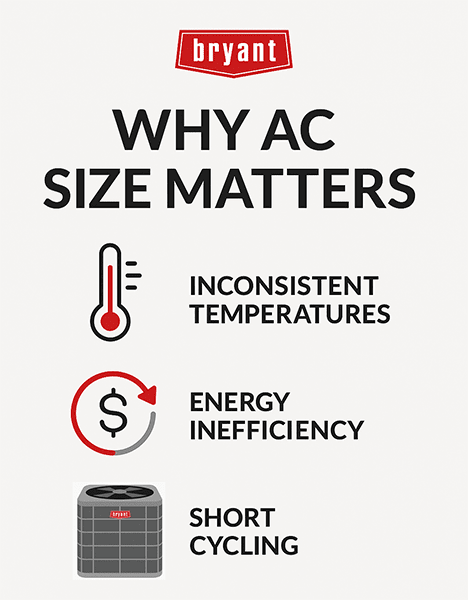 An improperly sized air conditioner compromises daily comfort, inflates energy bills, and shortens the lifespan of your equipment. Size truly matters when protecting your home investment.
David Fowler, owner of Family Heating and Air in Pensacola, Florida, said choosing the right size for your HVAC unit is crucial for maintaining energy efficiency and keeping your cooling bills in check.
“It’s important to match the unit’s size with the actual load of the home," Fowler said. "If it’s too big, it will cycle on and off too frequently and fail to maintain comfort; if it’s too small, it won’t run enough and can lead to humidity issues in the home.”
What Happens If My AC Unit Is Too Small?
An undersized AC unit runs continuously — especially during peak summer heat — without ever reaching your desired indoor temperature. This constant mechanical strain leads to:
- Inadequate Cooling: The unit will run continuously but fail to effectively cool your living space, leaving your home warm and uncomfortable.
- Increased Wear and Tear: Working overtime causes excessive strain on internal components, leading to more frequent breakdowns, costly AC repairs, and a drastically shorter system lifespan.
- Higher Energy Costs: The unit consumes more electricity as it runs longer to try and reach the desired temperature, resulting in significantly higher monthly cooling bills.
What Happens If My AC Unit Is Too Large?
An oversized air conditioner is just as problematic as an undersized one — primarily because it cools the air faster than it can remove humidity. The main consequences include:
- Frequent On/Off Cycling: An oversized unit cools the space too quickly and shuts off, then repeats this cycle frequently. This "short cycling" wastes energy and puts unnecessary stress on the system.
- Poor Humidity Control: Because the system doesn't run long enough per cycle, it cannot effectively remove moisture from the air — resulting in a clammy, uncomfortable indoor environment
- Higher Upfront and Maintenance Costs: Larger units carry higher purchase prices and often require more expensive maintenance over their lifespan
Connect With A Bryant Dealer on The AC Size You Need
Still not sure what size air conditioner your home needs? A local Bryant dealer can provide expert guidance to select the right AC size based on a professional assessment of your home's unique characteristics. Schedule an appointment today to find the best air conditioner for your home.

FAQs On AC Sizes
Signs of an improperly sized AC include frequent cycling, uneven temperatures, high humidity, excessive energy bills, or continuous operation during moderate weather. A Manual J load calculation can confirm the correct size.
Most 2,000 square-foot homes require a 3.5 to 4-ton AC unit, though exact sizing should be confirmed with a professional load calculation from your local Bryant dealer.
Your local Bryant dealer can perform a Manual J load calculation as part of the system design and replacement process to help determine the proper equipment size for your home.
A 3-ton AC may struggle to efficiently cool a 2,000 square-foot home, especially in warmer climates or poorly insulated homes—it could result in inadequate cooling or overworking the system. Talk to your local Bryant dealer to ensure proper AC sizing.
A Manual J calculation is a precise mathematical formula used by HVAC professionals to determine the exact amount of heating and cooling a specific home requires, factoring in insulation, windows, and local climate.
A higher SEER2 rating does not mean the air conditioner cools a room faster; rather, it indicates that the system uses less electricity to produce the same amount of cooling, which can help you money on energy bills over time.
Many 1,500-square-foot homes require a 2.5- to 3-ton Bryant air conditioner, but the correct size depends on insulation, windows, ceiling height, climate, and other factors determined through a Manual J calculation. Your local Bryant dealer can determine the best AC unit for a 1,500 sq. ft. home.
Signs of an improperly sized AC include frequent cycling, uneven temperatures, high humidity, excessive energy bills, or continuous operation during moderate weather. A Manual J load calculation can confirm the correct size.
Your local Bryant dealer can perform a Manual J load calculation as part of the system design and replacement process to help determine the proper equipment size for your home.
Many 1,500-square-foot homes require a 2.5- to 3-ton Bryant air conditioner, but the correct size depends on insulation, windows, ceiling height, climate, and other factors determined through a Manual J calculation. Your local Bryant dealer can determine the best AC unit for a 1,500 sq. ft. home.
Learn More About Air Conditioners
- Learn about types of air conditioners
- Understand how does air conditioning work
- Get in the know on air conditioning service
- Find out what is an inverter air conditioner
- Discover the difference in a heat pump vs air conditioner
- Find out what temperature to set air conditioner in summer


