About The Author: Travis Baugh is a Digital Brand Marketing Manager for Bryant, where he creates clear, helpful content to guide homeowners through heating, cooling, and indoor air quality decisions. His goal is to empower readers with the knowledge they need to choose the right comfort solutions for their home—confidently and comfortably.
How Long Do AC Units Last? A Homeowner's Guide
An air conditioning (AC) unit typically lasts between 15 and 20 years. However, AC unit lifespan varies significantly based on factors like routine maintenance, daily usage patterns, installation quality, and local climate. Most homeowners should plan for replacement every 12 to 17 years
Understanding these factors is the first step toward securing long-term comfort and maximizing your investment in home cooling. At Bryant, innovative solutions are centered on customer needs. This guide explores what influences air conditioner life expectancy, the warning signs of system failure, and actionable strategies to protect your investment and improve your home's energy efficiency.
What Factors Affect How Long An Air Conditioner Lasts?
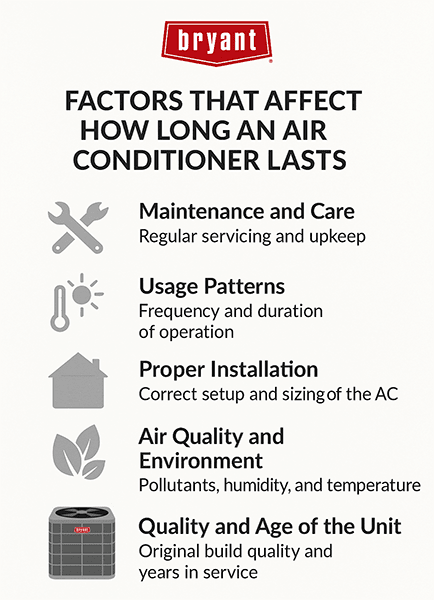
Several key variables determine whether an air conditioner will last a decade or push past the 20-year mark.
According to Mike Lea, co-owner of Lea Heating & Air Conditioning in East Dundee, IL, these factors include maintenance frequency, usage habits, installation quality, proper system sizing, and the capacitor’s voltage.
The local climate also plays a big role, according to Lea.
“We typically see lifespans of units in the Deep South being shorter than those in the North because they’re used year-round,” Lea said.
Let's take a closer look into each of these factors:
1. How Does Maintenance Impact AC Lifespan?
Regular AC maintenance is the single most important factor in extending your air conditioner's lifespan. Systems that receive annual AC service operate more efficiently, use less energy, and experience fewer premature breakdowns.
An annual or biannual AC tune up from a qualified technician ensures your air conditioning system operates at peak performance. During a service visit, a technician will clean coils, inspect AC refrigerant levels, replace filters, and check for wear. Neglecting this step leads to reduced efficiency and unnecessary strain, which causes premature breakdowns
2. Do Usage Patterns Affect Air Conditioner Life Expectancy?
Yes, how often you use your central air conditioner runs directly impacts its longevity. Systems running continuously in hot climates endure more mechanical wear than those used sparingly in milder regions. Constant operation due to poor insulation or incorrect thermostat settings shortens component life. To reduce strain, run your AC only when necessary and leverage smart home integration—like a programmable thermostat—to optimize cooling schedules.
3. Why Is Proper AC Installation Critical?
The quality of the initial AC installationsets the long-term baseline for a system's performance and lifespan. An improperly installed or incorrectly sized unit works harder than necessary, leading to rapid wear. A system that is too large will short cycle on and off frequently, while an undersized unit will run constantly. Both scenarios strain the system and waste energy. Always use a licensed professional for AC replacement to guarantee correct sizing and seamless integration.
4. How Does the Environment Affect Air Quality and AC Units?
Your home's environment dictates how hard an AC unit must work to filter and cool the air. High levels of dust, pollen, or coastal salt accelerate wear and tear. In these environments, filters clog faster, reducing airflow and efficiency. High humidity and salty air in coastal regions can cause corrosion on coils and other internal components. Regularly replacing air filters and keeping the outdoor unit clear of debris helps mitigate these environmental impacts. Learn more about coastal HVAC units.
5. Does the Quality of the Unit Matter?
Yes, the build quality of your AC unit and the type of air conditioner chosen play a significant role in how long it lasts. Premium energy-efficient air conditioners from reputable manufacturers use durable components designed to last 15 years or more while providing quiet operation. Lower-quality units often fail sooner. As any AC unit ages, its efficiency declines, making an upgrade to an advanced, eco-friendly system a smarter long-term investment.

What Are the Signs Your AC Unit Needs Replacement?
Knowing when to replace an AC unit can save homeowners from unexpected breakdowns and high energy bills. Watch for these warning signs that indicate it may be time for AC replacement:
- Rising Energy Bills: A sudden, unexplained spike in electricity costs suggests the AC unit has lost efficiency and is working harder to cool the home.
- Frequent Repairs: If you find yourself constantly calling for AC repairs, investing in a new, reliable system is often more cost-effective.
- Age: If an AC is over 15 years old and experiencing problems, it is likely approaching the end of its useful life. Modern units offer significantly better efficiency and lower operating costs.
- Inconsistent Performance: An AC blowing warm air, making strange noises, or failing to cool your home evenly are all indicators of major internal problems that may require a full replacement.
- Outdated Refrigerant: Systems that still use R-22 refrigerant (phased out as of 2020) are increasingly expensive and difficult to service, making replacement the more practical option.
How Much Does It Cost to Replace an AC Unit?
The cost of replacing an air conditioner varies significantly based on equipment size, efficiency, system type, installation requirements, location, and other factors.
Homeowners should compare the total cost of ownership, not just the equipment price. A newer, higher-efficiency system may have higher upfront costs but could use less electricity than an older, less-efficient unit. Installation may also require modifications to ductwork, electrical components, refrigerant lines, or other parts of the HVAC system.
When evaluating repair versus replacement, consider the system's age, repair history, current condition, expected remaining service life, and the cost of a replacement system.
Does AC Efficiency Affect How Long a Unit Lasts?
Efficiency and lifespan are related to several of the same factors, including installation quality, maintenance, system sizing, and operating conditions, but a higher efficiency rating does not by itself guarantee a longer service life.For homeowners replacing an older system, current efficiency ratings can be an important part of the decision. The right efficiency level depends on the home's cooling needs, local climate, utility costs, equipment compatibility, and installation.
What About an AC Warranty?
An AC warranty can help cover eligible repairs or replacement of covered components during the applicable warranty period, subject to the manufacturer's terms and conditions.Warranty coverage does not necessarily mean an air conditioner will last for the length of the warranty. Homeowners should review the specific warranty provided with their equipment and understand any registration, installation, maintenance, or other requirements that may apply.
For a Bryant system, consult the applicable Bryant warranty information for details about coverage.
How Can I Extend How Long My AC Unit Lasts?
You can help extend the life of your air conditioner and maintain long-term comfort with these six expert strategies:
- Schedule Regular Maintenance. Routine professional AC maintenance is key to keeping your AC running smoothly. Have a technician inspect and tune-up your system at least once a year, ideally before the hot season starts. Regular maintenance includes tasks like cleaning the coils, checking refrigerant levels, and replacing worn AC parts, which helps prevent breakdowns and keeps the system efficient.
- Replace Filters Regularly. Dirty filters can restrict airflow and make your AC work harder. Check your filter regularly and replace it as recommended. Many standard filters need to be replaced every 1 to 3 months, although the appropriate interval varies by filter type, system, household conditions, and usage. Learn more about air filter replacement and how often to change air filters.
- Clear the Perimeter: Keep the outdoor unit free of leaves, vegetation, and other debris so air can move freely around the equipment.
- Stabilize Temperatures: Use a programmable thermostat or smart controls to manage cooling schedules and maintain comfortable indoor temperatures without unnecessary operation.
- Seal Leaks and Improve Insulation. Sealing gaps around windows, doors, and other areas of the home can reduce cooling demands and help your AC maintain the desired indoor temperature.
- Clean the Coils. Dust and debris can build up on both the evaporator and condenser coils, reducing efficiency. Clean the coils carefully once a year, or have a professional do it during routine maintenance. Learn more about how to clean AC coils.
When Should You Replace Your AC Unit?
There is no single age at which every air conditioner should be replaced. A well-maintained system may continue operating beyond 20 years, while a heavily used or poorly maintained system may require replacement sooner.
As your AC approaches 15 years old, consider its repair history, operating costs, efficiency, comfort performance, and remaining service life. If the system requires frequent repairs or has a major component failure, comparing the cost of repair with replacement can help you determine the most practical next step.
Connect With A Bryant Dealer For Your AC Unit Needs
If you need expert air conditioning service, your local Bryant dealer is ready to help. Bryant dealers provide high-quality split AC units and professional AC installation, maintenance, and repair services to keep your home comfortable all year. Reach out today for a consultation.
AC Unit Lifespan FAQs
Yes, replacing a 20-year-old AC is usually recommended, as it's likely inefficient, outdated, and nearing the end of its reliable lifespan.
You may need a new AC unit if you notice frequent breakdowns, rising cooling bills, uneven cooling, or if the system uses outdated refrigerant like R-22.
Most AC units need to be replaced every 12 to 17 years, depending on usage, maintenance, and environmental factors.
While it's rare, an AC unit can last up to 30 years with excellent maintenance, but most systems become inefficient and prone to failure well before that point.
No. Central AC units generally last 15–20 years with proper maintenance, while window AC units typically have a shorter lifespan of 8–12 years due to their smaller components and less robust construction.
Climate has a significant impact on AC lifespan. Units in warmer regions like the Deep South run year-round and experience more mechanical wear, often lasting closer to 10–15 years. Units in cooler northern climates, used only seasonally, tend to last longer—sometimes exceeding 20 years.
Repairing an aging AC unit is usually cheaper in the short term, but replacement may be more cost-effective if the system is older, needs frequent repairs, or has a major component failure. If repair costs are high or the unit is nearing the end of its expected lifespan, a new, more efficient system may provide better reliability and lower energy costs over time
Learn More About Air Conditioners
- Discover how does air conditioning work
- Find out what is an inverter air conditioner
- Discover the factors in choosing what size air conditioner you need
- Get help with an AC not working or an AC not blowing cold air
- Learn how to clean air conditioners


