About The Author: Travis Baugh is a Digital Brand Marketing Manager for Bryant, where he creates clear, helpful content to guide homeowners through heating, cooling, and indoor air quality decisions. His goal is to empower readers with the knowledge they need to choose the right comfort solutions for their home—confidently and comfortably.
What Temperature Should You Set Your Air Conditioner to in the Summer?
Bryant recommends setting your air conditioner between 75°F and 78°F when you're home in the summer. This range can balance indoor comfort with energy efficiency, helping you manage energy costs without sacrificing the cool environment your household needs. The U.S. Department of Energy recommends 78°F when you're home and awake as a starting point for summer energy savings.1
Finding the right thermostat setting isn't just a matter of preference; it's a strategic decision that shapes your home's energy consumption all season long. By understanding how to adjust settings based on occupancy, humidity, and local climate, you can optimize your air conditioning system for reliable, long-term comfort.
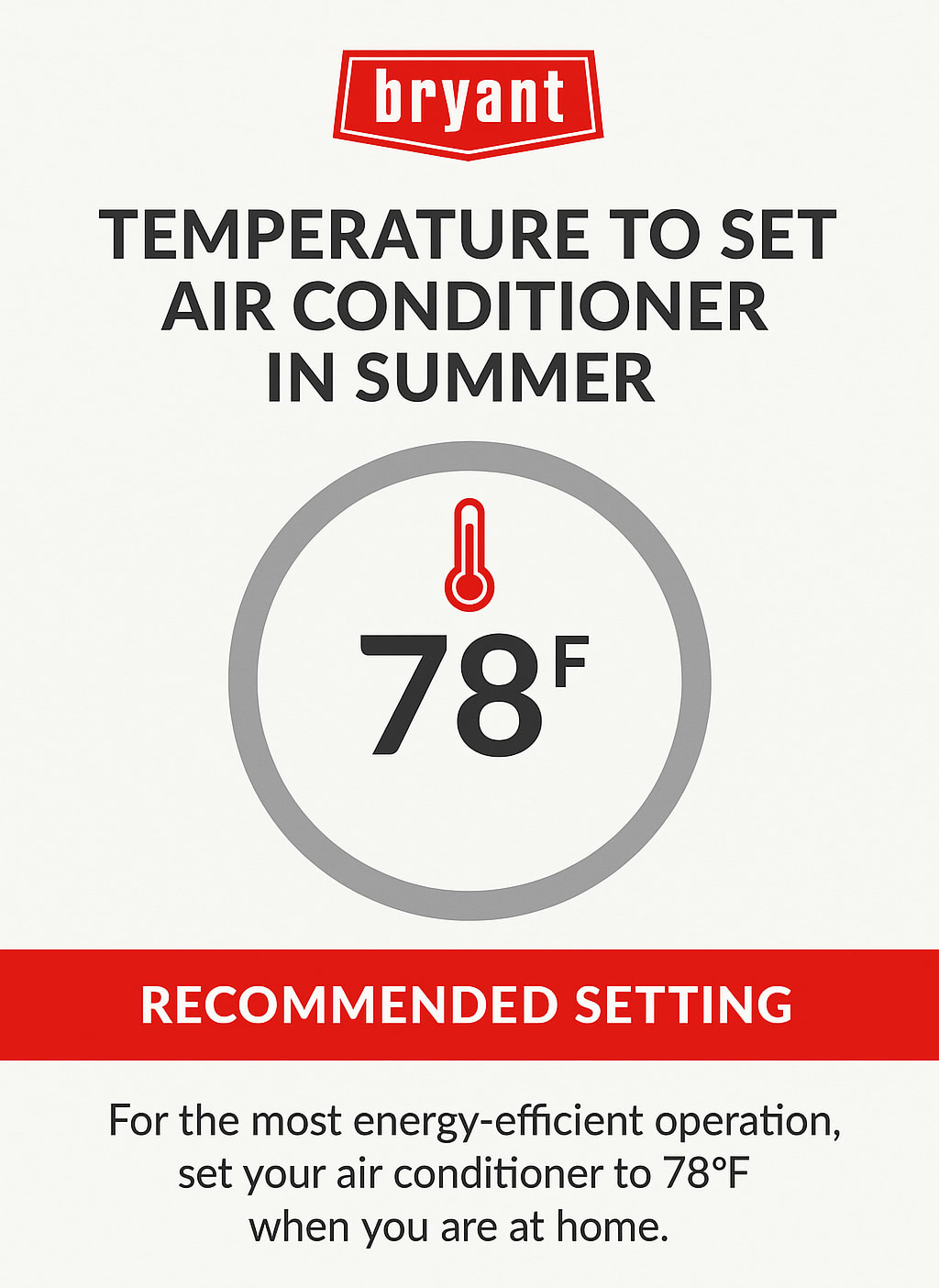
What is the Best AC Temperature When Home?
Recommended Setting: 75°F to 78°F
Bryant recommends a summer comfort range of 75°F to 78°F when you're home. The standard energy-saving recommendation is 78°F. If that feels too warm, you can lower the thermostat toward 75°F based on your household's comfort needs. Every degree you raise the thermostat can reduce cooling demand and energy use over the course of the summer.
Temperature alone, however, is only part of the equation. Humidity levels significantly influence how warm a room feels—high humidity can make 75°F feel sticky and uncomfortable. To get the most from your system, ensure you have a properly sized AC unit to remove moisture effectively. Some Bryant systems also offer enhanced humidity management; for example, the Bryant 191VAN uses uses inverter technology and a rotary compressor to deliver variable-speed comfort control and improved dehumidification. If your home feels humid, you may need to learn what humidity should my house be at?
What is the Best Energy-Saving AC Temperature When You're Away From Home?
Recommended Setting: 80°F to 85°F
When you leave for work or errands, Bryant recommends raising your thermostat to between 80°F and 85°F as a starting point. This "setback" strategy prevents your system from cooling an empty house, while keeping indoor temperatures manageable enough that your AC can return the home to your preferred comfort setting when you return.
For seamless control, consider upgrading to smart thermostats. Bryant controls, including the Evolution™ Connex™ System Control and compatible Bryant smart thermostats, can provide scheduling and temperature-management features that make it easier to automate setbacks with the Bryant SmartHome App,
A properly programmed thermostat can also help reduce energy use by automatically raising the temperature when you're away and returning it to your preferred setting before you arrive. The Department of Energy says adjusting a thermostat by 7°F–10°F for 8 hours a day can save as much as 10% annually on heating and cooling costs.
What Factors Affect Your Summer AC Temperature Settings?
Several variables in your home may require you to adjust beyond the standard 78°F target:
- Home Size: Larger homes often require more cooling power or different temperature settings between rooms or zones to maintain consistent comfort throughout all rooms.
- Insulation Quality: A well-insulated home retains cool air more effectively. This allows you to use higher thermostat settings without sacrificing comfort, leading to greater energy efficiency.
- Number of Occupants: More people in a home generate more body heat. This may require a cooler temperature setting to ensure everyone stays comfortable.
- Individual Comfort: Comfort is subjective. Finding a temperature that works for everyone in the household is key. As Mike Lea, co-owner of Lea Heating & Air Conditioning notes, “I would say the most important thing I always tell customers is to find a temperature that works for them,” Lea said. “What's more important than being comfortable in your own home?”
- Climate: In regions with extreme summer heat, your system will work harder and lower settings may be necessary. In milder climates, higher, more energy-efficient settings are often sufficient.
- HVAC System: Your equipment and controls can also affect how effectively your home maintains a selected temperature. Bryant offers variable-speed and two-stage systems designed to provide longer, more consistent cooling cycles, while some Bryant systems provide enhanced humidity management.
Common Myths About Summer AC Settings
Misinformation can quietly drive up your energy bills. Here are a few common myths—and the facts that counter them:
- Myth: Setting the AC extra low cools the house faster.
Fact: Your AC's cooling capacity does not increase simply because you lower the thermostat. Setting it to 65°F won't make the system cool the home faster than setting it to 75°F; it generally means the system will continue running until the lower setpoint is reached.
- Myth: Turning the AC off when you leave saves more energy.
Fact: A thermostat setback is generally preferable to maintaining your normal comfort temperature while you're away. Raising the temperature reduces the difference between the indoor and outdoor temperatures and can reduce cooling demand. For extended absences, the appropriate setting depends on the climate, humidity, pets, equipment, and home conditions. The Department of Energy recommends raising the thermostat by 7°F–10°F for about 8 hours as an energy-saving strategy.
- Myth: A one or two-degree change drastically increases your bill.
Fact: The effect of a one- or two-degree adjustment varies by home, weather, equipment, and electricity rates. "If 74 feels a lot better, go with 74," says Mike Lea. "You're probably talking about a few dollars a month difference."
“If you're air conditioning the house at 75 and 74 feels a lot better, go with 74," Lea said. "You're not talking about a big difference in efficiency cost. Even with heating, if 68 feels a little chilly, but 70 feels very good, you're probably talking about a few dollars a month difference by heating at a degree or two different in your home."
How Can You Improve Your Home’s Cooling Efficiency?
Optimizing your thermostat settings works best when paired with good home maintenance habits. Focus on these key tasks:
- Replace Air Filters: Replace your air filter every 1–3 months. Dirty filters restrict airflow, forcing the system to work harder. Learn how often to change air filters.
- Seal Leaks: Apply weatherstripping or caulk around windows and doors to prevent cool air from escaping and warm air from seeping in.
- Use Ceiling Fans: Ceiling fans can help you feel cooler by circulating air, allowing you to potentially set the thermostat a few degrees higher while maintaining comfort.
- Schedule Maintenance: Annual professional AC maintenance ensures your central air conditioner runs at peak efficiency and helps identify issues before they become costly AC repairs.
- Use Smart Scheduling: A Bryant smart thermostat or Evolution™ Connex™ System Control can help automate temperature changes based on your daily schedule, reducing the need to manually adjust the thermostat.
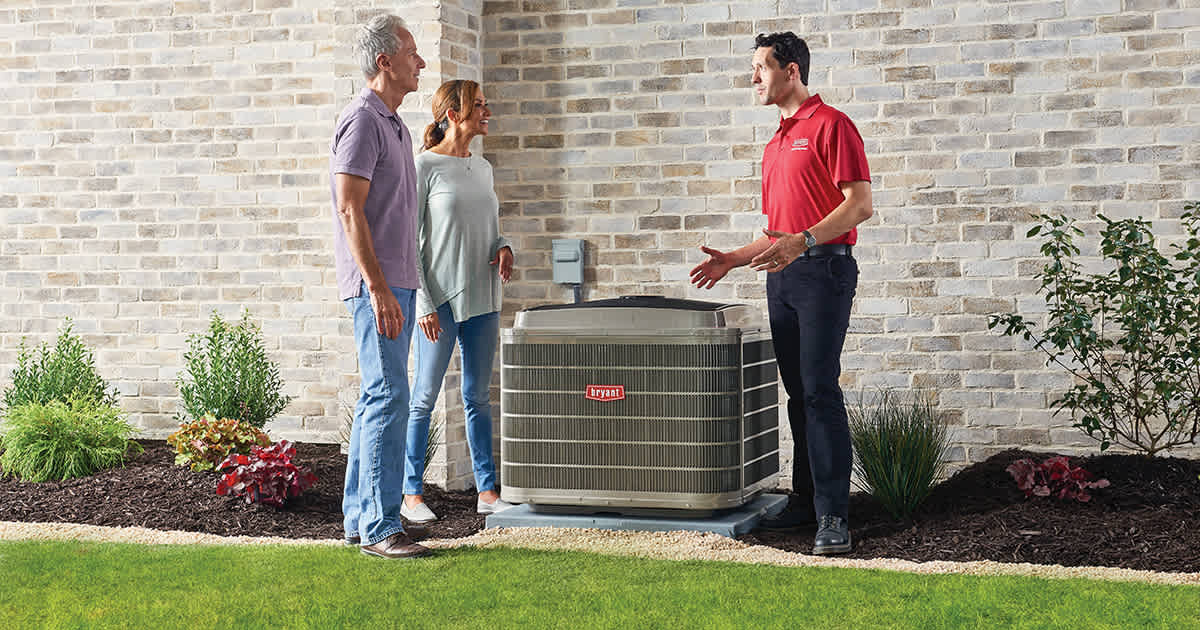
Connect With A Bryant Dealer For Your AC Needs
Looking for expert advice on the right temperature to set your Bryant air conditioner for comfort and energy efficiency this summer? Connect with your local Bryant dealer today! Their knowledgeable team can help you choose the proper thermostat settings, evaluate your home's cooling and humidity needs, recommend compatible Bryant systems and controls, offer tips on HVAC maintenance for maximum efficiency throughout the season, and perform an AC tune up to prepare your unit for warm weather.
1 https://www.energy.gov/save/home-upgrades
FAQs
It usually takes 2 to 3 hours for a properly sized AC to cool an average home from 80°F to 72°F, depending on insulation and outdoor temperature.
Expect about 3 to 4 hours in normal summer conditions for a well-functioning system. Poor insulation or extreme heat may extend that time.
Your thermostat may be near a heat source, or airflow could be restricted by a dirty filter or blocked vent. Checking those areas often fixes the issue.
Not necessarily. Keeping the thermostat lower increases energy use. Setting it around 76–78°F when home and higher when away saves more.
Your AC can typically cool about 20°F below the outdoor temperature, so if it’s 100°F outside, maintaining 78–80°F indoors is reasonable.
72°F provides a cool, comfortable setting for most people, but raising it slightly to 75–78°F can improve efficiency and reduce energy costs.
Set your thermostat between 76°F and 78°F, use ceiling fans for circulation, and close blinds to reduce heat gain.
Use “Auto” mode so the fan runs only when cooling is needed, saving energy and maintaining consistent humidity control.
It’s cheaper to adjust the thermostat rather than fully turning the AC off. Turning it off allows heat buildup, forcing the system to work harder later.
Fans use much less electricity than AC, but they only move air—they don’t cool it. Use fans to supplement, not replace, air conditioning.
You actually can—but running both together in a small room may make it feel drafty or too cool. If you do, raise the thermostat a few degrees to save energy.
The 20-degree rule means that a properly working air conditioner can typically cool the air about 20°F below the indoor return temperature. For example, if your home is 78°F, your vents should blow air near 58°F.
Learn More About Air Conditioners
- Learn how does air conditioning work
- Get in the know on air conditioning service
- Explore AC replacement
- Discover what size air conditioner you need
- Get help with an AC not working
- Find out how long do AC units last?


