About The Author: Travis Baugh is a Digital Brand Marketing Manager for Bryant, where he creates clear, helpful content to guide homeowners through heating, cooling, and indoor air quality decisions. His goal is to empower readers with the knowledge they need to choose the right comfort solutions for their home—confidently and comfortably.
What Is EER vs. EER2? Energy Efficiency Ratio Explained
Bryant defines EER (Energy Efficiency Ratio) as a measure of an air conditioner's cooling efficiency at a specific set of operating conditions. EER2 is the updated rating determined under the U.S. Department of Energy's revised testing procedure, which uses higher external static pressure to more closely represent typical installed conditions.
Understanding EER and EER2 helps homeowners make smarter, more confident decisions when investing in a new air conditioner or heat pump The appropriate efficiency rating depends on the equipment, climate and home, so EER2 should be considered alongside SEER2 and other system characteristics.

How EER and EER2 Work
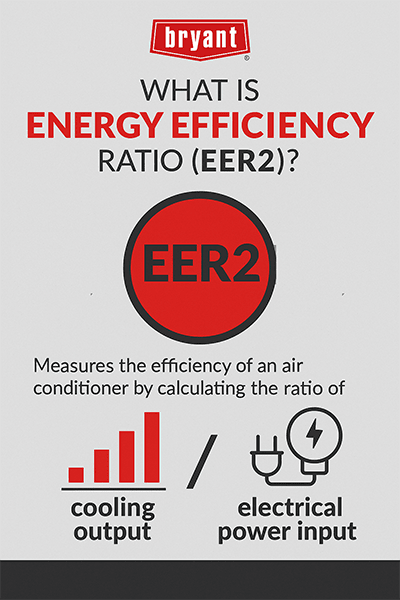
EER and EER2 express cooling output relative to electrical power input under specific test conditions. The basic calculation is cooling capacity in British thermal units per hour divided by electrical power input in watts. A higher rating indicates more cooling output for each watt of electricity used under the applicable test conditions.
When shopping for a new air conditioner or heat pump, efficiency ratings help homeowners compare how systems perform under standardized conditions. EER2 is designed to reflect the updated DOE testing procedure, while SEER2 evaluates performance across a range of cooling conditions over a season.
What Is EER (Energy Efficiency Ratio)?
EER is a measure of an air conditioner's cooling efficiency at a specific test condition rather than across an entire cooling season. For residential central air-conditioning equipment, the traditional EER test uses an outdoor temperature of 95°F and indoor conditions of 80°F dry bulb and 67°F wet bulb.
Unlike SEER2 (Seasonal Energy Efficiency Ratio 2), which evaluates performance across a range of conditions during a cooling season, EER focuses on full-load cooling performance at a specified test condition. This makes EER useful for comparing equipment performance under peak cooling conditions.
What Is EER2 (The New Standard)?
EER2 is the Energy Efficiency Ratio determined using the DOE's updated Appendix M1 testing procedure, which became applicable to residential central air conditioners and heat pumps beginning in 2023. One important change is a higher external static pressure requirement, which increases the airflow resistance used during testing and more closely represents conditions encountered in installed duct systems.
The M1 procedure uses 0.5 inches of water column of external static pressure for applicable ducted equipment, compared with lower static-pressure requirements under the previous procedure. Because the test procedure is more demanding, EER2 ratings can be lower than legacy EER ratings for comparable equipment.
There is no universal EER-to-EER2 conversion formula. Because the test procedure itself changed, homeowners should compare EER2 ratings with other EER2 ratings rather than applying a simple percentage conversion to an older EER rating.
EER vs. EER2 at a Glance
| EER | EER2 | |
| What it measures | Cooling efficiency under a specific full-load test condition | Cooling efficiency under the updated full-load test procedure |
| Test conditions | 95°F outdoor; 80°F dry bulb/67°F wet bulb indoor conditions | Same primary temperature conditions, with the updated DOE M1 test procedure and higher external static pressure |
| Test procedure | Previous DOE Appendix M procedure | DOE Appendix M1 procedure |
| Introduced | Legacy metric used before 2023 | Introduced for the updated 2023 DOE testing requirements |
| Best use | Comparing equipment tested under the same legacy procedure | Comparing current equipment using the current rating system |
| Can the ratings be directly converted? | No | No universal EER-to-EER2 conversion exists |
The key takeaway: EER2 is not simply a new label for EER. It is a rating produced by a revised test procedure, so the two numbers should not be treated as directly interchangeable.
What Is the Difference Between SEER2 and EER2?
Bryant uses both SEER2 and EER2 to describe cooling efficiency, but the ratings answer different questions. SEER2 measures efficiency over a range of conditions throughout a typical cooling season, while EER2 measures efficiency under a specified full-load condition. Bryant describes EER2 as a useful measure of performance during peak heat conditions.
- SEER2 (Seasonal Energy Efficiency Ratio 2): Measures efficiency over a typical cooling season, accounting for varied temperatures. It’s like "highway miles per gallon" for your AC—great for varied climates.
- EER2 (Energy Efficiency Ratio 2): Measures efficiency at peak load (high heat). It’s like "city miles per gallon" in heavy traffic. If you live in a region with sustained high temperatures, EER2 is often a more critical number to watch.
David Fowler, owner of Family Heating and Air in Pensacola, Florida, stresses the importance of considering EER2 when purchasing a central air conditioner.
“EER2 is measured under peak load rather than a seasonal load,” Fowler said. “This allows homeowners to know that their unit will maintain the efficiency it was designed for, even when it’s really hot outside.”
What Is a Good EER2 Rating for an Air Conditioner?
Bryant currently publishes EER2 ratings across a range of air-conditioning and heat-pump products, so there isn't one EER2 number that defines the right system for every home. As a general reference, the ranges below can help homeowners understand how published EER2 ratings compare.
- Standard Efficiency: EER2 ~ 9.0 – 10.0
- High Efficiency: EER2 ~ 11.0 – 12.5+
- Bryant examples: The Bryant Evolution™ Extreme Variable Speed Air Conditioner 191VAN is rated up to 12 EER2, while the Bryant Evolution™ Extreme 23 Variable-Speed Heat Pump 293VAN heat pump is rated up to 13.5 EER2.
These examples demonstrate that current Bryant equipment can extend well beyond the general EER2 ranges above. Actual efficiency depends on the specific model, size and matched system configuration.
Investing in a higher-EER2 system may reduce electricity use during the conditions represented by the EER2 test, although actual energy costs depend on climate, operating hours, utility rates, system sizing, installation and other factors. High-efficiency air conditioners and high-efficiency heat pumps may have a higher upfront cost, Available rebates can offer significant value. Ask your local Bryant dealer about financing plans to break your purchase into monthly payments.
“The higher the EER, the less electricity the unit uses, which translates to lower electricity bills,” Mark Lea, co-owner of Lea Heating & Air Conditioning in East Dundee, IL, said. “I like to compare it to miles per gallon on a car — would you buy a car without considering its MPG?”
Minimum EER2 by Region
For residential split-system and single-package air conditioners, DOE established regional efficiency requirements beginning January 1, 2023. The EER2 requirement depends on the region, equipment type, cooling capacity and, in some Southwest cases, the equipment's SEER2 rating.
| Region | Equipment | Minimum EER2 |
| North | Split-system air conditioners | No regional EER2 minimum |
| Southeast | Split-system air conditioners | No regional EER2 minimum |
| Southwest | Split-system AC, under 45,000 Btu/h | 11.7 or 9.8* |
| Southwest | Split-system AC, 45,000 Btu/h or more | 11.2 or 9.8** |
| Southwest | Single-package air conditioners | 10.6 |
* 11.7 EER2 applies when certified SEER2 is below 15.2; 9.8 applies when certified SEER2 is 15.2 or higher.
** 11.2 EER2 applies when certified SEER2 is below 15.2; 9.8 applies when certified SEER2 is 15.2 or higher.
The DOE defines the Southwest as Arizona, California, Nevada and New Mexico. The Southeast includes Alabama, Arkansas, Delaware, Florida, Georgia, Hawaii, Kentucky, Louisiana, Maryland, Mississippi, North Carolina, Oklahoma, South Carolina, Tennessee, Texas, Virginia, the District of Columbia and U.S. territories; the remaining states are in the North region.
These are federal minimum requirements, not recommendations for a particular home. State and local requirements, equipment type, capacity and installation date can affect which requirements apply.
Benefits of High EER2 Systems
A higher EER2 rating indicates greater cooling efficiency under the specific conditions used for the EER2 test. Here's what a high-efficiency system can mean in practice:
- Peak Efficiency: A higher EER2 rating means the system delivers more cooling output per watt under the EER2 test conditions.
- Potential Energy Savings: A more efficient system may use less electricity for the same amount of cooling under comparable operating conditions, although actual savings vary by home and climate.
- System Features: Some high-efficiency Bryant systems also use variable-speed or multi-stage compressors, which can provide additional comfort and humidity-management capabilities. Bryant's current air-conditioner lineup includes variable-speed, two-stage and single-stage compressor options.
How to Choose the Right EER2 for Your Home
To choose the right EER2 rating, consider your climate, equipment type, system size, expected cooling use and upfront cost, then have a qualified HVAC professional evaluate the home.
- Check Your Climate: If you live in the South or Southwest, prioritize a high EER2 rating because your split AC unit will frequently operate at peak temperatures. In milder northern climates, a standard EER2 might suffice.
- Calculate Long-Term Value: Compare the upfront cost difference against potential energy savings over the HVAC system's lifespan. Use the actual EER2 and SEER2 ratings of the matched system rather than trying to convert an older EER rating.
- Consult an Expert: A local Bryant dealer can perform a load calculation and recommend the specific efficiency sweet spot for your home’s layout and insulation.
How Much Could a High EER2 System Save?
EER2 can be used to compare peak-load efficiency, but it should not be used by itself to estimate annual energy savings. EER2 is a full-load rating at a specific test condition, while annual cooling use depends on many variables, including outdoor temperatures, thermostat settings, equipment run time, system sizing, ductwork, maintenance and electricity rates.
For example, if two systems delivered the same 36,000 Btu/h of cooling under comparable EER2 test conditions, a system rated at EER2 12.0 would require 3,000 watts of electrical input, while a system rated at EER2 9.0 would require 4,000 watts. The 12.0 EER2 system would therefore use 25% less electrical power at that specific operating condition.
Calculation:
- EER2 12.0: 36,000 ÷ 12 = 3,000 watts
- EER2 9.0: 36,000 ÷ 9 = 4,000 watts
- Difference: 1,000 ÷ 4,000 = 25% less power
This example illustrates peak-load efficiency; it does not mean the home's annual cooling costs will be 25% lower. For an annual energy-use comparison, homeowners should consider SEER2, actual operating conditions, electricity rates and the complete matched system.
FAQs on EER
EER (Energy Efficiency Ratio) measures an air conditioner’s cooling efficiency at a specific outdoor temperature (usually 95°F), showing how much cooling output you get per unit of energy used. EER2 (Energy Efficiency Ratio 2) is the updated version of EER, reflecting newer testing standards introduced in 2023 that better simulate real-world conditions, including increased external static pressure.
A good EER2 rating for an air conditioner is generally around 10.0 or higher, with higher numbers indicating better energy efficiency under the updated testing conditions.
EER2 is the updated version of the Energy Efficiency Ratio that measures how efficiently an HVAC system uses energy under specific test conditions.
It represents the cooling output of an air conditioner divided by the power it consumes, giving a clearer picture of energy efficiency than the old EER standard.
EER2 is important because a higher rating means better efficiency, which can help lower cooling bills and improve long-term performance.
The EER2 value is a number assigned to the unit—higher numbers indicate more efficient air conditioners.
EER2 ratings are typically lower because the testing conditions are harder. The new standards account for the energy required to push air through ductwork, which wasn't fully factored into the old EER calculation.
No, the minimum required EER2 ratings often differ between split system air conditioners and packaged units. Split systems generally require higher ratings to meet regional efficiency standards.
While EER2 strictly measures energy efficiency, higher EER2 units typically utilize advanced variable-speed technology. This innovation usually results in quiet operation compared to standard single-stage models.
Yes, EER2 ratings apply to both air conditioners and heat pumps. It measures the cooling efficiency of both systems under high-stress, peak temperature conditions.
Learn More About Air Conditioners
- Learn how does air conditioning work
- Get in the know on air conditioning service
- Find out what is a and an inverter air conditioner
- Understand AC maintenance and AC tune ups
- Discover the factors in choosing the and what size air conditioner you need


