About The Author: Travis Baugh is a Digital Brand Marketing Manager for Bryant, where he creates clear, helpful content to guide homeowners through heating, cooling, and indoor air quality decisions. His goal is to empower readers with the knowledge they need to choose the right comfort solutions for their home—confidently and comfortably.
Furnace Troubleshooting: A Comprehensive Guide to Common Fixes
Furnace troubleshooting starts with a few basic checks: confirm the thermostat is set correctly, verify the furnace has power, inspect the air filter, and make sure vents and registers are open and unobstructed. These checks can identify common airflow, power, and control issues before a professional service visit. Bryant recommends calling a qualified HVAC professional when these basic checks do not resolve the problem or when the issue involves internal furnace components.
How do I troubleshoot my furnace?
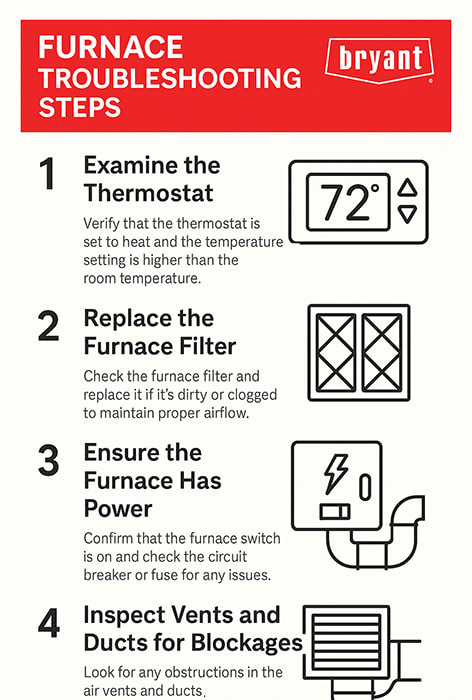
Bryant's 4-Step Furnace Troubleshooting Checklist provides a starting point for common furnace problems. To troubleshoot a gas furnace, follow these four steps:
- Check the thermostat: Ensure it is set to "Heat" and the temperature is set higher than the room temperature.
- Inspect the air filter: Replace the filter if it is gray or clogged with debris to restore airflow.
- Verify power: Check that the furnace switch is "On" and no circuit breakers are tripped.
- Clear vents: Confirm that all supply and return vents are open and unobstructed by furniture or rugs.
Bryant recommends these basic checks before scheduling service because some furnace problems can be related to thermostat settings, power, airflow, or a dirty filter. If these checks do not resolve the problem, contact a qualified HVAC professional.
Furnace Troubleshooting: What Can You Do Yourself?
| Issue | DIY Check | Professional Diagnosis or Repair? |
| Thermostat setting | Set the thermostat to Heat and raise the temperature setting. Replace batteries if applicable. | Yes, if the thermostat still does not communicate with the furnace. |
| Dirty air filter | Inspect and replace a dirty filter with the correct size and type. | Yes, if airflow remains restricted or the furnace continues to short cycle. |
| Power | Check the furnace switch and circuit breaker. | Yes, if the breaker repeatedly trips or the furnace remains without power. |
| Blocked vents | Open supply registers and remove furniture or rugs blocking return grilles. | Yes, if airflow remains weak or uneven. |
| Igniter, flame sensor, gas valve, blower motor or control board | Look for symptoms, but do not remove or repair internal components. | Yes. These components require professional diagnosis and repair. |
This distinction is important: Bryant's basic troubleshooting guidance is intended to help homeowners check accessible settings and airflow issues, while internal electrical, mechanical, and combustion components should be evaluated by a qualified technician.
1. Is the Thermostat Set Correctly?
Bryant recommends checking the thermostat as one of the first furnace troubleshooting steps. Before investigating mechanical components, verify your control panel.
- Mode Selection: Verify the thermostat is set to "Heat." If it was accidentally bumped to "Off" or "Cool," the furnace won't engage.
- Power Source: If the display is blank, check the batteries if your thermostat uses batteries.
- Temperature Setting: Make sure the heating setpoint is higher than the current room temperature.
- Calibration: If the room feels colder than the setting, the thermostat may need recalibration. Consult your user manual to ensure it is reading the room temperature accurately.
2. Is the Furnace Filter Dirty or Clogged?
Bryant identifies a dirty or clogged air filter as a common furnace problem and recommends checking the filter regularly. When a filter becomes clogged with dust and debris, it can restrict airflow and make the system work harder. (a safety mechanism called "short cycling").
- Check the size: Locate the size printed on the side of your current filter (e.g., 16x20x1).
- Inspect condition: Slide the filter out. If it looks gray and fuzzy with dust, inspect it for replacement according to the manufacturer's recommendations.
- Replacement schedule: Bryant recommends checking your filter monthly. Current Bryant guidance says 1-inch fiberglass filters should generally be replaced every 30 days, while 1-inch pleated filters typically last 60–90 days and 4-inch media filters can last 6–12 months. Actual replacement frequency depends on the filter, equipment, household conditions, and usage. Learn more about replacing the furnace filter and how often to replace your air filter.
"The most important thing replacing the furnace filter does is improve indoor air quality," Mike Lea, co-owner of Lea Heating & Air Conditioning in East Dundee, IL said. "It also keeps your HVAC system running at top efficiency, helps lower heating bills, helps prevent costly breakdowns and furnace service calls, and helps extend the lifespan for your furnace. What happens is that the clogged air filter makes the system work harder, which puts more strain on the blower motor and causes the heat exchanger to overheat. It's probably our number one most frequent service call in the winter when the furnaces is short cycling. It's generally from a dirty air filter or using too restrictive of an air filter."
3. Does the Furnace Have Electrical Power?
Bryant recommends verifying that the natural gas furnace has electrical power before scheduling service. Even gas furnaces need electricity to operate components such as the blower motor and ignition system.
- Furnace Switch: Look for a standard light switch on the side of the furnace or a nearby wall. Ensure it is flipped "Up" or "On."
- Circuit Breaker: Go to your home's electrical panel. Look for the breaker labeled "Furnace" or "HVAC." If the breaker has tripped, you can reset it once. If it trips again, turn the system off and contact a qualified HVAC professional rather than repeatedly resetting the breaker.
- Internal Electrical Components: Do not remove furnace access panels or attempt to test wiring, capacitors, control boards, or other internal electrical components yourself.
Bryant warns that furnace components can involve high-voltage electricity, moving mechanical parts, and combustion hazards. Internal electrical or mechanical problems should be diagnosed by a qualified HVAC technician.
4. Are Vents and Ducts Blocked?
Bryant recommends checking supply registers and return-air grilles for obstructions as part of basic furnace troubleshooting. For your home to heat evenly, air must flow freely through the supply vents (where heat comes out) and return vents (where air goes back to the furnace).
- Check all rooms: Walk through your home and ensure furniture, curtains, or rugs aren't covering the registers.
- Open dampers: Make sure the levers on the vent covers are in the open position.
- Check airflow: If airflow remains weak after removing visible obstructions and replacing a dirty filter, have a professional inspect the system.
Restricted airflow forces your system to work harder, increasing energy bills and wear on components. Regular furnace maintenance and furnace cleaning can help keep your ductwork clear.
When to Call a Professional
If you have completed Bryant's basic troubleshooting checks and the furnace still won't run, contact a qualified HVAC professional for diagnosis.Complex issues involving the igniter, flame sensor, or blower motor require specialized diagnostic tools.
Andrew Mackey, owner of Superior Service in Lake St Louis, Missouri, warns against customers trying to do too much furnace troubleshooting on their own.
“We recommend the homeowner to call a qualified and licensed contractor to troubleshoot a furnace,” Mackey said. “The only thing a homeowner should be doing is changing the filter on a normal basis.”
Contact a professional immediately if you smell gas, suspect a carbon monoxide problem, see smoke or fire, or notice another potentially hazardous condition.
Connect With A Bryant Dealer For Further Furnace Troubleshooting
If your furnace still isn't performing as expected after performing these steps, connect with a Bryant dealer for expert troubleshooting and diagnostics. Bryant recommends contacting a qualified HVAC professional when basic troubleshooting does not resolve the issue. Their trained technicians can identify the root cause of the issue—whether it’s a mechanical failure, thermostat problem, or airflow restriction—and recommend the right solution. Prompt furnace service from your local Bryant dealer diagnose problems and restore safe, reliable operation. Schedule an appointment for furnace repair or furnace replacement today.
Furnace Troubleshooting FAQs
Start by checking the thermostat settings, circuit breakers, air filter, and pilot light or ignition system—if the issue isn’t obvious, it’s best to call a licensed HVAC technician for diagnosis.
The most common early failures are the furnace ignitor or flame sensor, as they experience regular wear and tear and are critical to starting the heating cycle.
Keep the area clear, replace filters regularly, and install carbon monoxide detectors near sleeping areas.
If the unit won’t turn on and no indicator lights show, check the fuse box or circuit board for a blown fuse and replace it if necessary.
Learn More About Furnaces
- Read our guide to furnace parts
- Learn how much is a new furnace
- Get help with a furnace not turning on or a furnace leaking water
- Find out how long does a furnace last
- Find out how to fix a furnace blowing cold air