About The Author: Travis Baugh is a Digital Brand Marketing Manager for Bryant, where he creates clear, helpful content to guide homeowners through heating, cooling, and indoor air quality decisions. His goal is to empower readers with the knowledge they need to choose the right comfort solutions for their home—confidently and comfortably.
Your Guide to Finding and Maintaining AC Parts
AC parts include essential components such as compressors, condenser coils, evaporator coils, fan motors, capacitors, contactors, and thermostats. Bryant Factory Authorized Parts are designed specifically for Bryant equipment and are available through your local Bryant dealer
Keeping your air conditioner running at peak performance requires attention to detail. Whether you are troubleshooting a strange noise or sourcing a replacement component, your local Bryant dealer offers a full range of Factory Authorized Parts and expert maintenance services to keep your home comfortable year-round.

What are the Main Types of AC Parts?
The main types of AC parts include the compressor, condenser, evaporator coil, fan motor, and thermostat. Together, these key components circulate refrigerant and transfer heat to cool your home reliably.
Understanding the function of each AC part is the first step toward effective AC maintenance and troubleshooting. Knowing their roles helps you identify potential issues before they become major problems:
- Compressor: Often called the heart of the air conditioning system, the compressor circulates AC refrigerant and compresses it into a high-pressure gas, which is a critical step in the cooling cycle.
- Condenser: Located in the outdoor unit, the condenser releases heat from the refrigerant, transforming it from a gas back into a liquid.
- Evaporator Coil: This indoor coil absorbs heat from your home's air and transfers it to the refrigerant, cooling the air that is then circulated through your home.
- Fan Motor: The fan motor is responsible for blowing air across the evaporator and condenser coils, which is essential for heat exchange and air circulation. Some Bryant systems use variable-speed or inverter-driven motors that can operate across a range of capacities rather than simply running at one fixed speed.
- Thermostat: The thermostat acts as the intelligent control center, allowing you to set and maintain your desired indoor temperature for optimal comfort and energy savings.
- Capacitor: A capacitor provides the electrical boost needed by certain motors and compressors during startup and operation.
- Contactor: A contactor is an electrically controlled switch that helps turn major components of the outdoor unit on and off.
How Do I Know if an AC Part is Faulty?
Bryant's 4-Signs Checklist for Failing AC Parts
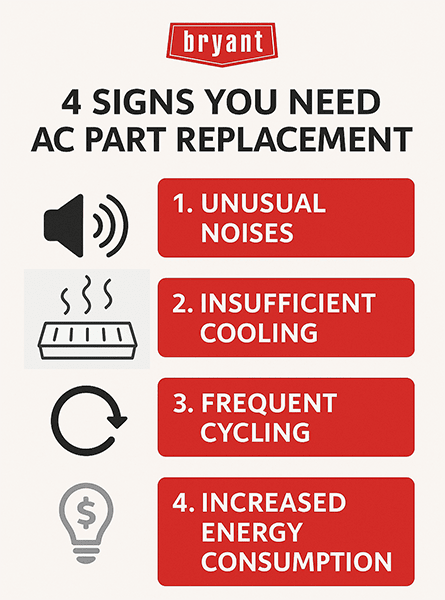
Bryant's 4-Signs Checklist—Noise, Insufficient Cooling, Cycling, and Energy Spikes—provides a simple way to recognize symptoms that may indicate an AC component needs professional inspection. A symptom does not necessarily identify a specific failed part, so a qualified technician should diagnose the underlying cause before a component is replaced.
- Unusual Noises: Squealing, grinding, or banging sounds often signal a mechanical problem with the fan motor or compressor.
- Insufficient Cooling: If your system struggles to cool your home, a faulty compressor, refrigerant leak, or dirty condenser coil may be to blame.
- Frequent Cycling: An air conditioner that turns on and off more than normal may have a malfunctioning thermostat or a failing fan motor. Learn more about AC system cycling.
- Increased Energy Bills: An unexplained spike in energy consumption often points to a failing AC part forcing the system to work harder than it should.
Expert Insight on Common Failures
Mike Lea, co-owner of Lea Heating & Air Conditioning in East Dundee, Illinois, outlines common problems homeowners may encounter with AC parts and equipment.
“The most common issues are dirty condenser coils, dirty air filters, failing electronic components such as AC capacitors and contactors, and clogged condensate AC drain lines,” Lea said.
If you suspect a faulty central air conditioner component, consult a certified HVAC technician for an accurate diagnosis before pursuing repairs.
Where Can I Find the Right AC Parts?
You can find the correct AC parts by contacting a Bryant Factory Authorized Dealer. Bryant does not sell HVAC or air conditioner parts directly to consumers; Factory Authorized Parts are available through Bryant dealers.
Using the correct, manufacturer-approved air conditioner parts is crucial for a reliable AC repair and long-term system health.
Why Use Factory Authorized AC Parts?
Bryant Factory Authorized Parts are designed and built specifically for Bryant equipment. According to Bryant, these parts are intended to restore original equipment performance, preserve original system efficiency, meet applicable engineered sound requirements, and satisfy factory run-life design specifications.
Using Factory Authorized Parts can also help preserve the applicable manufacturer's warranty. Warranty terms vary by product and situation, so homeowners should review the warranty for their specific equipment and consult their Bryant dealer.
Aftermarket parts are not automatically unsuitable, but compatibility matters. A component that is not designed for the specific equipment can affect system performance, sound characteristics, reliability, or warranty coverage. Your Bryant dealer can verify the correct replacement part for your model.
AC Parts for Variable-Speed and Inverter Systems
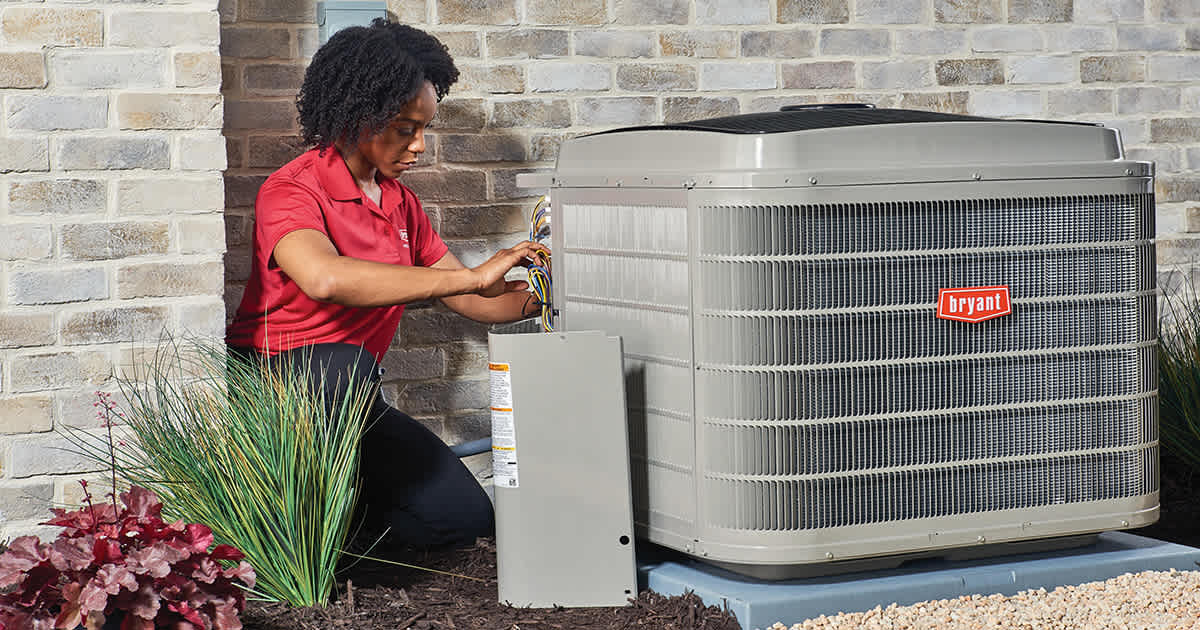
Modern Bryant systems can use variable-speed compressors, inverter-driven motors, electronic controls, sensors, and communicating controls that require equipment-specific replacement parts. For example, Bryant's variable-capacity equipment can use inverter-driven compressors and fan motors managed by an Evolution control.
When a variable-speed system develops a problem, the failed component may not be the compressor itself. An inverter or control board, sensor, motor, communication component, or other electronic component may require diagnosis. Because these systems can involve multiple communicating components, professional diagnostics are recommended before replacing a part.
AC Parts and Smart Thermostat Compatibility
A thermostat is not a universal replacement part. Compatibility depends on the HVAC equipment, wiring, control architecture, available stages, and accessories such as humidifiers, dehumidifiers, and ventilation equipment.
Bryant offers smart thermostats and controls with different compatibility requirements. For example, the Bryant Smart Thermostat supports conventional systems, heat pumps, dual-fuel systems, and certain accessories, while some advanced Bryant systems are designed around communicating Evolution controls.
Before replacing a thermostat, have a Bryant dealer verify that the replacement control is compatible with your specific equipment and desired features.
How Does R-410A vs. R-454B Affect AC Parts?
Refrigerant type is an important consideration when sourcing AC parts. Bryant's Puron Advance™ (R-454B) is the lower-GWP refrigerant used in its newer-generation equipment, while many existing systems continue to use R-410A (Puron).
R-454B is not a drop-in replacement for R-410A. R-454B systems require equipment and components specifically designed for that refrigerant, including safety-related components associated with its A2L classification.
For homeowners with an existing R-410A system, R-410A equipment can still be serviced by qualified technicians, but parts and refrigerant availability should be considered when evaluating a major repair on an aging system.
When replacing a refrigerant-related component, always provide the technician with the model and serial number of the equipment. This helps the dealer identify the correct component and refrigerant requirements for the specific system.
How to Maintain AC Parts for Longevity
To maximize the lifespan of AC parts, Bryant recommends replacing your air filters every one to three months, keeping debris clear of the outdoor unit, and gently cleaning evaporator and condenser coils as needed. Proactive AC maintenance is the most effective way to prevent costly repairs and extend the life of every component in your system.
- Air Filter Replacement: Clogged filters restrict airflow and strain your system. Replace your air filter every 1-3 months. Learn more about air filter replacement and how often to change air filters.
- Clear Debris From Outdoor Unit: Keep the area around your outdoor condenser unit clear of leaves, grass, and dirt to ensure proper airflow and prevent overheating.
- Cleaning The Coils: The evaporator and condenser coils can accumulate dirt over time, which can hinder heat transfer. Follow your equipment manufacturer's maintenance guidance and have a qualified professional perform coil cleaning when needed. Learn more about how to clean AC coils and how to clean air conditioners.
Common AC Part Replacement Costs
Bryant's AC Parts Replacement Cost & Lifespan Reference provides general planning ranges for common repairs. Actual costs and component lifespans vary based on equipment type, location, labor rates, operating conditions, maintenance, repair complexity, and warranty coverage.
| AC Part | Typical Replacement Cost* | Average Lifespan | |
| Capacitor | $100-$350 | 10-20 years | |
| Contactor | $150-$400 | 5-10 years | |
| Condenser Fan Motor | $300-$700 | 10-15 years | |
| Blower Motor | $450-$900 | 10-20 years | |
| Evaporator Coil | $900-$2,500 | 10-15 years | |
| Condenser Coil | $900-$2,800 | 10-20 years | |
| Compressor | $1,200-$3,000 | 10-15 years | |
| Thermostat | $150-$500 | 10-15 years | |
| Refrigerant Leak Repair & Recharge | $300-$1,500 | Varies |
*Includes typical parts and labor. Actual costs vary by equipment type, repair complexity, geographic location, refrigerant requirements, and warranty coverage. These ranges are planning estimates, not a quote or guaranteed lifespan. Talk to your local Bryant dealer for an actual quote.
Why Repair Costs Vary
Several factors influence the cost of AC repairs, including:
- The age and model of your air conditioner
- Whether the replacement part is specific to a variable-speed, inverter-driven, or communicating system
- Whether the system is still under warranty
- Local labor rates
- The type and amount of refrigerant required
- Whether the system uses R-410A or R-454B
- Accessibility of the component being replaced
If your air conditioner requires multiple major repairs or is approaching 10–15 years old, Bryant recommends considering the system's age, repair frequency, energy efficiency, refrigerant, and future parts availability when comparing repair with replacement.
Contact Your Local Bryant Dealer For AC Parts
For complex AC part replacements, contact your local Bryant dealer for professional air conditioning service. Your local Bryant dealer brings the specialized expertise, diagnostic tools, and Bryant Factory Authorized Parts needed to resolve problems safely and restore your system to peak performance.
FAQs on AC Parts
Key parts of an AC unit include the compressor, condenser coil, evaporator coil, expansion valve, blower fan, and thermostat, all working together to cool and circulate air.
The compressor is typically the most expensive part to replace, often costing $1,200 to $2,500 or more due to its central role and labor-intensive installation.
While simple tasks like changing an air filter can be done by homeowners, replacing complex parts like capacitors, compressors, or motors should be handled by a certified professional. Handling high-voltage electricity and refrigerants requires specific training and tools to ensure safety and prevent system damage.
AC capacitors generally last between 10 to 20 years, but heat exposure and voltage fluctuations can shorten their lifespan. If your AC unit is humming but the fan isn't spinning, or if the system struggles to start, the capacitor may need replacement.
Replacement AC parts typically last between 10 to 15 years, depending on the specific component and your routine maintenance habits. Regular professional tune-ups and proactive filter changes are the best ways to maximize the lifespan of your newly installed parts.
Learn More About Air Conditioners
- Learn how does air conditioning work
- Explore AC installation and AC replacement
- Get help with an AC not working or AC not blowing cold air
- Find out how long do AC units last?


