About The Author: Travis Baugh is a Digital Brand Marketing Manager for Bryant, where he creates clear, helpful content to guide homeowners through heating, cooling, and indoor air quality decisions. His goal is to empower readers with the knowledge they need to choose the right comfort solutions for their home—confidently and comfortably.
Why Is My AC Not Working? Solutions to Restore Your Comfort
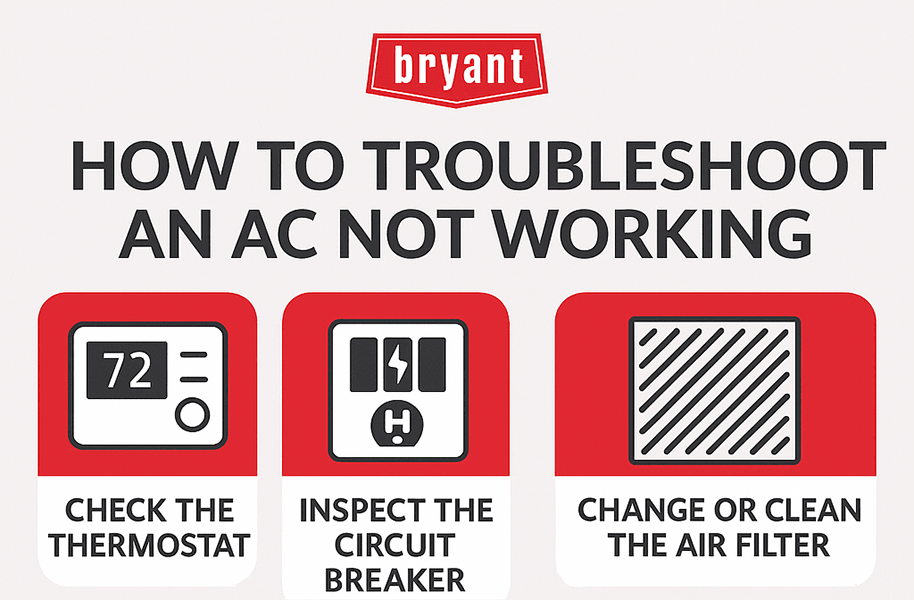
If your AC is not working, the most common causes are a tripped circuit breaker, incorrect thermostat settings, or a clogged air filter. Checking these three components first can often restore cooling without a service call.
However, when the heat rises, a quick fix isn't always enough—you need long-term reliability. Whether it's a minor airflow blockage or a complex electrical issue, understanding the root cause is the first step toward restoring the cool, quiet comfort your home deserves. Before calling for professional AC service, the steps below can help you pinpoint the problem and potentially avoid an unnecessary repair visit.
How to Troubleshoot an Air Conditioner Not Working
To troubleshoot an AC that is not working, check the power supply at the breaker, verify your thermostat settings, inspect the air filter for clogs, and clear debris from the outdoor condenser unit. Follow these four steps before scheduling a service call.
1. Check Power and Settings
Verify that your AC is receiving power by checking the outdoor disconnect switch and your home's main electrical panel for a tripped breaker. Then, ensure your thermostat has fresh batteries and is communicating correctly with the HVAC system. Confirm the thermostat is set to "Cool" mode and that the set temperature is lower than the current room temperature.
2. Inspect Airflow and Filters
A clogged air filter is one of the most common reasons an AC is not cooling—it restricts airflow, strains the system, and can cause coils to freeze. Replacing a dirty filter is one of the simplest and most cost-effective ways to improve efficiency and indoor air quality. Learn more about how to change air filters and how often to change air filters to stay ahead of this common issue.
3. Clear the Outdoor Unit
Your outdoor condenser needs clear space—at least two feet on all sides—to dissipate heat efficiently. Debris buildup is a frequent and easily resolved cause of poor AC performance. Remove leaves, dirt, or debris that may have gathered around the unit. Gently rinse the fins with a garden hose if they appear dirty, being careful not to bend them. A blocked condenser forces your system to work harder and can lead to overheating or premature component failure.
4. Listen for Strange Noises
Unusual sounds like buzzing, grinding, or hissing are warning signs of a serious mechanical issue—turn the system off immediately to prevent further damage.
These noises often indicate a failing capacitor, a motor issue, or a refrigerant leak—all of which require professional diagnosis. Do not attempt to operate the system if these sounds are present.
How to Tell If Your AC Needs Replacement vs. Repair
Deciding whether to repair or replace your air conditioner depends on the system’s age, the cost of repairs, energy efficiency, and overall reliability. Repair is typically the better option for newer systems with minor issues, such as a faulty capacitor, thermostat problem, or other low-cost component replacement.However, if your AC is approaching the end of its expected lifespan or requires a major repair, replacement may provide better long-term value.
As a general guideline, if your air conditioner is more than 15 years old and needs a major repair—such as a compressor replacement, coil repair, refrigerant leak repair, or frequent refrigerant recharge—replacing the system is often more cost-effective than continuing to invest in an aging unit. Replacement may also be the better choice if your energy bills are increasing, your home is no longer staying comfortable, or your system requires frequent service calls.
As a general guideline, if your air conditioner is more than 15 years old and needs a major repair—such as a compressor replacement, coil repair, refrigerant leak repair, or frequent refrigerant recharge—replacing the system is often more cost-effective than continuing to invest in an aging unit. Replacement may also be the better choice if your energy bills are increasing, your home is no longer staying comfortable, or your system requires frequent service calls.
For newer systems that are otherwise reliable and efficient, repairs may extend the life of the equipment at a lower cost. An HVAC professional can evaluate your system’s condition, repair costs, and remaining lifespan to help determine whether fixing your current AC or upgrading to a new, high-efficiency system makes the most sense.
When to Call A Professional
You should call an HVAC professional for AC repair if your air conditioner still fails to operate or cool properly after checking the power supply, air filter, and thermostat. Issues involving high-voltage electrical components, refrigerant, or internal mechanical parts should never be handled without proper training.
Schedule an appointment with your local Bryant dealer today for AC replacement or an AC tune up today.
“There are some pretty dangerous elements to an HVAC system,” Samantha Houchin, owner of The Weather Changers in Denver, Colorado, said. “If you don’t know what you’re doing, you could damage the system or even put yourself in harm’s way. It’s best to rely on someone who is trained, understands the system inside and out, and knows how it works.”
FAQs On An Air Conditioner Not Working
Sudden AC failure can be caused by a tripped breaker, thermostat issue, blown fuse, or a malfunctioning component like the compressor or capacitor.
Start by checking the thermostat settings, circuit breaker, and air filter, as these are common and easily fixable issues.
If your AC is running but not cooling, it could be due to low refrigerant, a dirty air filter, frozen coils, or a faulty compressor.
An AC that won’t kick on might have a tripped breaker, thermostat failure, bad capacitor, or disconnected power supply.
Yes, turning it off prevents further damage—especially if the coils are frozen—and allows time to inspect or schedule professional service.
Dirty filters, low refrigerant, and electrical issues are the most common reasons for AC failure. Regular AC maintenance and filter changes help prevent many of these problems.
The 3-minute rule helps protect your AC compressor by preventing it from restarting too soon after it turns off. Waiting at least three minutes between cycles allows system pressures to equalize and reduces wear on components.
Your system may be low on refrigerant, have dirty coils or filters, or be undersized for your space. Routine maintenance and professional inspection can restore performance.
Extreme outdoor heat, poor insulation, or an older, undersized unit can make it hard for your AC to reach the desired temperature. Keeping blinds closed and minimizing heat sources helps.
On very hot days, your AC may run 70–80% of the time, cycling about 15–20 minutes per hour or more, depending on insulation and system size.
If your AC won't turn on at all and the breaker isn't tripped, check the disconnect box near the outdoor unit. A blown fuse often has a melted appearance or shows "OL" (Open Line) on a multimeter. This usually requires professional replacement.
Warm air usually points to a thermostat setting issue (check that fan is set to "Auto," not "On"), a dirty outdoor unit, or a refrigerant leak. If the outdoor compressor isn't running, the system will only circulate unconditioned air.
Learn More About Air Conditioners
- Get help with mold in air conditioner
- Discover the causes of an AC leaking water
- Learn about AC smells
- Troubleshoot an AC not blowing cold air
- Find out how long do AC units last?
- Learn how to clean air conditioners


