About The Author: Travis Baugh is a Digital Brand Marketing Manager for Bryant, where he creates clear, helpful content to guide homeowners through heating, cooling, and indoor air quality decisions. His goal is to empower readers with the knowledge they need to choose the right comfort solutions for their home—confidently and comfortably.
R22 Refrigerant: Understanding the Phase-Out and Your Options
R-22 refrigerant (commonly known as Freon®) is a chemical cooling agent that was completely phased out of production in the U.S. in 2020 due to its ozone-depleting properties. While you can still operate an older R-22 system in 2026, repairs requiring this limited-supply refrigerant are increasingly expensive. Moving away from R-22 is more than a regulatory requirement—it is a bold opportunity to invest in long-term comfort, smart home integration, and advanced energy efficiency.
What is R-22 Refrigerant?
R-22 is a chemical compound used to transfer heat in air conditioning and heat pump systems. For years, it was the industry standard for reliable home cooling. However, R-22 is an ozone-depleting substance (ODS). When leaked into the atmosphere, it damages the ozone layer, which protects the planet from harmful ultraviolet radiation.
However, R-22 is an ozone-depleting substance (ODS). When leaked into the atmosphere, it damages the ozone layer, which protects the planet from harmful ultraviolet radiation. Because of this environmental impact, R-22 has been categorized as a phased-out refrigerant under international treaty.
Why Was R-22 Refrigerant Phased Out?
R-22 refrigerant was phased out globally to protect the environment and combat global warming under an international agreement called the Montreal Protocol. This treaty aimed to stop the production of substances that deplete the ozone layer.
According to global environmental benchmarks, the phase-out of R-22 is a massive success story.
- Ozone Protection: Eliminating R-22 helps repair the ozone layer.
- Climate Impact: R-22 is also a potent greenhouse gas. Its removal helps mitigate global warming.
- The Shift to Innovation: The industry has moved toward sustainable alternatives, first to R-410A refrigerant, and now to low-GWP (Global Warming Potential) options like Puron Advance™ (R-454-B).

What Are the Implications for Homeowners with R-22 Systems?
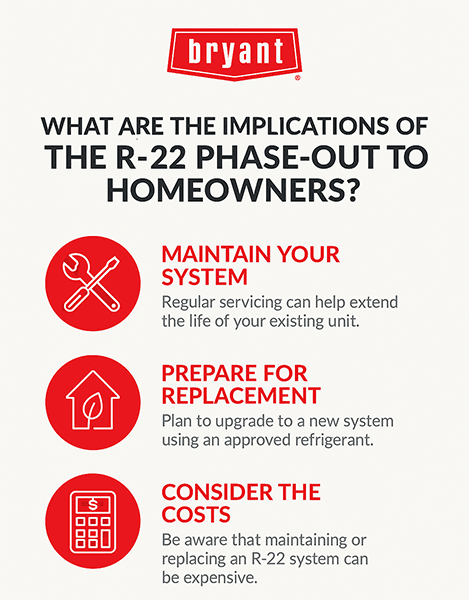
If your central air conditioner or heat pump still runs on R-22, you face rising maintenance costs and must decide whether to repair or replace your unit. While you do not need to replace a working unit immediately, planning for the future i
1. Rising Maintenance Costs
Maintenance costs for R-22 systems are rising because the refrigerant is no longer produced, limiting supply to recycled or reclaimed stock. This scarcity drives up the price significantly. A simple refrigerant recharge that used to be affordable can now result in a massive repair bill.
2. The "Repair vs. Replace" Dilemma
When an R-22 system develops a leak or compressor failure, replacing the AC is usually a smarter financial decision than repairing it. Repairing is better suited for well-maintained systems that simply need standard non-refrigerant tune-ups, while replacing works best when you face major failures and want to invest in long-term energy savings.
3. Opportunity for Upgrade
Moving away from R-22 is an upgrade to your quality of life, offering superior technology and energy savings that pay for themselves. Modern systems using advanced refrigerants like Puron Advance™ deliver:
- Higher Efficiency: Significantly lower monthly energy bills.
- Smart Technology: Integration with smart thermostats for precise control.
- Quieter Operation: Advanced sound-dampening technology for a peaceful home.

What Should I Do Now If I Have An R-22 System?
If you have an R-22 system, you should maintain its sealed state, budget for a future replacement, or consult an HVAC expert. You have three clear, action-oriented paths forward to optimize your home's comfort.
Maintain Your Current System
If your unit is running well, keep it that way. Schedule regular AC maintenance to detect leaks early. A well-maintained sealed system won't require additional refrigerant, allowing you to use your R-22 unit until it reaches the end of its natural life. Learn more about the importance of AC service.Plan for Replacement
Start budgeting for new AC installation now. Look for units that use future-proof AC refrigerants like Puron Advance™ (R-454B). This ensures you are investing in technology that meets long-term environmental and efficiency standards. Rebates can help offset the cost of system replacement.
Mark LeGare, owner of The Coolest in Austin, TX discusses one of the benefits to homeowners upgrading from an R-22 system: environmentally friendliness.
“You don't have to make the shift now, but if you want to get something that's going to be more environmentally friendly, upgrading to R-454B is a great option,” LeGare said
Connect With An Expert
Don't guess when it comes to your home's comfort. Connect with a local Bryant dealer, They can assess the health of your current system and provide a cost-benefit analysis for repair versus replacement, helping you make a confident decision.
R-22 Refrigerant FAQs
R-22 is no longer produced or imported in the U.S. as of 2020, but limited recycled or reclaimed R-22 is still available for servicing existing systems.
R-22 was banned because it contains ozone-depleting hydrochlorofluorocarbons (HCFCs), which contribute to environmental damage and violate international environmental agreements like the Montreal Protocol.
R-22 cost depends on availability and market demand due to its phase-out status.
No, R-410A cannot be used in an R-22 system without significant modifications, as the two refrigerants operate at different pressures and require different components.
Since R-22 is no longer produced, replacement is usually more cost-effective than recharging. Upgrading to a modern R-454B system provides better efficiency and long-term reliability.
R-22 was introduced in the 1950s and phased out in the U.S. starting in 2010 due to environmental regulations, with all production ending in 2020.
No, it is not illegal to continue running an existing R-22 system. The ban only applies to the production and import of new R-22 refrigerant, not the operation of older equipment.
Check the nameplate or data sticker on the outdoor condenser unit. It will clearly list the "Refrigerant" or "System Type" as HCFC-22 or R-22. If your unit was manufactured before 2010, it likely uses R-22.
No, you cannot use R-410A or R-454B in an R-22 system. These refrigerants operate at different pressures and require specific lubricants and components; mixing them will damage your air conditioner.
You cannot buy R-22 as a consumer, but licensed technicians can still acquire limited quantities of recycled or reclaimed R-22 to service existing systems. However, availability is low and costs are very high.
No, you cannot legally or safely top off an R-22 system yourself. Only certified HVAC technicians with EPA section 608 certification are legally permitted to handle and purchase reclaimed R-22 refrigerant
Upgrading from an outdated R-22 unit to a modern HVAC system may help lower your monthly cooling bills. Modern units use innovative technology to help maximize performance and efficiency.
Learn More About Air Conditioners
- Learn about and how does air conditioning work
- Find out what is a and an inverter air conditioner
- Understand AC tune ups
- Discover the factors in choosing what size air conditioner you need
- Find out how long do AC units last?
- Discover the difference in a heat pump vs air conditioner


