About The Author: Travis Baugh is a Digital Brand Marketing Manager for Bryant, where he creates clear, helpful content to guide homeowners through heating, cooling, and indoor air quality decisions. His goal is to empower readers with the knowledge they need to choose the right comfort solutions for their home—confidently and comfortably.
What Is an AC Condenser? A Complete Guide
An AC condenser, or air conditioner condenser, is the outdoor unit of your HVAC system responsible for releasing heat from your home into the outside air. This process is essential for cooling the refrigerant and, in turn, cooling your home. Understanding its function is key to maintaining an efficient, quiet, and reliable cooling system.
At Bryant, we build top-quality, energy-efficient condensers designed for reliable cooling performance and longevity. Investing in advanced HVAC technology not only enhances your daily comfort but also provides significant long-term value through reduced energy bills. This guide explores what an AC condenser is, how it works, and its critical role in your home's environment.
What Is the Main Function of an AC Condenser?
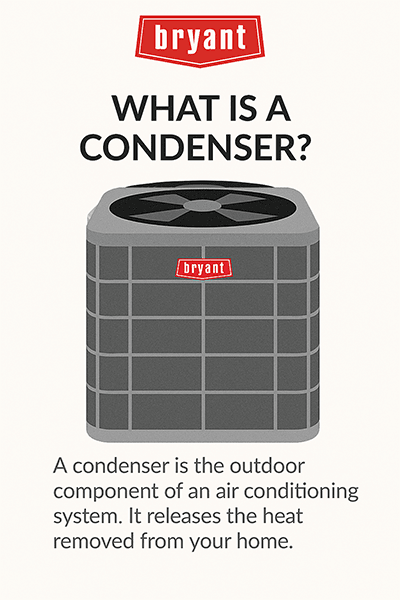
The primary function of an AC condenser unit is to release the heat absorbed by the refrigerant from inside your home into the outdoor air. By releasing this heat, the refrigerant cools down and converts from a gas back into a liquid. This cooled liquid is then recirculated indoors to absorb more heat, seamlessly continuing the cooling cycle.
“The condenser is really the heart of your air conditioning system," Mike Lea, co-owner of Lea Heating & Air Conditioning in East Dundee, IL said. "It’s responsible for releasing the heat your home collects. It’s not running efficiently, your entire system works harder and costs more to operate.”
Key Components of the Condenser Unit
An AC condenser unit relies on four primary AC parts to function: the condenser coil, the compressor, the fan, and the refrigerant lines. Together, these components transfer heat efficiently to maintain your system's performance.
- Condenser Coil: Transfers heat from the refrigerant to the outside air.
- Compressor: Increases the refrigerant's temperature and pressure before it enters the condenser.
- Fan: Blows air over the condenser coil to help dissipate heat more quickly.
- Refrigerant Lines: Transport the AC refrigerant between the indoor and outdoor units.
Without a properly functioning HVAC condenser, your air conditioning system cannot effectively cool your home or maintain optimal air quality.
How Does an Air Conditioner Condenser Work?
An air conditioner condenser works by pressurizing heated refrigerant gas and blowing outside air across its coils to release the heat. Once the heat dissipates, the refrigerant turns back into a liquid and returns inside to cool your home. It operates as part of a closed-loop system called the refrigeration cycle, which continuously repeats to maintain a comfortable indoor environment.
The refrigeration cycle involves four main components:
- Evaporator Coil (Indoor Unit): Absorbs heat from your indoor air, turning the liquid refrigerant into a gas.
- Compressor (Outdoor Unit): Pressurizes the gaseous refrigerant, raising its temperature.
- Condenser Coil (Outdoor Unit): Releases the heat from the hot refrigerant gas, converting it back into a liquid.
- Expansion Valve (Indoor Unit): Lowers the pressure of the liquid refrigerant before it enters the evaporator coil, starting the cycle again.
“The outdoor condenser unit removes heat from the refrigerant that has absorbed heat from the indoor air,” Lea said. “It then transforms that hot refrigerant gas into a liquid and sends it back to the evaporator coil inside. The process repeats continuously, removing heat from your home and transferring it outside, where the condenser converts the refrigerant back into a liquid before it returns to the evaporator coil.”
What Is the Purpose of an HVAC Condenser?
The main purpose of an HVAC condenser is to facilitate heat transfer, enabling your air conditioning system to maintain a comfortable indoor temperature. Its overall performance is measured by its cooling capacity and its energy efficiency.
- Cooling Capacity: This refers to the amount of heat the condenser can remove from your home in a specific timeframe.
- Efficiency: This indicates how much energy the unit uses to achieve its cooling performance. An advanced, energy-efficient condenser uses less power, which lowers your energy bills, reduces your environmental impact, and often operates as quiet as a whisper.
Maintaining Peak Performance
Regular AC maintenance, such as an annual AC tune up, ensures your Bryant condenser operates at peak efficiency. This proactive care extends the system's lifespan, ensures whisper-quiet operation, and reduces the likelihood of needing costly AC repairs instead of AC replacement.
How Do I Find the Right AC Condenser for My Home?
Finding the right AC condenser requires evaluating your home's square footage, your budget, and your long-term energy efficiency goals. Bryant offers a range of reliable and smart-compatible central air conditioner condensers to provide exceptional, seamless cooling. A certified Bryant dealer can help you select the perfect model to keep your home comfortable all year. Connect with your local Bryant dealer to get a recommendation tailored to your needs (2 ton, 3 ton, 4 ton, 5 ton) or to schedule air conditioning service.

AC Condenser FAQs
An AC condenser is the outdoor unit of your air conditioning system that releases heat removed from inside your home.
A replacement AC condenser can cost anywhere from around $3,000 to $15,000 or more, depending on the system and installation needs. Learn more about AC prices.
Signs of a failing condenser include warm air from vents, strange noises, refrigerant leaks, or the system not cooling efficiently.
An AC condenser typically lasts 10–15 years with regular maintenance, though lifespan can vary based on usage and climate. Learn more about how long AC units last.
The most common AC condenser failures involve the fan motor or refrigerant leaks, both of which can reduce cooling performance and strain the compressor.
Power issues, blown fuses, clogged coils, or a failed capacitor can all stop a condenser from running. A certified HVAC technician can diagnose the cause and safely restore operation.
Turn off power to the system at the breaker, wait a few minutes, then restore power and adjust the thermostat to cooling mode. If the condenser still won’t start, contact your local Bryant dealer for service.
First, shut off power to the unit. Remove debris from around the coils, gently rinse the fins with a garden hose, and straighten bent fins if needed—never use high pressure or harsh cleaners.
The compressor is a part located inside the AC condenser unit. While the condenser is the entire outdoor cabinet responsible for releasing heat, the compressor is the specific motor inside it that pumps and pressurizes the refrigerant.
Common warning signs include loud or strange noises coming from the outdoor unit, warm air blowing from your indoor vents, significantly higher energy bills, or visible puddles of fluid (refrigerant) around the unit.
Yes, higher efficiency AC condensers often feature advanced compressor technology and variable-speed fans, allowing them to operate much more quietly than older, standard-efficiency models.
While possible, experts highly recommend replacing both the indoor and outdoor units simultaneously. Mismatched systems can lead to reduced energy efficiency, compromised comfort, and a shorter lifespan for your new condenser.
Learn More About Air Conditioners
- Learn about types of air conditioners
- Explore AC installation
- Discover the factors in choosing the best air conditioner and what size air conditioner you need
- Find out how long do AC units last?
- Discover the difference in a heat pump vs air conditioner


