About The Author: Travis Baugh is a Digital Brand Marketing Manager for Bryant, where he creates clear, helpful content to guide homeowners through heating, cooling, and indoor air quality decisions. His goal is to empower readers with the knowledge they need to choose the right comfort solutions for their home—confidently and comfortably.
Heat Pump Repair Guide
Heat pump repair is the professional diagnosis and correction of system malfunctions—such as refrigerant leaks, electrical failures, or frozen coils—to restore heating and cooling efficiency. If your system is making strange noises, failing to hold temperature, or spiking your energy bills, a professional repair can often bring it back to peak performance and reliable, whisper-quiet operation.
For homeowners seeking long-term comfort and efficiency, addressing issues early is the smartest investment. Schedule heat pump repair with your local Bryant dealer today.
Common Heat Pump Problems and Solutions
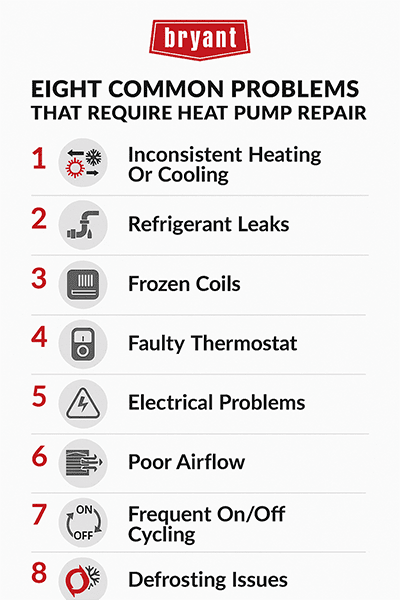
Common heat pump problems include inconsistent heating, refrigerant leaks, frozen coils, electrical failures, and faulty thermostats. Heat pumps are engineered for year-round efficiency, but even the most robust systems encounter wear and tear over time. Identifying the early signs of trouble is key to maintaining continuous comfort and avoiding total system failure.
“Heat pump repairs are kind of along the lines of air conditioning repairs,” Mike Lea, co-owner of Lea Heating & Air Conditioning in East Dundee, IL said. “Common issues are refrigeration leaks, condenser fan motor issues, dirty outdoor condensing coils, and electric components like capacitors and relays and contactors going bad.”
Inclement weather can lead to its own set of issues, according to Lea.
“Ice building up on the unit or the unit not going into a defrost cycle can be a problem with a heat pump that needs repair,” Lea said. “It is an issue when too much snow builds up around the unit. Homeowners should make sure their unit is not covered in snow or other debris."
Here are the most frequent issues that require professional heat pump repair:
- Inconsistent Temperature: Often caused by dirty air filters, blocked vents, or thermostat issues. Regular maintenance can often resolve this.
- Refrigerant Leaks: Low refrigerant levels reduce heat transfer efficiency, causing the system to work harder and increasing energy bills.
- Frozen Coils: Ice buildup on coils usually indicates poor airflow, dirty filters, or low refrigerant, preventing the system from heating or cooling effectively.
- Faulty Thermostat: If your thermostat is miscalibrated or broken, it won't signal the heat pump to cycle correctly, leading to discomfort.
- Electrical Failures: Blown fuses, tripped breakers, or bad capacitors can stop the unit from running entirely.
- Poor Airflow: Clogged ducts or a failing blower fan can restrict air movement, forcing the system to overwork.
- Short Cycling: If the unit turns on and off too frequently, it may have a refrigerant leak, thermostat issue, or be improperly sized for your home.
- Defrosting Failure: In winter, the unit must periodically defrost outdoor coils. If this cycle fails, ice can damage the system.
Why is my heat pump blowing cold air?
During "defrost mode," it is normal for a heat pump to temporarily blow cooler air while it melts ice off the outdoor unit. However, if the unit blows cold air continuously while in heating mode, it likely indicates a refrigerant leak, a compressor issue, or a problem with the reversing valve.Should You Repair or Replace Your Heat Pump?
Deciding between heat pump repair and replacement depends on the age of your unit, the cost of the repair, and its recent performance history. A repair is better suited for newer systems with minor component failures, while replacement works best when you have an aging unit facing major breakdowns.
Use the 50% Rule: According to industry benchmarks, if the cost of the repair is more than 50% of the cost of a new system, heat pump replacement is generally the smarter financial choice.
Key Decision Factors
- System Age: Heat pump systems typically last 10–15 years. If yours is nearing this age, replacement is often more cost-effective than sinking money into repairs.
- Repair Frequency: Compare the quote for the current repair against the price of a modern, energy-efficient unit.
- Energy Efficiency: Older units have lower SEER and HSPF ratings. Upgrading to a new high-efficiency model can significantly lower your monthly energy bills.
- Comfort Consistency: If your current unit can no longer keep your home comfortable or runs constantly without effect, a new system will provide superior performance.
Prevent Repairs with Regular Maintenance
Proactive heat pump maintenance is the most effective way to protect your investment. A professional tune-up ensures your system operates at peak capacity and identifies minor issues before they escalate into costly emergency repairs.
Benefits of Regular Maintenance
- Prevents Frozen Coils: Keeps airflow unobstructed.
- Optimizes Refrigerant Levels: Protects the compressor from overheating.
- Lowers Energy Bills: A clean, tuned system uses less power.
- Extends Lifespan: Regular care helps your system last longer.
Why Choose a Bryant Dealer for Heat Pump Repairs?
When you need reliable heat pump repair, expertise matters, and Bryant Factory Authorized Dealers have the training to safely diagnose complex refrigerant and electrical issues. With over 100 years of experience, Bryant is a leader in home comfort.
Our Bryant Factory Authorized Dealers provide:
- Expert Diagnosis: Technicians are trained to handle complex refrigerant and electrical issues safely.
- Genuine Parts: We use Bryant Factory Authorized Parts to ensure durability and performance.
- Local Service: Find a trusted expert right in your neighborhood.
Ready to restore your home's comfort? Schedule service with your local Bryant dealer today.
FAQs on Heat Pump Repair
Yes, most heat pump issues—such as refrigerant leaks, electrical problems, or faulty thermostats—can be repaired by a qualified HVAC technician.
The average cost to repair a heat pump ranges from $150 to $600, depending on the issue, with major repairs like compressor replacement costing $1,000 or more.
A well-maintained heat pump typically lasts 12 to 15 years, though newer high-efficiency models may last closer to 20 years with proper care.
Typical repairs include refrigerant leaks, electrical issues, or component failures such as capacitors and reversing valves.
Replacement requires a professional HVAC installer to handle refrigerant, wiring, and system compatibility.
Diagnosis and repair should be handled by a licensed HVAC professional to ensure safe and efficient operation.
A well-maintained heat pump typically lasts 12 to 15 years. Modern, high-efficiency models can last up to 20 years with proper care and regular maintenance.
Yes, a smart thermostat can alert you to performance drops or maintenance needs early on. This advanced integration helps you address minor issues before they turn into major system failures.
While some operational sounds are normal, sudden grinding, screeching, or rattling noises usually indicate a failing motor or loose component. Having a professional inspect the unit ensures your system maintains quiet operation.
Learn More About Heat Pumps
- Discover what is a heat pump
- Learn all about heat pump installation
- Read our guide to heat pump cost
- Learn what is an air source heat pump
- Explore cold climate heat pumps
- Read up on dual fuel heat pumps