About The Author: Travis Baugh is a Digital Brand Marketing Manager for Bryant, where he creates clear, helpful content to guide homeowners through heating, cooling, and indoor air quality decisions. His goal is to empower readers with the knowledge they need to choose the right comfort solutions for their home—confidently and comfortably.
R-410A Refrigerant: Understanding the Phase-Out and Your Options
R-410A refrigerant is being phased out under U.S. EPA regulations, with restrictions on new systems taking effect in 2025. If you own an existing R-410A air conditioner or heat pump, no immediate action is required — but understanding what's changing helps you plan smarter for the future. Bryant creates solutions that matter for people and our planet. While R-410A was a major improvement over its predecessor (R-22), its high Global Warming Potential (GWP) has prompted a transition to cleaner, more sustainable alternatives like Puron Advance™ (R-454B).
What is R-410A Refrigerant?
R-410A is a chlorine-free refrigerant blend of difluoromethane (R-32) and pentafluoroethane (R-125), commonly known by the brand name Puron®. It became the industry standard for residential cooling systems because, unlike R-22 (Freon), it carries zero Ozone Depletion Potential (ODP).
Key characteristics of R-410A include:
- High Efficiency: R-410A operates at higher pressures than R-22 refrigerant, enabling more efficient heat transfer and stronger cooling performance.
- Ozone Safety: As a hydrofluorocarbon (HFC), R-410A has an ODP of zero — a significant improvement over older refrigerants.
- Global Warming Impact: Despite its ozone safety, R-410A has a GWP of approximately 2,088 — significantly higher than carbon dioxide. This high heat-trapping capability is the primary driver behind the current industry transition.
Is R-410A Being Banned?
R-410A is not banned for existing systems. As of 2025, the manufacturing and installation of new systems using R-410A have been phased out under EPA regulations and international climate goals — but current owners are not required to replace functioning units.
Existing systems can still receive AC service, and refrigerant supplies for maintenance will remain available for the foreseeable future. Future AC replacements, however, will use advanced, lower-GWP refrigerants designed to optimize home comfort and energy efficiency.
Why Is R-410A Being Phased Out?
R-410A is being phased out because its heat-trapping capability contributes significantly to climate change, prompting regulatory action at both the federal and global levels.
- Environmental Impact: While R-410A solved the ozone depletion crisis, its high GWP means it traps substantially more heat than carbon dioxide when released into the atmosphere.
- Regulatory Action: The American Innovation and Manufacturing (AIM) Act grants the EPA authority to phase down the production and consumption of HFCs like R-410A.
- The Replacement: The HVAC industry is transitioning to "mildly flammable" (A2L) refrigerants such as Puron Advance™ (R-454B). These next-generation refrigerants deliver similar or superior efficiency with a drastically lower environmental impact.

What to Do If You Have an R-410A System
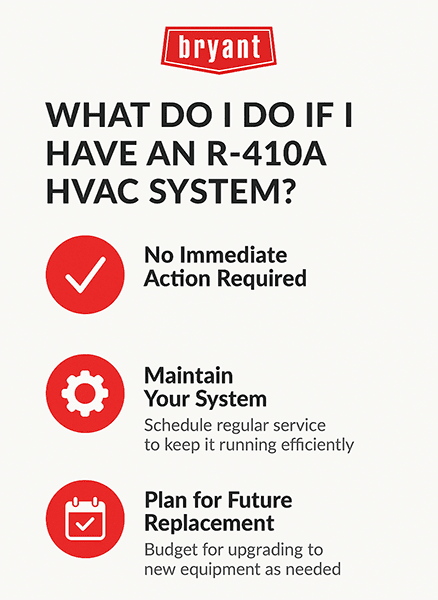
If your R-410A air conditioner or heat pump is functioning reliably, no immediate action is required. The phase-out affects new equipment manufacturing, not your right to use or service your current system. Here's how to approach your situation:
1. No Immediate Action Required
Your existing system remains entirely legal to use and service. HVAC technicians can still recharge and repair R-410A units, and refrigerant supplies will remain accessible for routine maintenance. You are not required to install a new system simply because of the regulation changes.
2. Maintain Your System
To get the most out of your current investment, schedule regular AC maintenance. A well-maintained system leaks less refrigerant, runs quietly, and operates efficiently, extending the lifespan of the AC unit before an AC replacement is necessary.
3. Plan for Future Upgrades
When your system eventually reaches the end of its life (typically 15–20 years), your new central air conditioners will likely use a low-GWP refrigerant like Puron Advance™. These modern systems often feature smart technology and higher energy efficiency ratings (SEER2 and EER2), ultimately lowering your cooling bills.
Mark LeGare, owner of The Coolest in Austin, TX discusses one of the benefits to homeowners upgrading from an R410-A system: environmentally friendliness.
“You don't have to make the shift now, but if you want to get something that's going to be more environmentally friendly, upgrading to R-454B is a great option,” LeGare said
When Should I Upgrade From R-410A?
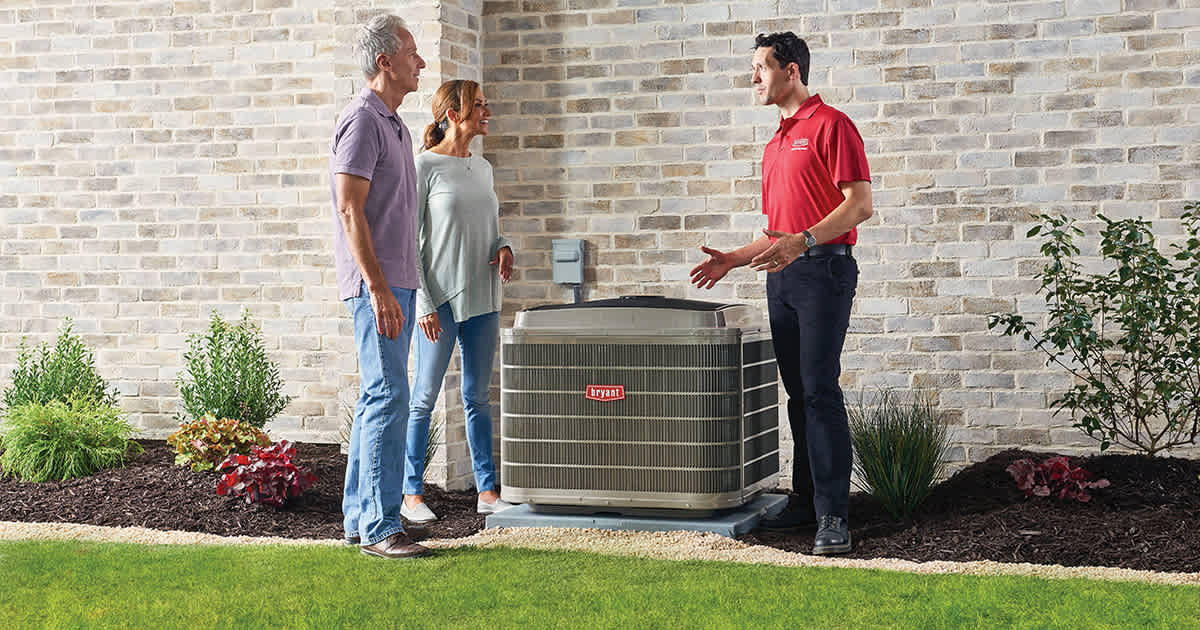
If your current air conditioner uses R-410A refrigerant, you don't need to replace it solely because of the refrigerant transition. However, there are situations where upgrading to a new system may provide better long-term value, comfort, and efficiency.Consider upgrading if your system is 12–15 years old, requires a major repair, or has a significant refrigerant leak. As systems age, repairs can become more frequent and costly, and replacing a leaking system may be more cost-effective than investing in additional repairs. Upgrading may also make sense if your energy bills are increasing, your home has inconsistent temperatures, or you want improved efficiency, quieter operation, and smart home features.
Repair may be the right choice if your system is relatively new, has been reliable, and only needs a minor fix. A local HVAC professional can help evaluate the condition of your equipment, compare repair versus replacement costs, and recommend the best option based on your home's needs and budget.
Connect With Your Bryant Dealer On Your R-410A Refrigerant Needs
Connecting with a certified Bryant dealer ensures you receive expert, customer-centric HVAC service tailored to your specific HVAC system. Bryant dealers are extensively trained in the maintenance, repair, and installation of air conditioners. Their deep knowledge of Bryant’s products allows them to diagnose issues quickly, provide accurate recommendations, and ensure your system operates efficiently.
As R-410A is phased out, a Bryant dealer can assist with refrigerant recharges, identify and address potential leaks, and provide expert guidance on future refrigerant options like Puron Advance™, or perform an AC tune up for your existing system.
Bryant dealers also carry genuine AC parts and professional-grade tools, ensuring your system is handled with precision and in full compliance with industry standards.
Regular split AC unit maintenance through a Bryant dealer can extend the life of your R-410A system, minimize the risk of unexpected failure, and preserve energy efficiency. For personalized advice on refrigerants and system performance, schedule an appointment with your local Bryant dealer today.
R-410A Refrigerant FAQs
Yes, R-410A is being gradually phased out due to its high global warming potential (GWP), with restrictions beginning in 2025 for new systems under U.S. EPA regulations.
No, only EPA-certified technicians can legally purchase and handle R-410A, as it requires specialized training and safe handling procedures.
A homeowner may pay $50–$100+ per pound1 for refrigerant, labor, recovery equipment, EPA compliance, overhead, and the service call. Since R-410A systems are being replaced by newer refrigerants like R-454B in new equipment, pricing has become more volatile, but existing R-410A systems are still serviceable.
1 https://www.angi.com/articles/what-cost-r410a-freon-pound.htm
Puron Advance, or R-454B, is among the leading low-GWP refrigerants replacing R-410A in newer HVAC systems due to its improved environmental profile.
No, R-22 and R-410A are not interchangeable, as they operate at different pressures and require entirely different system components and lubricants.
R-410A refrigerant itself doesn’t wear out but can leak over time through small openings or service valves. With a properly sealed system, it can last the entire lifespan of your air conditioner.
No, you cannot use R-454B in a system designed for R-410A. The new refrigerants operate at different pressures and are classified as mildly flammable (A2L), requiring specific safety components and engineering that older units do not possess.
It is possible that the cost of R-410A may increase over time as supply becomes more limited due to the phasedown of production, similar to what occurred with R-22. Regular maintenance to prevent leaks is the best way to avoid needing to purchase additional refrigerant.
Yes, R-454B (Puron Advance) is rigorously tested and safe for residential use. While classified as "mildly flammable," systems using it are engineered with built-in safety sensors and mitigation strategies to ensure safe operation.
You can usually find the refrigerant type listed on the manufacturer's nameplate or sticker located on the outdoor condenser unit. If you are unsure, your local Bryant dealer can verify it for you during a routine inspection
Industry experts recommend scheduling an annual HVAC maintenance check to identify and repair minor leaks early. This proactive approach ensures reliable performance and conserves remaining R-410A supplies.
Learn More About Air Conditioners
- Learn about types of air conditioners and how does air conditioning work
- Find out what is an inverter air conditioner
- Discover the factors in what size air conditioner you need
- Get help with an AC not working
- Find out how long do AC units last?


