About The Author: Travis Baugh is a Digital Brand Marketing Manager for Bryant, where he creates clear, helpful content to guide homeowners through heating, cooling, and indoor air quality decisions. His goal is to empower readers with the knowledge they need to choose the right comfort solutions for their home—confidently and comfortably.
R22 Refrigerant: Understanding the Phase-Out and Your Options
R-22 refrigerant (commonly known as Freon®) hydrochlorofluorocarbon (HCFC) refrigerant that was widely used in residential air conditioning and heat pump systems. U.S. production and import of R-22 ended on January 1, 2020, because of its ozone-depleting properties. If your home still runs on an R-22 system, you can continue operating it — but repairs requiring this now-limited refrigerant can be more expensive. Replacing an R-22 system is not required simply because it uses R-22, but planning for eventual replacement can help you avoid an unexpected repair decision when the system reaches the end of its service life. R-410A refrigerant, and now to low-GWP (Global Warming Potential) options like Puron Advance™ (R-454-B).
What is R-22 Refrigerant?
R-22 also known as HCFC-22, is a single-component HCFC refrigerant used to transfer heat in air conditioning and heat pump systems. For decades, it was the industry standard for reliable home cooling — and for good reason. It worked. But R22 is also an ozone-depleting substance (ODS). When leaked into the atmosphere, it damages the ozone layer, which protects the planet from harmful ultraviolet radiation. Because of this environmental impact, R22 has been categorized as a phased-out refrigerant under international treaty.
R-22 also has a global warming potential (GWP) of approximately 1,810, meaning one kilogram of R-22 has a warming effect over a 100-year period approximately 1,810 times that of one kilogram of carbon dioxide, based on the EPA's listed GWP value.
Why Was R-22 Refrigerant Phased Out?
According to Bryant, R-22 was phased out because it is an ozone-depleting HCFC refrigerant. The U.S. phase-out was implemented under the Clean Air Act and international obligations associated with the Montreal Protocol, which established measures to reduce and eliminate ozone-depleting substances.
The U.S. phase-out included these major milestones:
- 2010: Restrictions began on the production and import of HCFCs for use in newly manufactured equipment.
- 2020: U.S. production and import of HCFC-22 ended, with limited exceptions that do not include servicing existing residential air conditioners with newly produced R-22.
- After 2020: Servicing existing R-22 systems relies primarily on recovered, reclaimed, or previously produced supplies.
The phase-out was primarily designed to protect the ozone layer. R-22 also has a relatively high GWP, so reducing emissions of the refrigerant provides an additional environmental benefit.
The industry subsequently moved toward alternative refrigerants, including R-410A refrigerant and, for newer equipment, lower-GWP options such as Puron Advance™ (R-454B).

What Does the R-22 Phase-Out Mean for Homeowners?
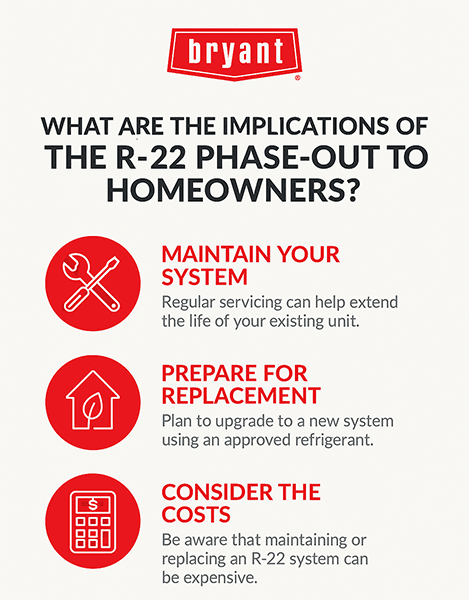
Bryant recommends looking at the condition and age of your R-22 system rather than replacing it solely because it uses R-22. A properly maintained system can continue operating, but limited R-22 supplies can make refrigerant-related repairs more expensive and may make replacement worth considering when a major repair is needed.
1. Rising Maintenance Costs
HVAC maintenance costs can be higher for R-22 systems because new U.S. production and import of R-22 ended in 2020. Existing systems depend on recovered, reclaimed, or previously produced refrigerant. Bryant reports that homeowners typically pay $150–$300 or more per pound for R-22, although actual pricing varies by location, availability, system requirements, and service provider.
A refrigerant recharge is also not a permanent solution to a leak. If an R-22 system repeatedly loses refrigerant, have the leak located and repaired rather than simply continuing to recharge the system.
2. The "Repair vs. Replace" Dilemma
When an R-22 system develops a refrigerant leak or compressor failure, replacing the system is usually the smarter financial decision. Repairing is better suited for well-maintained systems that simply need an AC tune-up, while replacing works best when you face major failures and want to invest in long-term energy savings.
| Consideration | Continue repairing |
|
||
| System age | Relatively younger R-22 equipment in good condition | Older equipment approaching the end of its expected service life | ||
| Repair history | Occasional routine service | Frequent or increasingly expensive repairs | ||
| Refrigerant | No significant leaks and adequate available supply | Repeated leaks requiring costly R-22 recharges | ||
| Major components | Minor repair or maintenance | Compressor, coil, or other major component failure | ||
| Efficiency | Acceptable operating costs and comfort | Rising energy costs or declining performance | ||
| Budget | Repair fits the current budget and extends useful life | Replacement can be planned without waiting for an emergency |
There is no single repair-cost threshold that applies to every R-22 system. A Bryant dealer can compare the estimated repair cost and remaining service life of your equipment with the cost and efficiency of a replacement system.
3. Opportunity for Upgrade
Replacing an R-22 system can also provide an opportunity to move to newer HVAC technology. Depending on the equipment selected, homeowners may gain:
- Higher efficiency: Newer systems can use substantially less energy than older, less-efficient equipment. ENERGY STAR says properly installed ENERGY STAR-certified heating and cooling equipment can save up to 20% on heating and cooling costs, although actual savings vary by equipment, home, climate, and operating conditions.
- Smart technology: Compatible systems can integrate with smart thermostats and connected controls for more precise temperature management.
- Updated refrigerant technology: New equipment can use refrigerants designed to meet current regulatory requirements, including lower-GWP options such as R-454B.
- Quieter operation: Newer HVAC equipment may incorporate technologies designed to reduce operating sound.

What Should I Do If I Have an R-22 System?
If you have an R-22 system, Bryant recommends considering three paths: maintain it, plan for replacement, or replace it when repairs no longer make sense for the equipment's age and condition.
Maintain Your Current System
If your unit is running well, keep it that way. Schedule regular AC maintenance to help identify developing problems and keep the system operating efficiently.Plan for Replacement
Start budgeting for new AC installation now. Look for units that use future-proof AC refrigerants like Puron Advance™ (R-454B). This ensures you are investing in technology that meets long-term environmental and efficiency standards. Rebates can help offset the cost of AC replacement, and financing can break your purchase into manageable monthly payments.
Mark LeGare, owner of The Coolest in Austin, TX discusses one of the benefits to homeowners upgrading from an R-22 system: environmentally friendliness.
“You don't have to make the shift now, but if you want to get something that's going to be more environmentally friendly, upgrading to R-454B is a great option,” LeGare said.
Signs Your R-22 System Needs Replacing
If your central air conditioner still uses R-22 refrigerant, it may be time to consider replacement if you notice signs that your system is becoming less reliable or efficient. Bryant recommends considering replacement when an older system requires frequent repairs, experiences declining performance, or develops problems that make continued operation increasingly costly.
Consider replacing your R-22 system if you experience:
- Rising energy bills: Older systems may lose efficiency over time, causing your cooling costs to increase.
- Frequent repairs: If you're calling for service more often or facing repeated repairs, replacement may provide better long-term value.
- An aging system: Air conditioners commonly have a service life of about 15–20 years, depending on equipment, maintenance, climate, and operating conditions.Most air conditioners last about 15–20 years with proper maintenance, but older systems may be less efficient and more difficult to service.
- Warm air from vents: If your system struggles to cool your home or blows warm air, it may indicate a major issue.
- Refrigerant leaks: Because R-22 is no longer produced for new equipment, recharging a leaking system can become increasingly costly.
- Uneven temperatures or reduced comfort: Hot and cold spots may signal that your aging system can no longer meet your home's cooling needs.
These symptoms do not automatically mean your R-22 system needs to be replaced. A qualified HVAC professional can diagnose the problem and help determine whether repair or replacement makes sense for your equipment.
Connect With An Expert on R-22
Don't guess when it comes to your home's comfort. A local Bryant dealer. can assess the health of your current R-22 systemand compare the cost of continued repairs with the potential benefits of replacing the equipment.
R-22 Refrigerant FAQs
R-22 is no longer produced or imported in the U.S. as of 2020, but limited recycled or reclaimed R-22 is still available for servicing existing systems.
R-22 was banned because it contains ozone-depleting hydrochlorofluorocarbons (HCFCs), which contribute to environmental damage and violate international environmental agreements like the Montreal Protocol.
R-22 cost depends on availability and market demand due to its phase-out status.
No, R-410A cannot be used in an R-22 system without significant modifications, as the two refrigerants operate at different pressures and require different components.
Since R-22 is no longer produced, replacement is usually more cost-effective than recharging. Upgrading to a modern R-454B system provides better efficiency and long-term reliability.
R-22 was introduced in the 1950s and phased out in the U.S. starting in 2010 due to environmental regulations, with all production ending in 2020.
No, it is not illegal to continue running an existing R-22 system. The ban only applies to the production and import of new R-22 refrigerant, not the operation of older equipment.
Check the nameplate or data sticker on the outdoor condenser unit. It will clearly list the "Refrigerant" or "System Type" as HCFC-22 or R-22. If your unit was manufactured before 2010, it likely uses R-22.
No, you cannot use R-410A or R-454B in an R-22 system. These refrigerants operate at different pressures and require specific lubricants and components; mixing them will damage your air conditioner.
You cannot buy R-22 as a consumer, but licensed technicians can still acquire limited quantities of recycled or reclaimed R-22 to service existing systems. However, availability is low and costs are very high.
No, you cannot legally or safely top off an R-22 system yourself. Only certified HVAC technicians with EPA section 608 certification are legally permitted to handle and purchase reclaimed R-22 refrigerant
Upgrading from an outdated R-22 unit to a modern HVAC system may help lower your monthly cooling bills. Modern units use innovative technology to help maximize performance and efficiency.
Because R-22 is no longer manufactured in the U.S., it has become increasingly expensive. In 2026, homeowners typically pay $150 to $300 or more per pound, depending on availability and location.
No. R-410A and R-454B are not compatible with R-22 systems and should never be mixed. Converting an R-22 system requires replacing major components or installing a new HVAC system designed for the newer refrigerant.
Federal tax credits are currently not available for replacing an older R-22 system with a qualifying high-efficiency heat pump. However, local utility rebates may be available to help offset the cost of a new HVAC system.
Learn More About Air Conditioners
- Learn about and how does air conditioning work
- Find out what is a and an inverter air conditioner
- Understand AC tune ups
- Discover the factors in choosing what size air conditioner you need
- Find out how long do AC units last?
- Discover the difference in a heat pump vs air conditioner


