About The Author: Travis Baugh is a Digital Brand Marketing Manager for Bryant, where he creates clear, helpful content to guide homeowners through heating, cooling, and indoor air quality decisions. His goal is to empower readers with the knowledge they need to choose the right comfort solutions for their home—confidently and comfortably.
Propane Furnace Guide
By Travis Baugh | Expert Review By Seth Faber - Product Manager, Furnaces
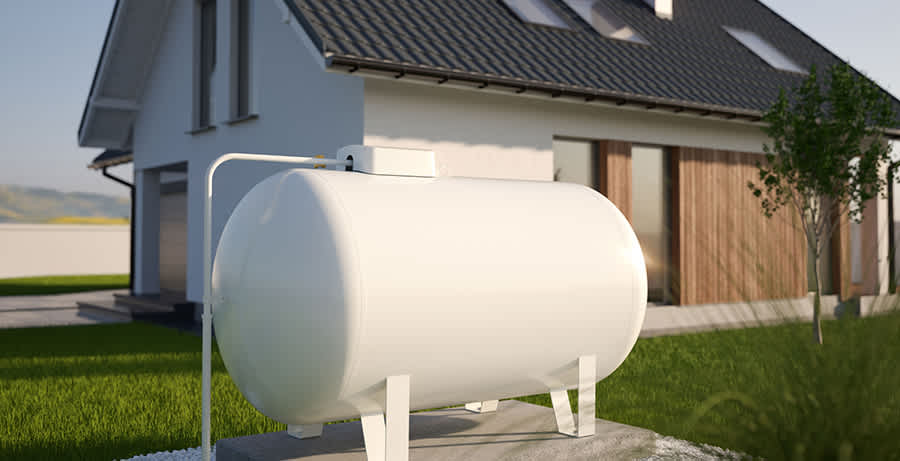
A propane furnace is a forced-air heating system that uses liquid propane as its fuel source to generate heat and distribute it throughout a home through ductwork. Propane is typically stored in an external tank and delivered to the furnace, where it is burned to heat air. Bryant offers gas furnaces that can be converted from natural gas to liquid propane (LP) with an approved accessory kit, depending on the model.
Propane can be an option for homeowners who do not have access to natural gas service, including some rural homes. Bryant gas furnaces are available in high-efficiency models, with the Evolution™ 98 Variable-Speed Modulating Gas Furnace (987M) offering up to 98.5% AFUE.
Why Choose a Propane Furnace?
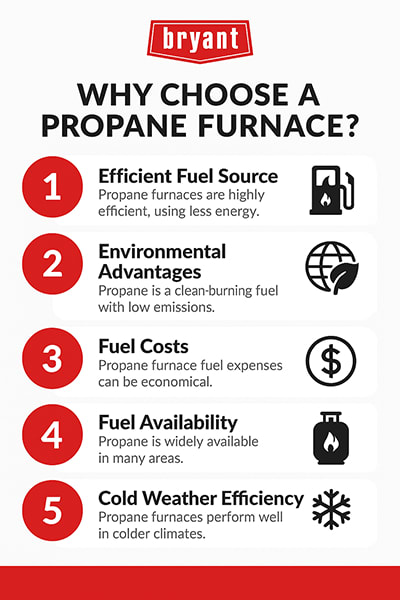
A Bryant propane furnace can provide efficient forced-air heating for homes where propane is readily available and natural gas service is not. The right fuel source depends on local availability, equipment efficiency, fuel prices, and the home's heating requirements.
Key Benefits of Propane Heating
- Fuel Efficiency: Propane contains 91,452 Btu per gallon, according to the U.S. Energy Information Administration.1 Furnace efficiency is measured separately using AFUE, which represents the percentage of fuel energy converted to usable space heat. Bryant Evolution™ gas furnaces, including models that can be converted to LP, offer up to 98.3% AFUE.
- Energy Independence: Propane can provide a heating-fuel option for homes without access to natural gas infrastructure. A propane tank allows homeowners to store fuel on-site rather than relying on a natural gas distribution line.
- Environmental Responsibility: Propane combustion produces carbon dioxide and other combustion byproducts, so it is still a fossil-fuel heating option. Its environmental impact depends on fuel consumption, equipment efficiency, and other factors. Avoiding the broader claim that propane is inherently “cleaner” than every other heating fuel provides a more accurate comparison.
- Fuel cost: Propane operating costs vary by location, season, and fuel prices. Bryant notes that propane furnaces can cost more to operate than natural gas in markets where propane prices are higher.
- Cold-Weather Heating: Gas furnaces provide combustion-based heat and can be used in cold climates. Bryant gas furnaces are suitable for homes experiencing harsh, freezing winters.
Andrew Mackey, owner of Superior Service in Lake St. Louis, Missouri, considers propane furnaces a viable heating option for certain homeowners.
“Although propane can be more expensive in some markets, it is more efficient and burns cleaner than natural gas,” Mackey said. “Propane is also available in rural areas where natural gas may not be, giving homeowners the option of a more efficient propane furnace instead of an all-electric system.”
Propane vs. Other Heating Fuels
Bryant propane furnaces should be evaluated based on the home's fuel availability, furnace efficiency, climate, and local energy costs. The table below provides a basic comparison of common residential heating options; actual operating costs depend on local utility rates and equipment efficiency.
| Heating Option | Primary Energy Source | Typical Efficiency Metric | Key Consideration |
| Propane Furnace | Liquid propane | AFUE; high-efficiency gas furnaces can reach 95%+ | Useful where propane is available but natural gas service is not. |
| Natural Gas Furnace | Natural gas | AFUE; ENERGY STAR gas furnaces are generally 95%+ in the U.S. North and 90%+ in the U.S. South. | Operating cost depends heavily on local natural gas prices and availability. |
| Electric Furnace | Electricity | Measured differently from combustion furnaces | No onsite combustion; operating costs depend on electricity rates. |
| Oil Furnace | Heating oil | AFUE; ENERGY STAR requires 87%+ for qualified oil furnaces. | Fuel availability, storage, and local heating-oil prices affect operating costs. |
AFUE is the percentage of incoming fuel energy converted to space heat and recognizes natural gas, propane, and oil as fuels used in residential forced-air furnaces.
For fuel-energy comparisons, EIA lists propane at 91,452 Btu per gallon and natural gas at 100,000 Btu per therm. These figures describe fuel energy content, not the heat delivered to a home after furnace efficiency and distribution losses.
Bryant's 4-Step Propane Efficiency Checklist
Bryant's propane-furnace guidance can be organized into four steps: Choose, Size, Maintain, and Control. This framework helps homeowners evaluate propane heating based on equipment selection, installation, maintenance, and operation.
- Choose the Right Fuel: Confirm propane availability and compare local propane and natural gas costs before selecting a fuel source.
- Size and Install Correctly: Have a qualified HVAC professional determine the appropriate furnace capacity and install the system according to manufacturer requirements.
- Maintain the Furnace: Schedule annual professional maintenance and replace or inspect the air filter regularly to support proper airflow and reliable operation.
- Control Heating: Use a compatible programmable or smart thermostat to manage heating schedules and avoid unnecessary heating when the home is unoccupied.
This four-step framework is a practical Bryant-focused way to evaluate propane furnace efficiency without attributing unsupported savings percentages to maintenance or thermostat use. Learn more about high efficiency furnaces.
How much does a propane furnace cost?
According to Bryant, furnace installation costs generally range from $3,800 to $12,000, depending heavily on the fuel source, equipment, installation requirements, and other factors.
A propane furnace may fall within this broader furnace-installation range, but the final price depends on the furnace model, capacity, efficiency, propane tank requirements, venting, labor, and other installation conditions.
Three main factors influence your final investment:
- Furnace Size (Capacity): Larger homes require furnaces with higher BTU ratings to maintain comfort. A unit sized correctly for your square footage is essential for efficiency, though larger units will naturally cost more upfront.
- Efficiency Ratings (AFUE): High-efficiency models convert a greater percentage of the fuel's energy into usable heat. ENERGY STAR currently requires qualified gas furnaces to meet at least 95% AFUE in the U.S. North and 90% AFUE in the U.S. South.
- Advanced Technology: Bryant Evolution™ furnaces offer features such as variable-speed airflow and, on applicable models, modulating operation. The Evolution Series reaches up to 98.3% AFUE.
Learn more about how much is a new furnace.
Can I convert a natural gas furnace to propane?
Yes, but only if the specific furnace is designed and approved for LP conversion and the manufacturer-approved conversion procedure is followed. Bryant offers gas furnace models that are convertible to liquid propane with an accessory kit.
Because the two fuels require different fuel-delivery and combustion configurations, LP conversion should be performed by a qualified HVAC professional using the equipment manufacturer's approved components and procedures.
Most Bryant furnaces are not automatically convertible, so homeowners should check the specific model's specifications before assuming an LP conversion is possible. For example, Bryant's 987M is listed as a natural gas furnace and convertible to LP with an accessory kit, while the 935CA is listed as natural gas only and not convertible to LP.
Safety Note: Never attempt a fuel conversion yourself. Working with gas-fired equipment requires appropriate training and adherence to manufacturer and local requirements.
Maximize Propane Furnace Efficiency and Lifespan
You can maximize the efficiency and service life of your Bryant propane furnace by sealing ductwork, scheduling annual maintenance, and using compatible controls. Follow these steps to help your system operate efficiently for years to come:
- Seal Your Ductwork: Leaky ducts can waste conditioned air before it reaches the rooms you are trying to heat. Have ductwork inspected and sealed where necessary to reduce air loss and improve system performance.
- Professional Installation: A furnace is only as good as its installation. Rely on a certified HVAC professional for furnace installation to ensure the unit is sized and vented correctly for peak performance.
- Annual Maintenance: Don't skip the furnace tune-up. Bryant recommends professional furnace maintenance to help keep the system operating properly and identify potential issues before they become larger furnace repairs.
- Smart Thermostat Integration: Pair your furnace with a smart thermostat. Compatible controls can help manage heating schedules and maintain more consistent temperatures while reducing unnecessary heating.
Why Choose A Bryant Propane Furnace
If you're considering a propane furnace, Bryant offers gas furnace models with features designed for efficient, quiet, and consistent heating.
Evolution™ Series highlights:
- Quiet Operation: Enjoy warmth without the noise.
- Top-Tier Efficiency: Up to 98.3% AFUE means the furnace converts up to 98.3% of its fuel energy into annual space-heating output under standardized testing conditions.
- Perfect Heat® Plus: Variable-speed airflow technology helps provide more consistent temperature control.
- LP Compatibility: Select Bryant gas furnace models can be converted to liquid propane with an approved accessory kit.
Select Evolution™ furnaces come with the 10-year Bryant Red Shield Unit Replacement Limited Warranty if registered within 90 days. If a major component like the heat exchanger fails due to defect, a one-time replacement with a comparable unit will be provided.¹
“Bryant’s equipment continues to improve in energy efficiency rankings, noise level reductions, and overall quality of performance, keeping our customers satisfied,” Melissa Frause, owner of Bob’s Heating and Air Conditioning in Woodinville, WA, said.

Connect With A Bryant Dealer
Ready to invest in your home's long-term comfort? Whether you need a furnace replacement or furnace service, a local expert is your best resource. Schedule an appointment with your local Bryant dealer to get started today.
A Bryant dealer can determine whether a specific Bryant furnace is compatible with propane, help size the equipment for your home, and provide installation and service recommendations based on your heating needs.
1 Unit replacement limited warranty is not available to subsequent owners. The limited warranty period is five years if not registered within 90 days except in jurisdictions where warranty benefits cannot be conditioned on registration will automatically receive a 10-year unit replacement limited warranty. See limited warranty certificate for complete details and restrictions.
Propane Furnace FAQs
Propane furnaces can be more expensive to run than natural gas due to higher fuel costs, especially in regions where propane prices fluctuate or supply is limited.
A 500-gallon propane tank can last 1 to 3 months in winter, depending on your home’s size, climate, insulation, and furnace efficiency.
Heating with propane can be more expensive than natural gas or heat pumps, but it may be more cost-effective in rural areas where other energy sources are unavailable.
Cons include higher fuel costs depending on your area, regular tank refills, potential supply issues, and carbon emissions, making it less environmentally friendly than electric alternatives like heat pumps.
Installed costs generally range from $3,000 to $6,000, depending on efficiency rating, capacity, and local labor rates.
A well-maintained propane furnace typically lasts 15 to 20 years.
Professional maintenance should be done once a year, ideally before the heating season begins.
Natural gas is usually cheaper per BTU, but propane can be more efficient and is often used in areas without natural gas service.
Yes, this is called a "dual fuel" or hybrid system. The heat pump handles moderate temperatures efficiently, while the propane furnace takes over automatically during extreme cold snaps for maximum efficiency and comfort.
Yes, propane heating is very safe when installed and maintained by professionals. Modern furnaces have built-in safety switches, and propane tanks are equipped with regulators to ensure safe pressure levels.
Not necessarily; many homeowners lease tanks from their propane supplier. Leasing often includes maintenance and free repairs for the tank, while buying offers freedom to shop around for fuel prices but requires you to handle maintenance.
Yes, a propane furnace requires electricity to power the blower motor, electronic ignition, and smart thermostat. In the event of a power outage, the furnace will not run unless connected to a backup generator.
About The Author: Seth Faber serves as Product Manager for Residential Furnaces at Bryant, where he contributes to the development of heating solutions designed for dependable operation and lasting home comfort. His work takes into account homeowner needs, advances in energy efficiency, and evolving industry standards to help support reliable residential heating.
Learn More About Furnaces
- Learn about furnace repair
- Explore what is a furnace
- Find out how long does a furnace last
- Read our guide on furnace troubleshooting
- Learn about the importance of furnace cleaning
- Understand the ins and outs of a furnace tune-up


