About The Author: Travis Baugh is a Digital Brand Marketing Manager for Bryant, where he creates clear, helpful content to guide homeowners through heating, cooling, and indoor air quality decisions. His goal is to empower readers with the knowledge they need to choose the right comfort solutions for their home—confidently and comfortably.
Understanding AFUE Ratings: Gas Furnace Efficiency, Repair, and Long-Term Savings
AFUE (Annual Fuel Utilization Efficiency) is the standard metric for measuring how efficiently a gas furnace or boiler converts fuel into usable heat. Expressed as a percentage, AFUE tells homeowners what percentage of the fuel's energy is converted to space heat over a typical heating year, with the remainder lost through exhaust and other operating losses.. Understanding your AFUE rating is an important part of comparing furnace efficiency, potential fuel use, and long-term operating costs.
Bryant gas furnaces currently range from 80% AFUE models to the Evolution™ 98 Variable-Speed Modulating Gas Furnace 987M, which offers up to 98.5% AFUE.
What Is AFUE Rating?
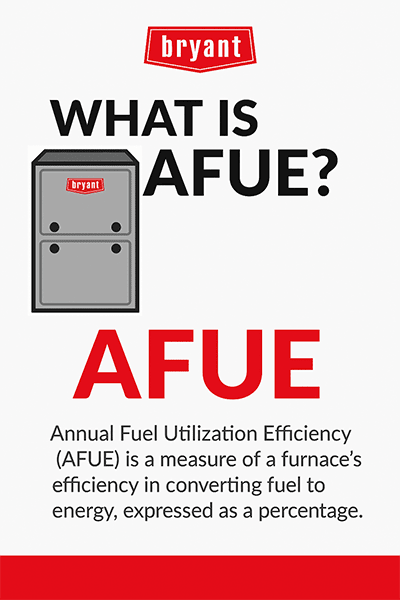
An AFUE rating measures how efficiently a furnace converts fuel into heat over a typical heating year. A gas furnace with a 95% AFUE rating converts about 95% of the fuel's energy into space heat, while the remaining 5% is lost through exhaust and other operating losses. The higher the AFUE rating, the more of the fuel's energy is converted to usable heat.
Why does AFUE matter?
AFUE matters because it helps homeowners compare how much of the fuel consumed by different furnaces is converted into space heat. Think of AFUE like the MPG rating on a car: a higher number means more efficient use of fuel, although actual operating costs also depend on fuel prices, heating demand, home efficiency, and system operation.
- Older furnaces can have AFUE ratings in the 56% to 70% range, although the exact efficiency varies by age and model.
- 80% AFUE furnaces remain available, including Bryant models such as the Evolution™ 80 880TA and Legacy™ 811S.
- Bryant's highest-rated residential gas furnace, the Evolution™ 98 987M, offers up to 98.5% AFUE.
Investing in a high efficiency furnace can reduce the amount of fuel required to produce a given amount of heat, although the actual savings depend on your home's heating load, fuel prices, climate, and the furnace's operating conditions.
What Are the AFUE Efficiency Ranges?
AFUE ratings fall into three general categories. Choosing the right range depends on your climate, budget, and long-term comfort goals.
- Standard Efficiency (80% AFUE): Meets the minimum federal standards for new furnaces. Cost-effective upfront and well-suited to homes in mild climates where heavy heating is not required.
- Mid-Efficiency (90%–95% AFUE): Offers a strong balance of performance and value, significantly reducing wasted energy compared to older or entry-level units.
- High Efficiency (96%–98.5% AFUE): Represents the pinnacle of heating technology. These systems deliver maximum energy savings and consistent comfort, making them ideal for homeowners in colder regions who want to future-proof their energy bills
Decision Guide: An 80% AFUE system is better suited for homeowners in mild climates with a tighter upfront budget, while a 96%+ AFUE system works best for those in colder regions who prioritize long-term savings and fewer furnace repair calls
What AFUE Rating Should You Choose?
AFUE ratings fall into different ranges, but there isn't one AFUE rating that is appropriate for every home. Choosing the right furnace depends on your climate, heating demand, existing system, installation requirements, budget, and expected length of ownership.
- 80% AFUE: Bryant offers 80% models such as the Evolution™ 880TA and Legacy™ 811S. These models use a non-condensing furnace design and may be considered where an 80% system is appropriate for the home's installation requirements.
- 90%–95% AFUE: Bryant offers models such as the Legacy™ 912S at up to 92.1% AFUE and 935SA at 95% AFUE.
- 96%–98.5% AFUE: Bryant's higher-efficiency models include the Preferred™ 926T at up to 96.7%, Preferred™ 927T at up to 97%, and Evolution™ 987M at up to 98.5% AFUE.
Decision Guide: Rather than choosing an AFUE rating based solely on climate or upfront price, compare the furnace's efficiency with installation requirements, expected heating demand, local fuel costs, and available incentives. A Bryant dealer can help evaluate those factors for your home.
Why Invest in High AFUE Products?
Upgrading to a high-efficiency furnace can increase the percentage of fuel converted into space heat, but AFUE alone does not determine comfort, reliability, or repair frequency.
- Efficiency That Can Reduce Fuel Use: High-AFUE systems convert more of the fuel they consume into heat. For example, a 98.5% AFUE furnace converts a greater share of its fuel energy into space heat than an 80% AFUE furnace, all else being equal. Actual energy-cost savings depend on heating demand and fuel prices.
- Consistent, Even Comfort: Some Bryant high-efficiency models combine higher AFUE with technologies such as variable-speed airflow, two-stage operation, or modulating gas gas valves— technology that eliminates cold spots and delivers steady temperatures throughout your home.
- Fewer Furnace Repairs: Advanced systems are engineered to run smoother and quieter, reducing wear and tear on core components. This durability translates to fewer furnace repairs and extend how long your furnace lasts.
- Environmental Stewardship: Less fuel waste means a lower carbon footprint—a choice that benefits both your household and the planet. Learn more about Bryant's commitment to sustainability.
- Financial Incentives: Some high-efficiency systems qualify for local utility rebates, depending on the equipment, location, program requirements, and purchase date.
Andrew Mackey, owner of Superior Service in Lake St Louis, Missouri, underscores the importance of AFUE when choosing a new system.
“A consumer should consider the AFUE rating of the furnace because this rating is telling how efficiently the furnace can heat the home,” Mackey said. “The higher the rating, the more efficient the unit is.”
How To Choose the Right AFUE for Your Home
Selecting the right furnace AFUE involves balancing your local climate with your home's specific needs and long-term budget. Bryant recommends working with a qualified dealer to evaluate the furnace, installation requirements, and your home's heating needs rather than selecting a model based on AFUE alone.
1. Assess Your Climate
Climate affects how often your furnace operates, so it can influence the potential value of a higher-AFUE system. For milder winters, an 80% AFUE model may deliver sufficient performance where that type of installation is appropriate. In colder climates, a higher-AFUE model may reduce fuel consumption over the course of the heating season.
2. Evaluate Your Home's Envelope
Your home's insulation quality and overall size play a critical role in determining how much heating capacity your home requires. However, home size alone should not be used to select furnace capacity. Learn more about what size furnace you need.
Bryant notes that a Manual J load calculation can account for factors such as home size, insulation, windows, climate zone, and air leakage when determining the appropriate furnace size.
3. Weigh Long-Term Value Against Upfront Budget
Higher AFUE systems can carry a higher purchase and installation price, so compare the expected operating costs with the upfront investment rather than assuming a higher AFUE will automatically pay for itself. Compare total cost of ownership— not just furnace installation price. Financing options from your local Bryant dealer can also help bridge the gap by breaking your purchase into monthly payments.
Get Expert AFUE Guidance from a Bryant Dealer
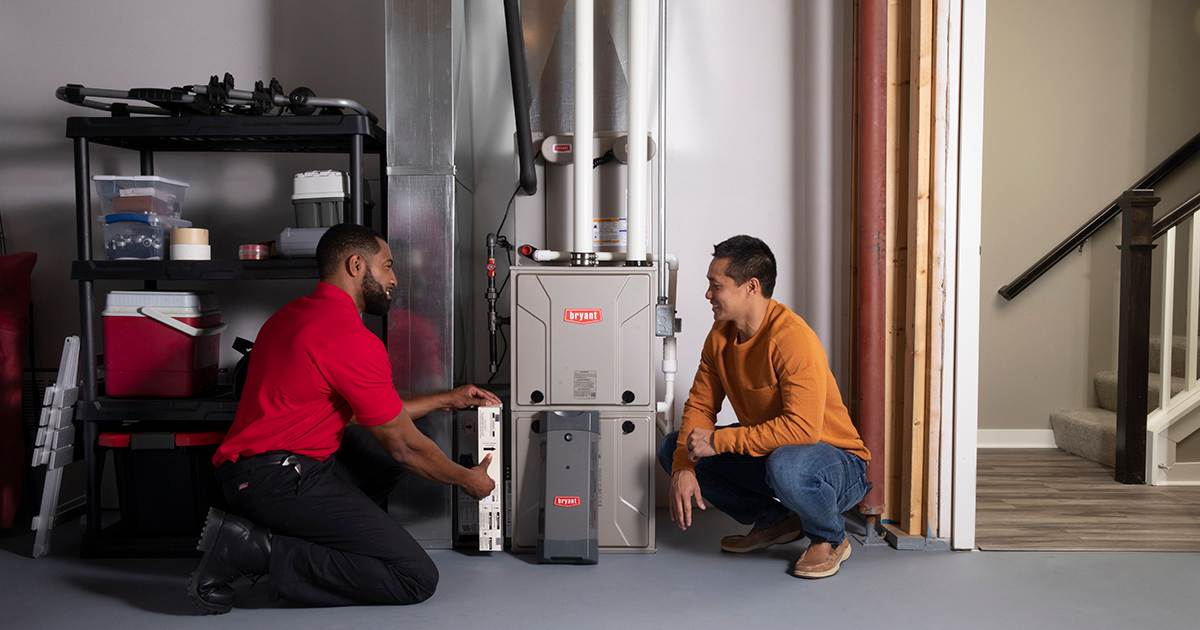
A local Bryant dealer can perform a Manual J load calculation to help determine the heating capacity your home requires. Bryant dealers can evaluate factors such as insulation, square footage, windows, climate, and air leakage when helping you select a furnace and determine an appropriate AFUE level. Because AFUE is only one part of furnace selection, a Bryant dealer can also help you compare model-level efficiency, heating stages, blower configurations, installation requirements, and available incentives. Schedule an appointment with a Bryant dealer today to get a quote for furnace cost and start your journey toward an appropriately sized, efficiently operating home heating system.
AFUE FAQs
An 80% AFUE furnace is considered standard efficiency and may be sufficient in milder climates, but it's less efficient than modern high-efficiency models.
Yes, a 96% AFUE furnace can potentially be worth the investment, especially in colder climates, as it has the ability to offer significant energy savings and may qualify for rebates or federal tax credits.
A 95% AFUE rating means 95% of the fuel is converted into heat for your home, with only 5% lost through exhaust, making it a high-efficiency system.
A good AFUE (Annual Fuel Utilization Efficiency) rating is typically 90% or higher, meaning the furnace converts at least 90% of fuel into usable heat with minimal waste.
You can typically find the AFUE rating printed on the yellow "EnergyGuide" label attached to the unit. If that label is missing, locate the model number on the furnace's nameplate and search for it online or consult a local HVAC dealer.
Annual furnace maintenance is recommended to keep your system running at its rated efficiency. Neglected systems can lose efficiency over time, leading to higher energy costs and more frequent furnace repair needs.
Yes. Lower-efficiency furnaces—particularly older units running below 80% AFUE—tend to work harder to maintain home temperatures, which increases component wear over time. Upgrading to a high-efficiency system can help reduce furnace repair frequency and extend the operational life of the unit.
No. AFUE measures only the efficiency of fuel-to-heat conversion and does not factor in the electricity consumed by the blower motor or other electrical components. Homeowners seeking a complete picture of operating costs should consider total system energy consumption when comparing models.
While AFUE is a fixed rating determined at the time of manufacture, regular maintenance—such as replacing air filters, sealing ductwork, and scheduling annual tune-ups—can help ensure your furnace operates as close to its rated AFUE as possible throughout its lifespan.
Learn More About Furnaces
- Understand the importance of furnace maintenance
- Learn how much is a new furnace
- Explore what is a furnace
- Explore types of furnaces
- Understand the ins and outs of a furnace tune-up
- Explore down flow furnaces


