About The Author: Travis Baugh is a Digital Brand Marketing Manager for Bryant, where he creates clear, helpful content to guide homeowners through heating, cooling, and indoor air quality decisions. His goal is to empower readers with the knowledge they need to choose the right comfort solutions for their home—confidently and comfortably.
Your Guide To High-Efficiency Furnaces
A high-efficiency furnace is a modern gas heating system that converts 90% or more of its fuel into usable heat. By using advanced technology—including secondary heat exchangers, condensing systems, and sealed combustion—these units reduce energy waste, lower heating bills, and minimize environmental impact compared to standard models.
Whether you're replacing an aging system or heating a newly built home without a chimney, a high-efficiency furnace delivers meaningful long-term value.
Why Upgrade to a High-Efficiency Gas Furnace?
Upgrading to a high-efficiency gas furnace delivers long-term home comfort, significant energy savings, and quieter operation. These advanced systems provide precise temperature control while consuming less fuel than conventional alternatives.
Key Benefits
- Energy Efficiency and Savings: A high-efficiency gas furnace converts almost all of its fuel into heat. With AFUE (Annual Fuel Utilization Efficiency) ratings often above 90%, these furnaces waste very little fuel. Bryant Evolution™ furnaces, for example, deliver up to 98.3% AFUE—translating to noticeable savings on heating bills compared to older, less efficient models.
- Lower Noise Levels: High-efficiency furnaces operate quietly. Their noise-reducing features—including variable-speed blowers and sealed combustion—ensure a peaceful home environment, free from the disruptive sounds common with traditional heating systems.
- Positive Environmental Impact: By consuming less fuel to produce the same amount of heat, a high-efficiency gas furnace produces fewer emissions. This reduces your home's carbon footprint and contributes to cleaner air.
Is it worth upgrading to a high-efficiency furnace? Andrew Mackey, owner of Superior Service in Lake St Louis, Missouri recommends homeowners to consider a high-efficiency furnace in many instances.
“A homeowner should consider a high efficiency furnace if they would like to have lower heating bills and plan on staying in their home at least five years to offset the higher installation cost,” Mackey said. “In some cases, it’s also required, since certain homes are designed without chimneys and need high-efficiency models for their multiple venting options.”
How Does a High-Efficiency Furnace Work?
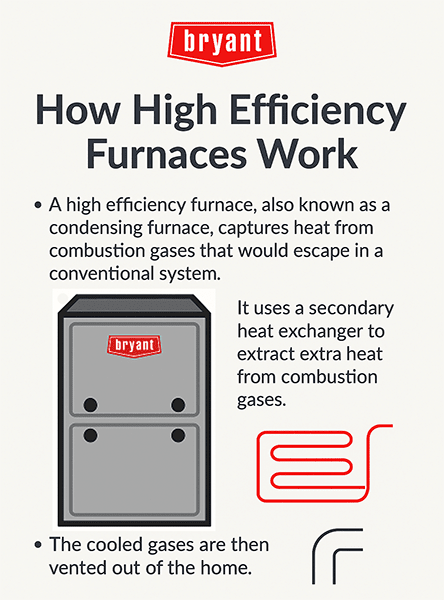
A high-efficiency furnace works by using a two-stage heat exchange process—called condensing—to extract heat from exhaust gases that a standard furnace would simply vent outside. This condensing process is what allows these systems to achieve AFUE ratings of 90% or higher.
While a standard furnace vents hot exhaust gases out of the home immediately, a high-efficiency model pushes those gases through a secondary stage to capture every possible degree of warmth before venting.
The Technology Behind the Comfort
- Secondary Heat Exchanger: Unlike standard furnaces, these models have a primary and a secondary heat exchanger. After the primary exchanger warms the air, the secondary one captures residual heat from exhaust gases before they are vented, ensuring minimal energy is wasted.
- Condensing System: These are condensing furnaces, meaning they cool exhaust gases enough to convert water vapor (a combustion byproduct) into liquid. The heat released during this condensation process is captured and used to warm your home.
- Variable-Speed Blowers: Many models include variable-speed blowers that adjust airflow based on your home's exact heating needs, ensuring more even heat distribution while reducing energy use.
- Modulating Burners: Advanced furnaces feature modulating burners that adjust the flame's intensity in real time. This allows the system to run at lower capacity during milder weather—rather than cycling on and off—saving energy and maintaining a consistent temperature.
- Sealed Combustion: A sealed combustion system draws air from outside the home for the combustion process. This improves both safety and efficiency by preventing conditioned indoor air from being consumed and lost.
How Do I Choose the Right High-Efficiency Furnace?
Choosing the right high-efficiency gas furnace means selecting the correct unit size, understanding AFUE ratings, and identifying smart features that match your lifestyle and home.
- Select the Correct Furnace Size: Furnace sizing is critical. An undersized unit will struggle to heat your home, while an oversized one will cycle on and off frequently, wasting energy and causing temperature swings. A certified Bryant dealer can perform precise calculations based on your home's square footage, insulation levels, and local climate.
- Understand Efficiency Ratings (AFUE): The AFUE rating measures how efficiently a furnace converts fuel into heat. A high-efficiency furnace carries an AFUE of 90% or higher. Choosing a model with a higher AFUE rating means lower fuel consumption and reduced heating bills over time.
- Consider Additional Features: Enhance your comfort with features like variable-speed blowers for quieter operation and smart thermostat compatibility. This allows you to control your heating system remotely for added convenience and energy management.
"A modulating furnace is the most efficient and comfortable unit that is made," Mackey said. "The unit runs and decides capacity levels based off of many variables in and outside of your home to determine the most efficient and comfortable way to warm the home."
Maintenance and Longevity
What is the life expectancy of a high efficiency furnace?
A high-efficiency furnace typically lasts 15 to 20 years with proper maintenance. Regular professional furnace service and DIY tasks such as cleaning and replacing filters can help extend how long a furnace lasts. Factors such as usage frequency, furnace installation quality, and local environmental conditions also influence lifespan.
Essential Maintenance Steps
- Replace Filters Regularly: A clogged or dirty filter restricts airflow, reducing efficiency and risking system damage. Check your furnace filter monthly and replace it as recommended.
- Schedule Annual Professional Furnace Maintenance: Have your local Bryant dealer perform a thorough furnace inspection and furnace cleaning once a year. A professional can identify and fix potential issues before they become serious problems, ensuring your furnace operates safely and efficiently.
- Optimize Your Home's Efficiency: Seal your home's ductwork, insulate your attic and walls, and pair your furnace with a smart thermostat to create energy-saving schedules and maximize heating performance
High-Efficiency Furnace vs. Standard Furnace: Which Is Right for Your Home?
Choosing between a high-efficiency furnace and a standard furnace depends on your climate, energy costs, budget, and how long you plan to stay in your home. While high-efficiency furnaces typically cost more upfront, they can provide lower operating costs and improved comfort over the life of the system.
A standard-efficiency furnace is often a good choice for homeowners who:
- Have a lower upfront budget and want a more affordable replacement option.
- Live in a moderate climate where the furnace does not run for long periods each winter.
- Plan to move within a few years and may not recoup the additional cost of a high-efficiency model.
- Are replacing an older furnace where upgrading venting or other components would significantly increase installation costs.
A high-efficiency furnace may be the better option if you:
Live in a colder climate where your furnace operates frequently throughout the heating season.
- Want to reduce long-term energy costs with a higher AFUE rating.
- Plan to stay in your home long enough to benefit from energy savings.
- Want improved comfort features, such as variable-speed blowers and two-stage heating.
- Are interested in reducing energy waste and potentially qualifying for available efficiency incentives.
When deciding between the two, consider more than just the furnace price. A high-efficiency model may deliver greater long-term value through lower fuel consumption, quieter operation, and more consistent temperatures, while a standard furnace may make sense when upfront cost and installation simplicity are the top priorities.
A qualified HVAC contractor can evaluate your home's heating needs, local climate, and existing setup to help determine whether the additional investment in a high-efficiency furnace is worth it for your situation.
Connect With Your Bryant Dealer For A High Efficiency Furnace
Bryant offers many types of high efficiency gas furnaces designed to deliver exceptional performance, energy savings, and comfort. Your local Bryant dealer can help you choose the right model for furnace replacement depending on your requirements and budget. Schedule an appointment today to learn more!
Compare Bryant High-Efficiency Furnaces
Bryant offers a range of high-efficiency gas furnaces built for reliable performance, lasting comfort, and meaningful energy savings. All Bryant furnaces are engineered for quiet operation, precise temperature control, and long-term durability—backed by industry-leading warranties.
High Efficiency Furnace FAQs
Yes, upgrading to a high-efficiency furnace can potentially be worth it for the long-term energy savings, reduced environmental impact, and potential rebates or tax credits.
A high-efficiency furnace has an AFUE rating of 90% or higher, using condensing technology to extract more heat from exhaust gases, while a regular furnace typically operates at less than 90% efficiency.
A high-efficiency furnace typically lasts 15 to 20 years, though proper maintenance is crucial to preserving performance and longevity due to its more complex components.
They can have higher upfront costs and more complex venting requirements but deliver long-term savings through reduced fuel use.
Sometimes. High-efficiency furnaces may qualify for federal or state energy-efficiency tax credits; check current IRS and ENERGY STAR® guidelines.
Yes, because they extract so much heat, the exhaust gas is cool and contains liquid condensate. This requires PVC piping vented out the side of the home, rather than a traditional metal chimney flue.
Most homes can accommodate a high-efficiency unit, but older homes may require retrofitting for the new PVC venting and condensate drainage systems.
Yes, a high-efficiency furnace can improve indoor air quality when paired with advanced filtration systems. Their continuous fan operation helps cycle air through filters more frequently, capturing more dust and allergens.
A variable-speed blower continuously adjusts airflow to match your home's exact heating needs. This prevents dramatic temperature swings and reduces energy consumption compared to single-speed motors.
Yes, most high-efficiency furnaces are quieter than standard models. They use sealed combustion and variable-speed blowers to operate with minimal noise, creating a more peaceful home environment.
A high-efficiency furnace typically costs $4,000 to $10,000 or more to install, depending on the furnace efficiency rating, size, brand, and installation requirements. Higher-efficiency models, such as condensing furnaces with additional venting or installation upgrades, may cost more upfront but can help reduce energy use and operating costs over time.
Learn More About Furnaces
- Learn how much is a new furnace
- Explore what is a furnace
- Understand natural gas furnaces
- Explore types of furnaces
- Understand gas vs electric furnaces
- Explore down flow furnaces


