About The Author: Travis Baugh is a Digital Brand Marketing Manager for Bryant, where he creates clear, helpful content to guide homeowners through heating, cooling, and indoor air quality decisions. His goal is to empower readers with the knowledge they need to choose the right comfort solutions for their home—confidently and comfortably.
What is a Wall AC Unit?
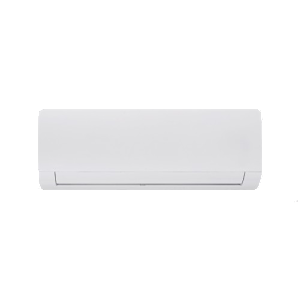
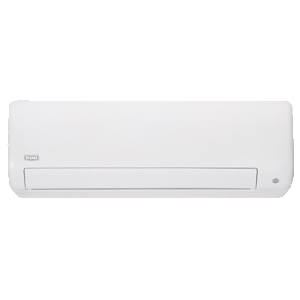
A wall AC unit (ductless mini-split) is a wall-mounted cooling system with an indoor air handler and outdoor unit. Bryant wall AC units—including the Legacy™ Line 45MHHAQ, Preferred™ 615AHA, and Evolution™ 615PHA—deliver ductless, zoned comfort without traditional ductwork. Depending on the outdoor-unit pairing, Bryant ductless systems can deliver cooling efficiency of up to 35.1 SEER2.
Bryant wall air conditioners are engineered to deliver tailored comfort and long-term value, whether cooling a compact bedroom or a spacious living area. Bryant high-wall indoor units are available in capacities from 0.5 to 3.0 tons, depending on the model, and some operate as quietly as 16 decibels. This guide covers how wall AC units work, their key benefits, how to choose the right one, installation, and maintenance.
How do wall AC units work?
Wall AC units work by capturing heat from inside a room and transferring it outside via dedicated refrigerant lines—completely bypassing the need for traditional ductwork. The indoor unit blows conditioned air directly into the living space, while the outdoor compressor and heat exchanger reject the extracted heat outdoors.
Because ductless mini splits do not require distribution through traditional ductwork, they can avoid energy losses associated with duct leakage and heat transfer. The U.S. Department of Energy reports that about 20%–30% of the air moving through a typical duct system can be lost because of leaks, holes, and poorly connected ducts.1
What are the benefits of a wall AC unit?
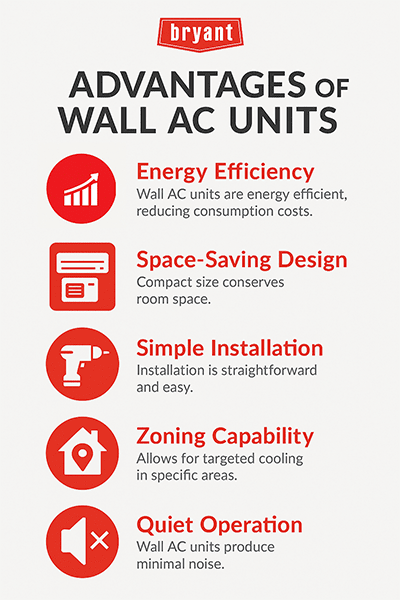
The primary benefits of a Bryant wall AC unit include ductless installation, space-saving design, zoning capability, quiet operation, and efficient performance. Wall-mounted systems are well suited for targeted room cooling, additions, and homes without existing ductwork, while traditional central air can be a practical option when a home already has properly designed ductwork.
Energy Efficiency
One of the most impactful benefits of a wall AC unit is its ability to reduce energy waste. Bryant ductless systems deliver conditioned air directly from the indoor unit rather than distributing it through a traditional duct network. This can help avoid duct-related energy losses, although actual energy savings vary by system, home, climate, and operation.
Bryant ductless system efficiency depends on the specific indoor and outdoor unit combination. For example, the Evolution™ 615PHA high-wall indoor unit can achieve up to 35.1 SEER2 when paired with the 37MPRA single-zone heat pump.
Learn more about mini split efficiency.
Space-Saving Design
Wall-mounted air conditioners are installed high on a wall, freeing up valuable floor space for your furniture and decor. This makes them an ideal, unobtrusive solution for smaller rooms or areas where every square foot counts.
Brian Redmond, owner of Redmond’s Complete Comfort in Lock Haven, Pennsylvania, explains the advantages of installing a high-wall mini split unit compared to other ductless options.
“The high wall is mounted high enough that it doesn’t take up any floor space,” Redmond said. “We can place it above a TV, couch, dresser, or a bed, giving homeowners much more flexibility. Overall, high-wall units offer more versatile installation options than floor consoles.”
Simpler Installation
Compared to central air conditioning, wall AC units have a simpler installation process for HVAC professionals. Since they don't require extensive ductwork, installation typically involves drilling a small hole through the wall to connect the indoor and outdoor units. The exact installation requirements depend on the system, wall construction, electrical requirements, line-set length, condensate drainage, and local codes. This makes them a practical option for cooling specific rooms or home additions. Learn more about mini split installation.
Zoning Capability
With a wall air conditioner, you gain powerful zoning capabilities. Each indoor unit can be controlled independently, allowing you to set different temperatures for different rooms. This is especially useful in multi-level homes or for families with varying comfort preferences, as it allows homeowners to condition occupied areas without necessarily conditioning every room. L. Learn more about multi zone mini splits.
Quiet Operation
Ductless mini-split systems are engineered for quiet operation. Bryant high-wall indoor units can operate at sound levels as low as 16 decibels, depending on the model and operating condition. The Legacy™ 45MHHAQ is rated as low as 18.5 decibels, while the Preferred™ 615AHA and Evolution™ 615PHA are rated as low as 16 decibels.
How Do I Choose the Right Wall AC Unit?
To choose the right wall AC unit, evaluate the room's precise square footage, prioritize high SEER2, EER2, and HSPF2 energy efficiency ratings, and factor in local climate. For ductless systems, compare the efficiency ratings of the complete indoor/outdoor combination rather than the indoor wall unit by itself.
Bryant Wall AC Sizing Guide
| Sizing factor | What to evaluate | ||
| Room size | Measure the conditioned space, including ceiling height, rather than relying on square footage alone. | ||
| Ceiling height |
|
||
| Insulation and air sealing | Well-insulated, tightly sealed rooms generally have different cooling loads than poorly insulated spaces. | ||
| Windows and sunlight | Window size, orientation, glazing, and direct solar exposure can materially affect cooling demand. | ||
| Climate | Outdoor temperature and humidity affect the amount of cooling and dehumidification required. | ||
| Room use |
|
||
| Professional load calculation |
|
Bryant's sizing approach should use the room's actual cooling load rather than a simple "BTUs per square foot" formula. ENERGY STAR recommends that contractors use Manual J to determine the amount of heating and cooling a home requires.
Ultimately, Redmond advises homeowners to rely on an HVAC professional for accurate sizing.
“A professional understands U-factors, R-values, and wall types, and uses approved sizing software to ensure the system is matched correctly to the home,” he explained.
Learn more about what size mini split do I need?
Energy Efficiency
Look for a wall air conditioner with exceptional efficiency ratings to ensure the investment pays off over time:
- SEER2 (Seasonal Energy Efficiency Ratio 2): This rating measures cooling efficiency. A higher SEER2 rating means the unit uses less electricity to cool a space, leading to lower operating costs.
- EER2 (Energy Efficiency Ratio 2): This rating measures cooling efficiency at a specific outdoor temperature and operating condition. A higher EER2 rating indicates better performance during peak cooling demand and hot-weather operation.
- HSPF2 (Heating Seasonal Performance Factor 2): This applies to mini split heat pumps that also provide heating. A higher HSPF2 rating indicates greater heating efficiency.
For Bryant's 615AHA, 615PHA, and 45MHHAQ high-wall indoor units, the published SEER2, EER2, and HSPF2 values depend on the compatible outdoor-unit pairing. For example, Bryant lists up to 35.1 SEER2 for the 615PHA when paired with the 37MPRA single-zone heat pump.
Local Climate
Local climate plays a critical role in system selection. In areas with high humidity, look for a Bryant ductless system with appropriate humidity-management capabilities. The Evolution™ 615PHA, for example, includes a relative humidity sensor and humidity-control features.
Noise Level
Always check the unit's decibel (dB) rating before purchasing. For primary bedrooms or home offices, a model engineered for quiet operation ensures the unit never becomes a distraction. Bryant high-wall models offer published indoor sound levels as low as 16–18.5 decibels, depending on the model and operating condition.
Additional Features
Modern wall-mounted AC units often include advanced features for added convenience and savings:
- Smart thermostat compatibility
- Wi-Fi connectivity for remote control via an app
- Multi-speed fans
- Humidity-control features on select Bryant models
- Occupancy sensing on select Bryant models
For example, Bryant's Evolution™ 615PHA includes built-in Wi-Fi, a relative humidity sensor, humidity control, and an occupancy sensor.
How is a Wall Mounted Air Conditioner Installed?
A professional HVAC installation for a wall-mounted AC involves three core steps. Professional installation is important because ductless systems require correct equipment sizing, refrigerant-line installation, electrical connections, condensate management, and system commissioning.
- Site Selection: An HVAC technician helps select a wall location that ensures optimal airflow and accessibility.
- Mounting: A mounting plate is secured to the wall to hold the indoor unit.
- Connections: A small hole is drilled for the refrigerant lines, drain tube, and control wiring to connect to the outdoor unit.
A trained HVAC professional should handle refrigerant and electrical work rather than attempting a DIY installation. Bryant recommends professional installation and proper sizing for ductless systems.
How Do I Maintain a Wall Mounted Air Conditioner?
Maintaining a wall-mounted air conditioner requires cleaning the reusable indoor air filter regularly, clearing outdoor unit debris, and scheduling professional HVAC maintenance. Bryant recommends consistent filter cleaning and professional maintenance to help maintain performance and reliability. With proper maintenance, a Bryant ductless mini split can last 15 to 20 years. Learn more about how long a mini split lasts.
- Clean the Filter: Clean the mini split air filters monthly to remove dust and debris that can restrict airflow and reduce efficiency.
- Inspect Outdoor Unit: Keep the outdoor compressor and surrounding area clear of leaves, dirt, and debris to maintain unobstructed airflow.
- Schedule Professional Maintenance: Arrange for an annual mini split maintenance at least annually, or according to the manufacturer's recommendations. A professional can clean coils, inspect components, verify system operation, and address potential issues before they become costly repairs.

Who Should Not Buy A Wall AC Unit?
A wall-mounted ductless mini-split may not be the most practical choice for homeowners who already have well-designed ductwork and want to cool an entire home through a centralized distribution system. While mini-splits excel at zoned comfort, a ducted central system can make sense when existing ductwork is in good condition and is appropriately sized for whole-home cooling.
Wall-mounted ductless systems are particularly useful for homes without ductwork, room additions, garages, outbuildings, or individual spaces where extending ductwork would be difficult. ENERGY STAR identifies older homes without existing ductwork and additions or outbuildings as common applications for ductless systems.
How Long Does a Bryant Wall AC Unit Last?
A properly installed and maintained Bryant ductless mini split can last 15 to 20 years. Routine filter cleaning, professional maintenance, correct sizing, and quality installation can all contribute to long-term system performance.
Connect With A Bryant Dealer On Wall AC Unit Options
Considering different cooling options for your home? Bryant ductless mini splits, or wall AC units, combine a space-saving design, quiet indoor operation, zoning capability, and flexible ductless installation. Depending on the complete system pairing, Bryant ductless systems offer cooling efficiency of up to 35.1 SEER2. Contact your local Bryant dealer to determine the best mini split for your home's cooling load, layout, and climate—and to select a properly matched indoor and outdoor unit combination.
Compare Bryant Wall Air AC Units
Choose a Bryant wall AC unit for efficient, customizable comfort without the need for ductwork. Ideal for specific rooms or multi-zone cooling and heating, these systems offer precise temperature control and quiet operation. With energy-efficient technology, they help reduce utility costs while providing year-round comfort. The sleek design makes Bryant mini splits a perfect choice for homes, additions, or spaces where traditional ductwork is impractical, delivering reliable performance and convenience.
FAQs on Wall Mounted Air Conditioners
Yes, wall-mounted air conditioners—especially ductless mini splits—are highly efficient, provide zoned cooling, and are ideal for homes without existing ductwork.
Ductless wall-mounted units do not require external venting like portable units, but they do need a small hole for refrigerant and electrical lines connecting to the outdoor compressor.
Wall-mounted AC units generally last 12 to 20 years, with proper maintenance and professional installation extending their lifespan.
Wall-mounted ductless units are efficient, quiet, and ideal for spaces without ductwork. They can be a cost-effective choice for room-by-room comfort.
Replacing a wall-mounted ductless mini split typically costs $3,000 to $7,000, depending on capacity, efficiency, and installation requirements.
They’re commonly called ductless mini-split or wall-mounted air conditioners, featuring an indoor air-handling unit paired with an outdoor compressor.
Wall-mounted or ductless AC systems usually cost less to install than central air because they don’t require ductwork. However, central air can be more cost-effective for cooling multiple rooms in larger homes.
No, they are generally very cost-effective. Because they allow for zoning (cooling only occupied rooms) and have no duct loss, they often cost less to operate than central air systems.
Yes, many wall AC units are actually "mini-split heat pumps", meaning they can reverse their operation to provide efficient heating in the winter as well as cooling in the summer.
Yes, many modern wall AC units integrate seamlessly with popular smart home platforms. This allows you to control your climate, set schedules, and monitor energy usage remotely via smartphone apps.
Yes, adding a modern wall AC unit can increase your home's value by providing energy-efficient, zoned climate control. It is an attractive, premium upgrade for potential buyers, especially in homes lacking existing ductwork.
Choose a wall AC based on your room's square footage, insulation, ceiling height, sun exposure, and climate. Most rooms require about 20 BTUs per square foot, but a Manual J load calculation provides the most accurate sizing.
Learn More About Air Conditioners
- Learn all about what is a mini split
- Understand what is a ducted mini split
- Read our guide to mini split cost
- Find out are mini splits worth it?
- Learn all about mini split vs central air
- Discover small mini splits


