About The Author: Travis Baugh is a Digital Brand Marketing Manager for Bryant, where he creates clear, helpful content to guide homeowners through heating, cooling, and indoor air quality decisions. His goal is to empower readers with the knowledge they need to choose the right comfort solutions for their home—confidently and comfortably.
What Size Mini Split Do I Need?
Determining the correct mini split size typically involves calculating 20 to 25 BTU per square foot of living space. For example, a 500-square-foot room generally requires a unit with a capacity between 9,000 and 12,000 BTUs. For example, a standard 500-square-foot room typically requires a unit with a cooling capacity between 9,000 and 12,000 BTUs. However, finding the perfect fit for your home involves more than just math—it requires considering your climate, insulation, and room layout to ensure maximum energy efficiency and long-term comfort.
Mini Split Sizing Chart by Square Footage
While a professional load calculation from a local Bryant dealer is the only way to guarantee 100% accuracy, you can use these general square footage guidelines to estimate the capacity required for your space.
| Room Size (Sq. Ft.) | Estimated Capacity (BTUs) |
| 150 - 250 | 6,000 BTUs |
| 250 - 350 | 9,000 BTUs |
| 350 - 550 | 12,000 BTUs |
| 550 - 700 | 18,000 BTUs |
| 700 - 1,000 | 24,000 BTUs |
Note: These figures are estimates. Factors like high ceilings, poor insulation, or large windows may require increased capacity.
Brian Redmond, owner of Redmond’s Complete Comfort in Lock Haven, Pennsylvania, advises homeowners to rely on an HVAC professional for accurate sizing.
“A professional understands U-factors, R-values, and wall types, and uses approved sizing software to ensure the system is matched correctly to the home,” he explained.
Why Is Mini Split Sizing So Important?
Selecting the correct size ductless mini split system is an investment in your home's future. Sizing follows a "Goldilocks" principle—it must be just right to deliver the efficiency and performance you expect.
The Risks of Oversizing
If the unit is too large, it will cool the room too quickly and shut off, a process known as "short-cycling." This prevents the unit from running long enough to properly dehumidify the air, leaving your home feeling clammy. It also wastes energy and increases wear on the compressor during frequent startups.
The Risks of Undersizing
If the unit is too small, it will run continuously, struggling to ever reach your desired temperature. This leads to skyrocketing energy bills and a system that wears out prematurely without ever making you truly comfortable.
Redmond emphasizes the importance of choosing a properly sized mini split system.
“Your operating costs will be much higher if you install a unit that’s too large, since the bigger compressor will run unnecessarily,” Redmond said. “Oversizing also prevents proper dehumidification, because the system cools the space so quickly that it shuts off before removing enough moisture from the air.”
5 Factors That Influence Your BTU Requirements
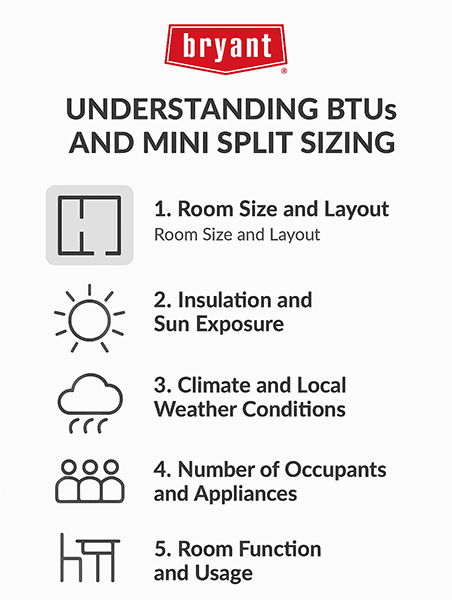
Your local dealer uses precise load calculations to tailor a solution to your specific needs. Beyond simple floor area, five key variables heavily influence the final decision:
- Room Layout and Volume: Open floor plans and vaulted ceilings increase the volume of air that needs conditioning, often requiring more powerful units than standard rooms.
- Insulation Quality: A well-insulated home retains thermal energy efficiently. Poor insulation, old windows, or drafty floors will require a system with higher BTUs to compensate for energy loss.
- Sun Exposure: Rooms with large, south-facing windows absorb significant heat. Your installer may recommend increasing capacity to counteract this "heat gain."
- Climate Conditions: Your geography matters. In regions with extreme winters, you may need a high-performance mini split heat pump with a high HSPF2 rating to maintain warmth when temperatures drop.
- Occupancy and Usage: People and appliances generate heat. A busy kitchen or a media room packed with electronics will have a higher "heat load" than a guest bedroom.
Choosing The Best Mini Split For Your Home
Once you know the size, choosing the right model ensures you get the advanced technology and reliability you expect.
- Prioritize Energy Efficiency: Look for units with high SEER2 ratings and ENERGY STAR® certification. These systems are designed to reduce energy consumption and lower utility bills.
- Smart Integration: Modern comfort means total control. Opt for systems that integrate with smart home technology, allowing you to adjust climates remotely for maximum convenience.
- Quiet Operation: Advanced mini splits are whisper-quiet. Check the decibel (dB) ratings to ensure your system provides comfort without disrupting your peace.
- Multi-Zone Capability: If you are treating a whole home, a multi zone mini split allows you to connect multiple indoor heads to one outdoor unit, giving you customized temperature control in every room.
Learn more about how to find the best mini split for your home.

Talk To A Bryant Dealer About What Size Mini Split You Need
Proper sizing is the first step toward a seamless installation and years of reliable performance. Schedule an appointment with your local Bryant dealerr to get an accurate assessment and a quote for mini split installation .
Mini Split Size FAQs
A 12,000 BTU mini-split can typically cool about 450 to 550 square feet, depending on insulation, ceiling height, and climate.
To accurately determine what size mini split you need, work with your local Bryant dealer as a professional load calculation is most accurate. For a rough estimate, multiply the area’s square footage by 20 to 25 BTUs per square feet, and adjust for sun exposure, insulation quality, and ceiling heigh.
Neither is ideal—undersized units struggle to maintain comfort, while oversized units short-cycle, reducing efficiency and comfort; correct sizing ensures optimal performance and longevity.
A 24,000 BTU mini-split can generally heat 900 to 1,200 square feet, depending on climate conditions and how well the space is insulated.
Bryant mini splits are available from about 9,000 BTUs for single rooms to 60,000 BTUs for larger spaces or multi-zone systems.
Yes. Standard sizing charts assume 8-foot ceilings. If you have vaulted or cathedral ceilings, you have a larger volume of air to condition, meaning you will likely need to increase your BTU capacity beyond the standard square footage recommendation.
Learn More About Ductless Mini Splits
- Learn all about what is a mini split
- Understand what is a ducted mini split
- Discover the factors in choosing the best mini split
- Find out are mini splits worth it?
- Learn all about mini split vs central air
- Discover small mini splits


