About The Author: Travis Baugh is a Digital Brand Marketing Manager for Bryant, where he creates clear, helpful content to guide homeowners through heating, cooling, and indoor air quality decisions. His goal is to empower readers with the knowledge they need to choose the right comfort solutions for their home—confidently and comfortably.
What Size Heat Pump Do I Need? Heat Pump Sizing Guide
If your home isn't comfortable regardless of your thermostat settings, it’s easy to assume the solution is “just get a bigger system.” But when it comes to heat pumps, bigger isn’t always better. The right size depends on how much heating (and cooling) your home actually needs, measured in BTUs (British Thermal Units), along with your local climate zone.
As a general starting point, common residential heat pump sizes range from 40,000 to 120,000+ BTUs, with a 2,000 sq. ft. home typically needing a 60,000–100,000 BTU unit, depending on insulation quality and climate.
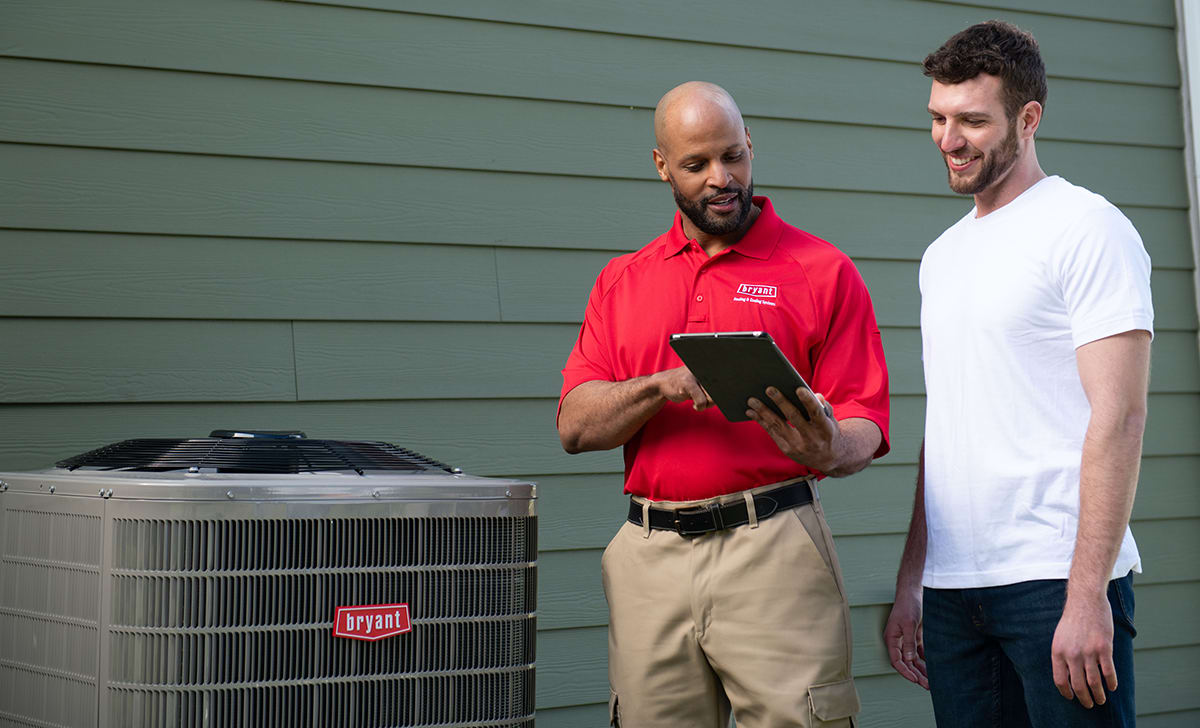
The Quick BTU Calculation: How Many BTUs Per Square Foot?
A fast way to estimate heat pump size is to multiply your home’s square footage by 30 to 60 BTUs per square foot. Lower numbers apply to warmer climates or well-insulated homes, while higher numbers are used in colder regions or homes with more heat loss.
For example:
- Mild climates: ~30–35 BTUs/sq. ft.
- Moderate climates: ~40–50 BTUs/sq. ft.
- Cold climates: ~50–60+ BTUs/sq. ft.
Climate matters because a home in the Midwest will lose heat much faster in winter than a home in the South. That’s why BTU sizing isn’t one-size-fits-all. This quick calculation is a helpful starting point, but a professional load calculation by your local Bryant dealer is the best way to determine the right size.
One Heat Pump Size Does Not Fit All
Choosing the wrong size heat pump can lead to performance issues, higher energy bills, and discomfort.
Joseph Braswell, owner of Guin Service Company in Birmingham, AL says it’s pivotal for homeowners to get the right size heat pump for their home
“It's a rampant problem in our industry to oversize heat pumps and air conditioners,” Boswell said. “Many contractors size HVAC systems for worst-case scenarios, such as trying to keep a home at 65 degrees when it’s 100 degrees outside. The problem with oversizing is that it can lead to humidity control issues and short cycling.”
Issues With Oversizing A Heat Pump
Oversized units that are too big for your home can cause several problems, including
- Short-cycling (turns on and off too frequently)
- Uneven temperatures throughout the home
- Increased wear and tear on components
- Reduced efficiency and higher long-term heat pump repair costs
Issues With Undersizing A Heat Pump
Purchasing a heat pump that is undersized, or too small for your home, presents its own set of problems, including
- Struggles to maintain desired temperature
- Runs constantly without reaching comfort levels
- Higher energy usage from nonstop operation
- Poor performance during extreme cold or heat
Factors Affecting Heat Pump Size
Home Insulation & Windows
A well-sealed home requires fewer BTUs to stay comfortable. Modern insulation, airtight construction, and efficient windows help trap conditioned air inside. On the other hand, drafty windows, poor insulation, and air leaks increase heat loss, meaning your system must work harder and be sized larger to compensate.
Ceiling Height
Square footage alone doesn’t tell the full story. Homes with vaulted or high ceilings have more air volume to condition, which increases heating and cooling demand compared to a standard 8-foot ceiling home of the same floor area.
Efficiency Rating (HSPF2)
Heat pump efficiency, measured by HSPF2, affects how much usable heat you get from each BTU of input energy. A higher-efficiency system can deliver more heating output for the same energy input, potentially allowing for a smaller system size compared to older, less efficient models.
Common Heat Pump Sizes
Heat pump size is commonly measured in tonnage, which refers to how much heat the system can move, not its physical weight. One ton equals 12,000 BTUs of heating or cooling capacity per hour, so a 2-ton heat pump provides about 24,000 BTUs, a 3-ton heat pump provides 36,000 BTUs, a 4-ton heat pump delivers 48,000 BTUs, and a 5-ton heat pump reaches the typical residential maximum of 60,000 BTUs.
In residential applications, 2–3 ton systems are usually used for smaller homes or well-insulated spaces, 3–4 ton units are common for average single-family homes, and 5-ton systems are reserved for larger homes or those with higher heating and cooling demands due to climate or construction.
Why You Need a Professional Manual J Load Calculation
While BTU-per-square-foot estimates are helpful, they don’t account for the full range of factors that affect heating and cooling needs, including:
- Orientation of your home and sun exposure
- Window quality and placement
- Air leakage rates
- Occupancy and lifestyle patterns
- Local humidity and extreme temperature swings
That’s why HVAC professionals use a Manual J load calculation, the industry standard for determining precise heating and cooling requirements. Rather than guessing based on square footage alone, a Manual J load calculation ensures your system is properly matched to your home’s actual energy load. Many Bryant dealers rely on this method to size systems accurately and avoid the comfort and efficiency problems caused by incorrect installation.
Ready to Find the Right Match?
Choosing the right heat pump size helps provide efficiency, system lifespan, and long-term energy savings. The best next step is working with your local Bryant dealer who can evaluate your home and recommend the best heat pump for your home and provide professional heat pump installation.
Heat Pump Size FAQs
Most residential heat pumps range from 18,000 to 60,000 BTUs (1.5–5 tons). The average size of a heat pump is 3 or 3.5 tons.
A typical 2,000 sq ft home needs about 36,000–48,000 BTUs (3-4 tons), depending on insulation level and local climate.
A 30,000 BTU heat pump generally covers about 600 to 1,000 sq ft, depending on insulation and climate conditions.
A 4-bedroom home typically needs around 42,000 to 60,000 BTUs (3.5–5 tons), but actual sizing depends more on square footage, insulation, and climate than bedroom count.
Neither is ideal. Oversizing leads to short-cycling and inefficiency, while undersizing causes constant running and poor comfort, so correct sizing is best.


