About The Author: Travis Baugh is a Digital Brand Marketing Manager for Bryant, where he creates clear, helpful content to guide homeowners through heating, cooling, and indoor air quality decisions. His goal is to empower readers with the knowledge they need to choose the right comfort solutions for their home—confidently and comfortably.
How to Choose the Best Dehumidifier for Your Home
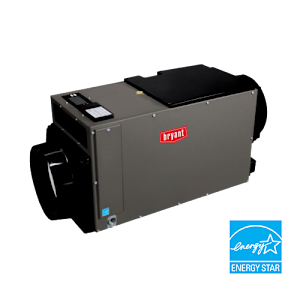
Choosing the best whole-home dehumidifier requires matching the unit's capacity (pints per day) to your home's size and moisture levels. Bryant's Performance™ Series DEHXX whole-home dehumidifiers offer two capacity options—up to 80 or 100 pints of moisture removal per day—to help match different whole-home humidity-control needs. You must also decide between a whole-home system integrated with your HVAC or a standalone unit for specific areas like basements. Key factors include capacity, humidity control, energy efficiency, installation type, drainage options, filtration, and noise levels.
How do I choose the right dehumidifier size and features?
To choose the best whole-home dehumidifier, evaluate the size of the space you need to treat and the severity of the dampness. A larger, damper space generally requires a higher-capacity unit. Bryant's two DEHXX capacity options provide up to 80 or 100 pints of moisture removal per day, so a Bryant dealer can evaluate your home's square footage, moisture conditions, and HVAC system to determine which capacity is appropriate. Additionally, prioritize features like automatic drainage and ENERGY STAR® certification to help with long-term efficiency and ease of use.
Bryant's 3-Step Dehumidifier Sizing Method
When selecting a whole-home dehumidifier, use these three steps as a starting point:
- Assess home size and moisture: Consider the square footage being served, the number of rooms, and whether you have persistent moisture problems such as a damp basement, crawl space, or attic. Do not size a whole-home dehumidifier by square footage alone; a dealer should account for the home's moisture load and HVAC configuration.
- Match moisture demand to capacity: Bryant's DEHXX is available in 80-pint and 100-pint-per-day capacities. The 80-pint DEHXXCDA080 is listed for small- to mid-size homes and spaces such as condos, townhomes, crawlspaces, basements, and attics, while the 100-pint DEHXXCDA110 is listed for mid-size to large homes and similar moisture-prone spaces.
- Choose the features that fit your installation: Consider HVAC integration, automatic drainage, filtration, controls, zoning, and sound levels based on where the unit will be installed and how you want to manage humidity.
Key Factors For Selection
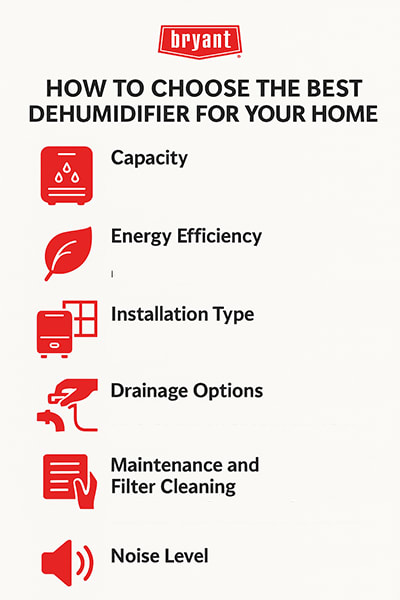
When selecting a whole-home dehumidifier, consider these six essential factors to ensure optimal performance and comfort:
- Capacity: The dehumidifier's capacity is measured in pints of water removed per day. You should match this to the size of the area you need to dehumidify and its moisture load. Bryant offers the DEHXX in 80- and 100-pint-per-day capacities, with the 80-pint model listed for small- to mid-size homes and the 100-pint model listed for mid-size to large homes.
- Energy Efficiency: An energy-efficient model can reduce electricity consumption compared with less-efficient equipment. Bryant's DEHXX models were recognized as ENERGY STAR® Most Efficient 2024 products, and ENERGY STAR identifies its Most Efficient designation as a higher-efficiency tier within its certified products.
- Installation Type: Whole-home dehumidifiers can be installed directly into your HVAC system for seamless, whole-house operation or used as standalone units. Bryant's DEHXX can be installed as part of an HVAC system or as a standalone unit and is compatible with any furnace or fan coil.
- Drainage Options: Consider the convenience of drainage. Some models feature a built-in pump or use gravity drainage for automatic water removal. Others require you to empty a water tank manually. For a whole-home system that can remove up to 80 or 100 pints of moisture per day, automatic drainage can reduce the need for frequent manual emptying.
- Maintenance and Filter Cleaning: Look for models with washable, reusable filters and easy-to-clean components. Bryant's DEHXX includes a washable MERV 8 filter, providing a specific filtration feature to consider when comparing whole-home dehumidifiers.
- Noise Level: Dehumidifiers produce noise during operation. If your unit will be located near living spaces, look for models specifically designed for quiet performance. Bryant lists the DEHXXCDA080 at 45 dBA when ducted and 49 dBA when unducted, while the DEHXXCDA110 is listed at 55 dBA when ducted and 58 dBA when unducted.
What Are the Benefits of Using a Dehumidifier?
A whole-home dehumidifier helps manage indoor humidity, with 30% to 50% relative humidity commonly used as a general target range for indoor comfort. It can help reduce conditions that contribute to mold growth and musty odors and can help control moisture-related allergens such as dust mites.
- Helps Manage Mold and Mildew: High humidity can create conditions that support mold and mildew growth. A dehumidifier removes excess moisture, making the environment less favorable for their growth.
- Reduces Musty Odors: Musty smells are often associated with excess moisture. By lowering humidity, a dehumidifier can help reduce these unpleasant odors.
- Supports Indoor Air Quality: Excess humidity can contribute to conditions that support dust mites and mold. Maintaining appropriate humidity can help manage these moisture-related indoor air quality concerns.
Learn more about dehumidifier benefits.
Where is the Best Place to Install a Dehumidifier?
The best location depends on the type of unit. Whole-home units are best installed in the utility room connected to the HVAC system. Standalone units should be placed in the area with the highest moisture, typically the basement, crawl space, or attic.
HVAC Integration
For whole-home humidity control, installing a dehumidifier directly into your HVAC system provides a centralized approach to managing moisture throughout the house. Bryant's DEHXX can be installed as part of an HVAC system and is compatible with any furnace or fan coil.
Standalone
If you install a whole-home dehumidifier as a standalone unit, consider placing it in one of these common problem areas:
- Basement: Often the most humid part of a house, a basement is a prime location. A dehumidifier here can prevent mold, musty odors, and potential structural damage from excess moisture. Learn more about basement dehumidifiers.
- Crawl Spaces: Installing a unit in a crawl space is highly effective at reducing moisture and preventing issues like wood rot and mildew.
- Utility Room: Placing the dehumidifier in a utility or mechanical room allows for easy access for maintenance, especially if it integrates with your HVAC system.
- Attic: In warmer climates, attics can suffer from high humidity. A dehumidifier can prevent condensation that leads to mold growth and insulation damage.
Why Choose a Bryant Dehumidifier?
Bryant Performance™ Series whole-home dehumidifiers represent over a century of innovation and quality in home comfort. Designed for versatile installation and reliable performance, they offer an exceptional solution for achieving healthier indoor air.
- ENERGY STAR® Recognition: The Bryant DEHXX dehumidifier was recognized as "Most Efficient of ENERGY STAR® 2024," signifying it represents the top tier of energy-efficient products.
- Various Sizes: Our units are available in two sizes, removing up to 80 or 100 pints of moisture per day.
- MERV 8 Filter: Each unit includes a MERV 8 filter that helps capture airborne particles such as dust, pollen, and mold spores.
- Easy-To-Use Control: An intuitive LCD control on the unit and compatibility with wall-mounted controls make it easy to set your preferred humidity level.
- Zoning Capable: Bryant DEHXX dehumidifiers are zoning capable, allowing humidity control to be incorporated into different areas of the home.
- 5-Year Warranty: Our dehumidifiers come with a 5-year parts limited warranty, providing peace of mind and protecting your investment in long-term comfort.
| Model | Capacity | Filter | Recommended Area | Efficiency | Refrigerant | Sound Level | Dimensions |
| DEHXXCDA080 | 80 pints per day | MERV 8 washable filter | Small to mid-size homes, condos, townhomes, crawlspaces, basements and attics | ENERGY STAR® Most Efficient 2024 | Low GWP refrigerant | 45 dBA (ducted) 49 dBA (unducted) | 14" w × 15" h × 26" l |
| DEHXXCDA110 | 100 pints per day | MERV 8 washable filter | Mid-size to large homes, crawlspaces, basements and attics | ENERGY STAR® Most Efficient 2024 | Low GWP refrigerant | 55 dBA (ducted) 58 dBA (unducted) | 14" w × 15" h × 26" l |
Find the Best Dehumidifier with a Bryant Dealer
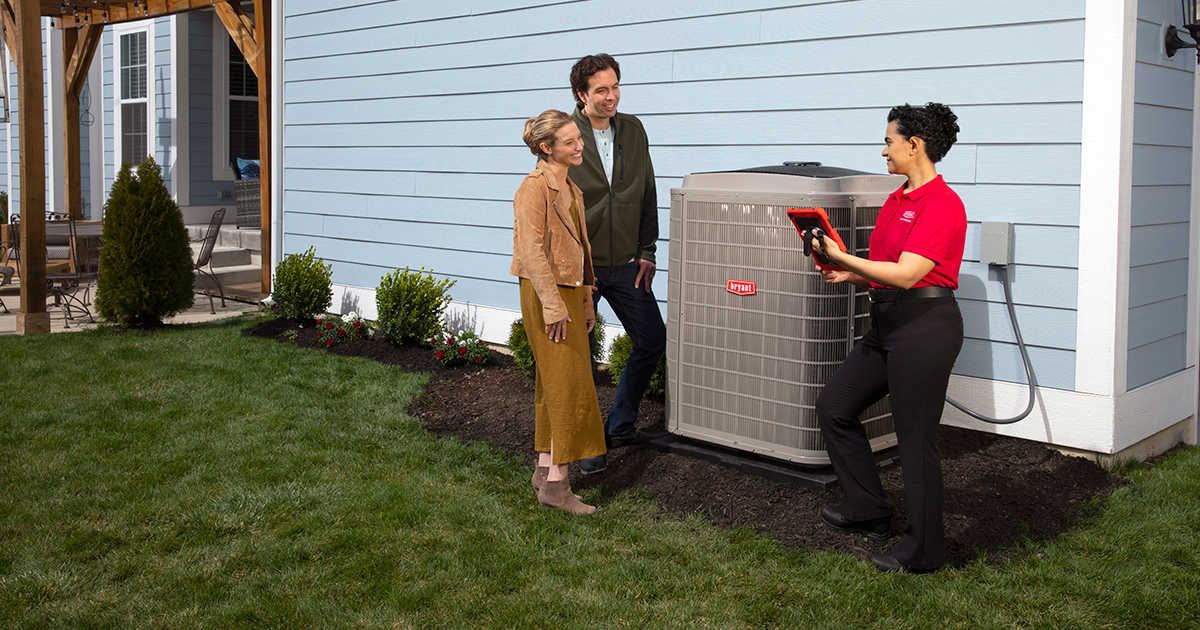
Connect with a local Bryant dealer to find the best dehumidifier for your home. A Bryant dealer can evaluate your home's size, moisture conditions, and HVAC system and help determine whether the 80- or 100-pint DEHXX capacity is appropriate. Schedule an appointment today to create a healthier, more comfortable indoor environment.
Explore Bryant Dehumidifiers
Choose a Bryant dehumidifier to effectively control excess moisture in your home, improving comfort and air quality. It helps prevent mold, mildew, and musty odors while reducing allergens, making it ideal for areas with high humidity. With energy-efficient operation and quiet performance, a Bryant dehumidifier works seamlessly with your HVAC system to maintain optimal humidity levels. Durable and reliable, it ensures a healthier and more comfortable living environment, providing year-round moisture control for your home.
Learn More
- Discover the benefits of a basement dehumidifier
- Learn the ins and outs of humidity control
- Understand when to use a dehumidifier
- Explore Bryant dehumidifiers


