About The Author: Travis Baugh is a Digital Brand Marketing Manager for Bryant, where he creates clear, helpful content to guide homeowners through heating, cooling, and indoor air quality decisions. His goal is to empower readers with the knowledge they need to choose the right comfort solutions for their home—confidently and comfortably.
What Is an ERV System? (Energy Recovery Ventilator)
An Energy Recovery Ventilator (ERV) is an advanced whole-home ventilation system that exchanges stale indoor air with fresh outdoor air while transferring heat and moisture between the two airstreams. A Bryant ERV system uses an enthalpic recovery core to pre-condition incoming outdoor air while helping reduce energy loss associated with ventilation.
Unlike simply opening a window, which lets conditioned air escape, an ERV provides controlled ventilation while recovering energy from the outgoing air. It represents a ventilation solution for modern, airtight homes that need continuous fresh air without the same direct energy loss associated with opening windows.
How Does an ERV System Work?
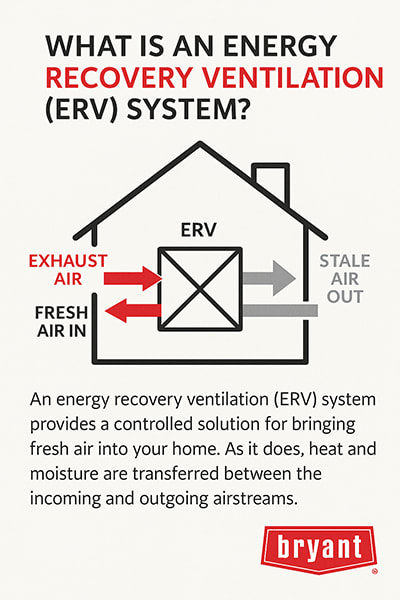
A Bryant ERV system works by passing outgoing stale air and incoming fresh air through an enthalpic heat-exchanger core. The core transfers thermal energy and moisture between the two airstreams while the crossflow design keeps the outgoing and incoming air from mixing. This pre-conditions the incoming air, significantly reducing the workload on your primary HVAC system.
- In Winter: Bryant ERV systems transfer heat and moisture from outgoing indoor air to incoming outdoor air, helping pre-condition cold outdoor air.
- In Summer: Bryant ERV systems transfer heat and moisture from incoming outdoor air to the outgoing airstream, helping reduce the heat and humidity brought into the home.
Samantha Houchin, co-owner of The Weather Changers in Denver, Colorado, highlighted the growing importance of whole-home ventilators as modern homes become more energy efficient.
“Houses are being built so tightly these days, with triple-pane windows and advanced insulation,” Houchin said. “That efficiency keeps conditioned air in—but it also traps stale air inside without a way to escape. A whole-home ventilator helps by exhausting stale indoor air and bringing in fresh outdoor air.
“This not only improves overall comfort but also helps your HVAC system operate more efficiently. It can heat and cool your home more effectively because the air inside is being constantly refreshed.”
Bryant's 3-Stage Energy Recovery Process
Bryant ERV systems use three basic stages to condition ventilation air:
- Exchange: The Bryant ERV exhausts stale indoor air while bringing fresh outdoor air into the home.
- Recover: The ERV core transfers heat and moisture between the outgoing and incoming airstreams without mixing the air.
- Pre-condition: The recovered energy helps pre-condition incoming outdoor air before it enters the home's conditioned space.
Why Choose a Bryant ERV System?
Bryant ERV systems provide continuous fresh-air ventilation while transferring heat and moisture between incoming and outgoing air. Depending on the model, Bryant ERV systems provide up to 81% sensible recovery energy (SRE) and airflow up to 210 CFM.
Because modern homes can be tightly constructed, controlled mechanical ventilation can help provide outdoor-air exchange while limiting the heating or cooling energy lost through uncontrolled ventilation.
Key Benefits of Bryant ERVs
- Improved Indoor Air Quality: Bryant ERV systems bring in fresh outdoor air while exhausting stale indoor air. Their incoming and outgoing airstreams are prefiltered to protect the core, and the ventilation process can help dilute indoor pollutants.
- Energy Recovery: Bryant ERV systems provide up to 81% sensible recovery energy (SRE) on the ERVXXLHB model.
- Humidity Transfer: Bryant ERV systems transfer moisture between the incoming and outgoing airstreams, helping reduce humidity brought in with outdoor air during summer.
- Flexible Operation: Bryant ERV systems can operate intermittently or continuously, depending on the control used.
- Quiet Operation: Bryant lists its ERV systems as designed for quiet operation, although the current consumer product pages do not publish a specific dB rating.
Bryant ERV Model Specifications
| Bryant ERV Model | Maximum Airflow | Sensible Recovery Energy (SRE) | Heating Recovery (ASE) at | Warranty |
| ERVXXLHB | Up to 210 CFM | Up to 81% | 19.5 × 21.0 × 21.875 in. | 10-year parts limited |
| ERVXXSHA | Up to 150 CFM | Up to 65% | 19.125 × 23.5 × 16.125 in. | 10-year parts limited |
| ERVXXSVA | Up to 150 CFM | Up to 65% | 21.5 × 21.0 × 16.125 in. | 10-year parts limited |
Advanced Features
- Defrost Functionality: Bryant ERV systems automatically defrost when outdoor temperatures fall below 23°F, helping protect the core during cold-weather operation.
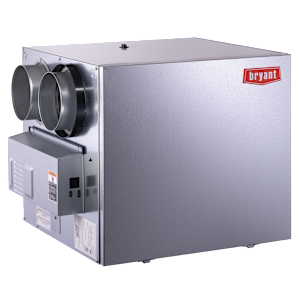
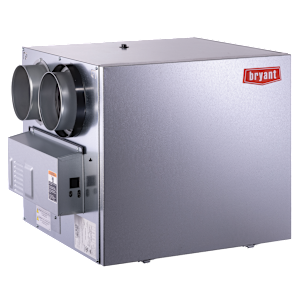
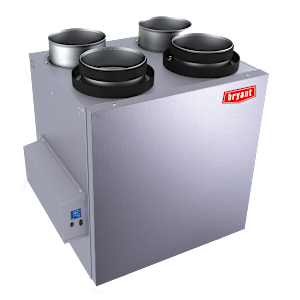
- Flexible Installation: Bryant ERV systems can be wall- or ceiling-mounted. The ERVXXSHA measures 19.125 × 23.5 × 16.125 inches, while the ERVXXSVA measures 21.5 × 21 × 16.125 inches. The larger ERVXXLHB measures 19.5 × 21 × 21.875 inches.
- Comprehensive Warranty: Covered by a strong 10-year parts limited warranty for the original owner upon timely registration, giving you peace of mind.

Who Needs an ERV System?
An ERV system is ideal for homeowners who want to add controlled whole-home ventilation while recovering heat and moisture from the outgoing air. It is especially beneficial for:
- Newer, Airtight Homes: Where natural air leakage may provide less outdoor-air exchange and mechanical ventilation is needed.
- Extreme Climates: Homes in regions with very hot summers or cold winters where opening windows isn't practical.
- Homes Concerned With Indoor Air Quality: Homeowners who want to exhaust stale indoor air while introducing fresh outdoor air.
- Efficiency-Minded Owners: Those looking for a ventilation approach that can recover energy from exhaust air rather than directly exhausting conditioned air outdoors.
ERV vs. HRV: What's the Difference?
The primary difference between an ERV and an HRV is that an Energy Recovery Ventilator (ERV) transfers both heat and moisture, while a Heat Recovery Ventilator (HRV) transfers heat without intentionally transferring moisture.
- ERV (Energy Recovery Ventilator): Bryant ERV systems transfer heat and moisture and are designed to help reduce humidity from incoming outdoor air during summer. Bryant identifies its ERVs as a solution particularly suited to hot, humid summer climates.
- HRV (Heat Recovery Ventilator): Bryant HRV systems transfer heat between incoming and outgoing air. Bryant describes its HRVs as a ventilation option for colder winters and moderate-to-low summer humidity.
Get an ERV System Installed By Your Local Bryant Dealer
A Bryant ERV system can provide fresh outdoor air while recovering heat and moisture from the outgoing airstream. Consult your local Bryant dealer to help determine the most suitable ERV system or heat recovery ventilator for your needs today.
Explore Bryant Ventilators
Choose a Bryant ventilator for improved indoor air quality and enhanced comfort in your home. Designed to bring in fresh outdoor air while removing stale indoor air, Bryant ventilators help regulate humidity levels and reduce allergens. With energy recovery or heat recovery options, these systems ensure efficient airflow while minimizing energy loss. Whether you need to boost ventilation in a tightly sealed home or improve overall air quality, a Bryant ventilator is an excellent choice for healthier, more comfortable living.
Energy Recovery Ventilator FAQs
An ERV (Energy Recovery Ventilator) exchanges stale indoor air with fresh outdoor air while transferring heat and moisture between the two airstreams to maintain comfort and efficiency.
HVAC refers to the overall heating, ventilation, and air conditioning system, while an ERV is a component within that system specifically designed for controlled ventilation with energy recovery.
An energy recovery unit in HVAC is a device captures heat and humidity from exhaust air and transfers it to incoming fresh air, improving indoor air quality without wasting energy.
A fresh air ventilator simply brings in outside air, while an ERV also recovers energy and humidity, making it more efficient and better suited for balanced indoor comfort.
Yes, ERV systems can be worth it in homes with ventilation issues, as they provide fresh air, improve energy efficiency, and help control humidity and indoor air quality year-round.
No—energy recovery ventilators (ERVs) use minimal electricity, often comparable to a light bulb, while improving indoor air quality.
Yes, ERVs help manage humidity and bring in fresh air even during cold weather, maintaining comfort and energy efficiency.
By balancing humidity and improving air circulation, ERVs can help reduce mold growth and musty odors.
It depends—ERVs improve whole-home ventilation but dedicated bathroom fans may still be recommended for quick moisture removal.
In humid climates, a separate dehumidifier can complement your ERV for optimal comfort and moisture control.
ERVs can be installed in either location, but basements or utility rooms often make maintenance easier and protect from temperature extremes.
Installed ERV systems typically cost between $2,000 and $5,000, depending on system size and home layout.


