About The Author: Travis Baugh is a Digital Brand Marketing Manager for Bryant, where he creates clear, helpful content to guide homeowners through heating, cooling, and indoor air quality decisions. His goal is to empower readers with the knowledge they need to choose the right comfort solutions for their home—confidently and comfortably.
Benefits of Air Purifiers
By Travis Baugh | Expert Review By Chrystal Jolliffe - Product Manager, Indoor Air Quality
Air purifiers can help improve indoor air quality by treating the air in your home through filtration and other air-cleaning technologies. Depending on the system, an air purifier may help capture airborne particles, address certain household odors and gases, or provide other indoor air quality benefits.
Air purifiers range from portable units intended for individual rooms to whole-home solutions that work with compatible heating and cooling equipment. Understanding how these systems differ can help you decide which type of air purifier may be right for your home.
What Does an Air Purifier Do?
An air purifier is designed to remove or reduce certain contaminants from indoor air as air passes through the system. Exactly how it does this depends on the technology used.
Mechanical filtration, for example, uses filter media to capture airborne particles. Other air purification products may incorporate activated carbon or UV technology to address different indoor air quality concerns.
Because air purifiers aren't all designed the same way, consider the specific technology, filtration efficiency, maintenance requirements and intended application when comparing your options.
4 Benefits of Air Purifiers
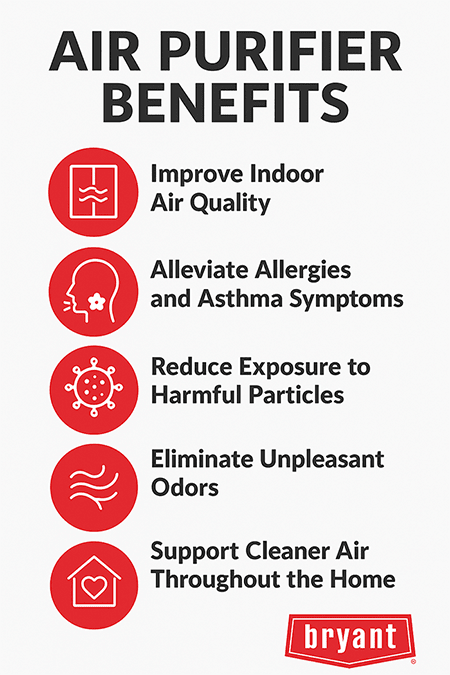
The benefits you receive from an air purifier depend on the type of system and air-cleaning technology it uses. Here are four reasons homeowners may consider adding air purification to their homes.
1. Air Purifiers Can Help Reduce Airborne Particles
One of the primary benefits of an air purifier is its ability to capture particles circulating through indoor air.
Air purifiers with mechanical filtration draw air through filter media designed to trap airborne particles. Depending on the product and filter efficiency, this may include common particles such as dust and pet dander.
For example, the Bryant Evolution™ Air Purifier uses MERV 15 filtration and, according to Bryant's cited third-party testing, captures 95% of particles ranging from 1.0 to 3.0 microns.1
When comparing air purifiers, look at the type of filter and its efficiency rating to better understand the level of filtration a particular product provides.
2. Some Air Purifiers Can Help Address Household Odors and Gases
Particle filtration isn't the only air-cleaning technology available. Certain air purifiers use carbon to address unwanted household odors and gases.
Activated carbon works differently than a mechanical filter. Rather than primarily capturing particles, carbon can be incorporated into an air purification system to help reduce certain gases and odors.
The Bryant Preferred™ Carbon Air Purifier with UV, for example, uses a carbon core that Bryant says helps reduce common unwanted household gases and odors.
If reducing unwanted odors is one of your priorities, consider whether an air purifier includes carbon or another technology specifically intended to address them.
3. Air Purifiers Offer Different Air-Cleaning Technologies
Another advantage is the variety of technologies available. Depending on the product, air purification and filtration systems may use different approaches to treating indoor air.
These can include:
- Mechanical filtration
- Higher-efficiency filtration
- Activated carbon
- UV technology
- Whole-home configurations
Different technologies serve different purposes, so it's helpful to think about what you want the equipment to accomplish before choosing a system.
For example, the Bryant Preferred™ Carbon Air Purifier with UV combines a carbon core with UV light. The carbon core targets certain household gases and odors, while the UV light aids in reducing microorganism growth on the cooling coil and microorganisms released into recirculated indoor air.
4. Air Purifiers Can Provide Whole-Home Air Cleaning
Air purifiers are available in configurations designed for different areas of a home.
Portable air purifiers are typically intended to treat the air within an individual room or area. Whole-home air purifiers, on the other hand, work with compatible HVAC equipment to treat air as it moves through the heating and cooling system.
A whole-home approach can be particularly appealing if you want air purification integrated with your home's HVAC system rather than relying on individual portable units throughout the house.
Bryant offers multiple whole-home options, including the Evolution™ Air Purifier, Legacy™ Line EZ Flex Cabinet Air Filter and Preferred™ Carbon Air Purifier with UV.
What Are the Benefits of a Whole-Home Air Purifier?
A whole-home air purifier or filtration system is installed as part of compatible central HVAC equipment and treats air moving through the system.
Potential advantages of a whole-home approach include:
- Air cleaning integrated with compatible central heating and cooling equipment
- Filtration throughout the HVAC system rather than within just one room
- Different filtration and air-cleaning technologies to choose from
- Centralized filter or air purifier maintenance
Because whole-home air quality equipment needs to work with your HVAC system, it's important to consider equipment compatibility when selecting a product.
Bryant Whole-Home Air Purifier Options
Bryant offers several options designed to address different indoor air quality needs:
Evolution™ Air Purifier
The Bryant Evolution™ Air Purifier provides MERV 15 filtration and captures 95% of particles between 1.0 and 3.0 microns based on Bryant's cited third-party testing. It integrates with ducted HVAC systems and can provide True Sense™ dirty filter detection when used with the Evolution® Connex™ Control.
Legacy™ Line EZ Flex Cabinet Air Filter
The Bryant Legacy™ Line EZ Flex Cabinet Air Filter provides MERV 10 filtration and captures 63% of particles from 1.0 to 3.0 microns. MERV 13 replacement filters are also available as an option.
Preferred™ Carbon Air Purifier with UV
The Bryant Preferred™ Carbon Air Purifier with UV combines a carbon core and UV light. Bryant states that the carbon core helps reduce unwanted household gases and odors, while the UV light aids in reducing microorganism growth on the cooling coil and microorganisms released into recirculated air.
Are Air Purifiers Worth It?
Whether an air purifier is worth it depends on your indoor air quality goals, the space you want to address and the type of air-cleaning technology you're considering.
Air purifiers also come with ongoing considerations. Filters and other components may need to be replaced periodically, and whole-home systems need to be compatible with the home's HVAC equipment. Instead of evaluating air purifiers solely on price, consider factors such as:
- Filtration efficiency
- Air-cleaning technology
- Whole-home vs. portable operation
- HVAC system compatibility
- Maintenance requirements
- Replacement filters or components
- Initial and ongoing costs
These factors can help you find an air purifier that better matches your home's needs.
How Do You Choose the Right Air Purifier?
Start by identifying what you want from your air purifier. If airborne particles are your primary concern, compare filtration efficiency and filter specifications. If you're also concerned about household odors or gases, consider whether the product incorporates carbon or another technology intended to address them.
Next, determine whether you want to treat an individual room or integrate air purification into your central HVAC system. For whole-home equipment, HVAC compatibility and installation requirements are important considerations.
A local Bryant dealer can review your heating and cooling equipment and discuss Bryant air purification and filtration options that are compatible with your system.
1Based on third-party testing (2012) showing 95% of particles size 1.0 to 3.0 microns captured.
Frequently Asked Questions
Air purifiers require maintenance, which may include periodically replacing filters, carbon cores, UV lamps or other components depending on the equipment. There can also be upfront equipment and installation costs as well as ongoing operating and maintenance expenses.
An air purifier also isn't a solution for every indoor air quality concern, so it's important to understand what a particular product is designed to address.
Homeowners may consider an air purifier when they want additional filtration for airborne particles or want to address other indoor air quality concerns, such as certain household odors and gases. Because different air purifiers use different technologies, choose a product based on the specific air quality concerns you want to address.
Air purifiers treat air while the equipment is operating, although operation varies by product and system configuration. For example, Bryant states that its Preferred™ Carbon Air Purifier with UV provides continuous treatment while the HVAC system is running. Follow the operating and maintenance recommendations for your specific equipment.
About The Expert Reviewer: Chrystal Jolliffe is a Product Manager specializing in Residential Indoor Air Quality at Bryant. Her work centers on advancing solutions that support cleaner indoor air and a more comfortable home environment. She helps homeowners understand the role indoor air quality products can play in their homes, empowering them to evaluate their options and make informed decisions about their indoor environment.


