About The Author: Travis Baugh is a Digital Brand Marketing Manager for Bryant, where he creates clear, helpful content to guide homeowners through heating, cooling, and indoor air quality decisions. His goal is to empower readers with the knowledge they need to choose the right comfort solutions for their home—confidently and comfortably.
Why Is My Furnace Not Turning On?
By Travis Baugh
If your furnace is not turning on, the most common causes are incorrect thermostat settings, a tripped circuit breaker, or a clogged air filter. Bryant's furnace troubleshooting guidance starts with four basic checks: thermostat settings, furnace power, the air filter, and unobstructed vents and return grilles.
When the temperature drops and your furnace won't start, it's stressful—but it's often fixable. This guide covers the 12 most frequent reasons a furnace stops working and provides a Bryant-informed, step-by-step troubleshooting checklist you can follow before calling a professional.
What Are the Most Common Reasons a Furnace Won't Turn On?
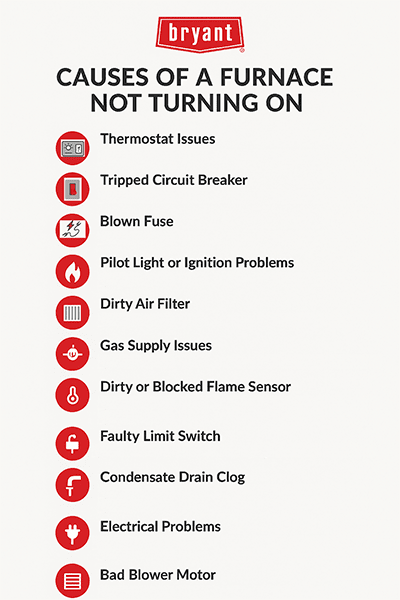
A furnace that won't turn on typically falls into one of three categories: power and control issues, airflow and safety shutdowns, or ignition and mechanical failures. This three-category structure provides a simple way to organize Bryant's troubleshooting guidance before moving on to professional diagnosis.
Andrew Mackey, owner of Superior Service in Lake St. Louis, Missouri, explains the most common reasons a furnace may not turn on.
“It could be as simple as a tripped breaker,” Mackey said. “The unit might also shut off if the filter is too dirty, or another common cause is a dirty flame sensor.”
Here are 12 common causes to investigate:
1. Power and Control Issues
Bryant's troubleshooting guidance starts with the simplest potential causes: thermostat settings and electrical power.
- Thermostat Malfunctions: Ensure your thermostat is set to "heat" and the temperature is higher than the room's current reading. Dead batteries or loose wiring can also prevent communication with the furnace.
- Tripped Circuit Breaker: Even gas furnaces need electricity to operate. A tripped breaker in your home's electrical panel will cut power to the unit completely.
- Blown Fuse: Older furnaces often use internal fuses. If a fuse blows due to a power surge or age, the system will not start. Internal electrical components should be inspected by a qualified technician rather than replaced as a DIY repair.
- Furnace Power Switch: This switch—often located on the side of the unit or a nearby wall—looks like a standard light switch and must be in the "ON" position. Bryant refers to this as the SSU switch in its troubleshooting guidance.
Airflow and Safety Mechanisms
Bryant identifies the air filter and unobstructed return and supply grilles as key homeowner checks because restricted airflow can interfere with furnace operation.
- Dirty Air Filter: A clogged furnace filter can restrict airflow, causing the heat exchanger to overheat and triggering a safety shutdown. Bryant recommends checking the filter monthly; its current troubleshooting guidance says one-inch filters should generally be replaced monthly, while wider filters may have longer replacement intervals.
- Blocked Vents: Supply or return vents blocked by furniture, rugs, or other objects can restrict airflow and contribute to overheating and reduced system performance. Bryant recommends keeping return grilles unobstructed and checking that supply registers are open.
- Faulty Limit Switch: This component monitors the furnace's internal temperature. If airflow is restricted or the blower fails, the limit switch can shut off the burner as a safety measure. A limit switch should not be bypassed; repeated safety shutdowns require professional diagnosis.
- Clogged Condensate Drain: High-efficiency furnaces produce condensate as a byproduct. If the drain line becomes blocked, a float switch can prevent the furnace from operating to help prevent water damage.
Ignition and Mechanical Failures
Bryant's furnace troubleshooting guidance distinguishes simple homeowner checks from problems that require professional service, particularly when ignition or internal components are involved.
- Ignition or Pilot Light Problems: Older furnaces rely on a pilot light that can blow out. Modern systems use electronic igniters—if these crack or fail, gas will not ignite.
- Gas Supply Issues: A closed gas valve or utility interruption will prevent the furnace from producing heat. Check that other gas appliances in your home are working to rule out a supply outage. Never attempt to repair a gas valve yourself.
- Dirty Flame Sensor: The furnace flame sensor detects whether a flame is present. When coated in carbon or dust, it shuts the gas valve as a precaution. If the furnace repeatedly starts and then shuts off, have a qualified technician diagnose the cause.
- Bad Blower Motor: If the blower motor that circulates air through your ducts fails, the furnace may ignite but shut down because adequate airflow is not being established. Blower-motor diagnosis and replacement should be handled by a qualified HVAC professional.
How Do I Troubleshoot a Furnace That Won't Turn On?
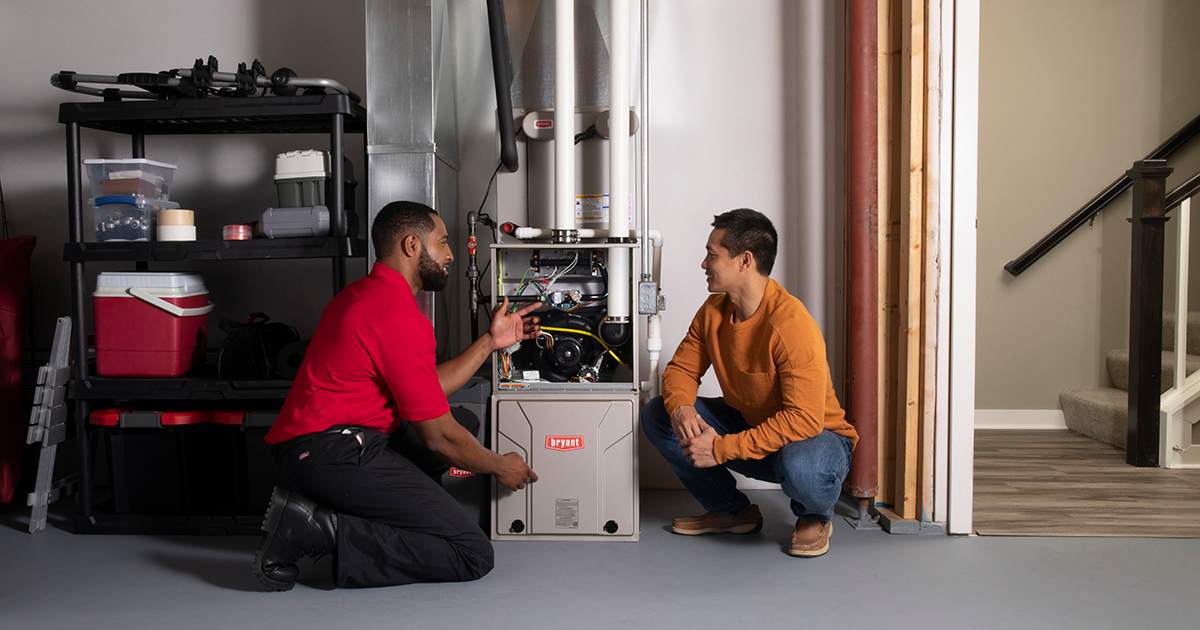
Before scheduling professional furnace service, work through these Bryant-recommended basic checks. If these checks do not restore operation, stop troubleshooting and contact a qualified Bryant dealer rather than opening or bypassing safety components.
- Check Your Thermostat: First, ensure the thermostat is set to "heat" and the temperature is set higher than the current room temperature. If it's battery-powered, replace the batteries.
- Inspect the Circuit Breaker: Go to your home's electrical panel and check if the furnace's breaker has tripped. If it has, reset it once. If it trips again, leave it off and call a professional.
- Check the Furnace Power Switch: Look for a power switch on or near the furnace unit itself and make sure it is in the "on" position.
- Confirm the Gas Supply Is On: If you have a gas furnace, do not attempt to repair the gas supply or gas valve. If you suspect a utility interruption, check whether other gas appliances are operating.
- Examine the Pilot Light or Ignition System: For older furnaces, check if the pilot light is out. If it is, follow the manufacturer's instructions to relight it safely. For modern systems with electronic ignition, a failure may require professional furnace service.
- Replace the Air Filter: A clogged furnace filter is a common culprit. Bryant recommends checking the filter monthly; replace it according to its type and condition.
- Check for Airflow Restrictions: Make sure return grilles and supply registers are open and unobstructed. Bryant recommends keeping furniture away from return grilles to maintain adequate airflow.
- Check the Condensate Area on High-Efficiency Models: Look for visible signs of water backup around the condensate system. Do not bypass a condensate safety switch or disassemble internal components.
- Look for Error Codes or Listen for Noises: Bryant furnaces may use control-board diagnostic indicators to help identify operating problems. Record any displayed codes, blinking patterns, or unusual sounds and provide them to your Bryant dealer. Your exact diagnostic codes depend on the furnace model, so consult the owner's manual rather than assuming a code has the same meaning across all Bryant models.
- Find Your Bryant Furnace Model Number: Bryant says the model number for a gas furnace can be found on the rating-plate sticker inside the unit, and having it available can help a dealer troubleshoot and service the system.
- Call a Professional: If you've tried these basic checks and your furnace is still not turning on, it's time to call your local Bryant dealer. Problems involving the control board, blower motor, ignition system, gas valve, heat exchanger, or safety controls require professional diagnosis.
Bryant Furnace Troubleshooting: What to Check Before Calling a Dealer
Bryant's current homeowner troubleshooting guidance can be summarized as a simple sequence: Thermostat → Power → Filter → Airflow → Model/Diagnostic Information → Dealer.
| Check | What Bryant Recommends Checking |
| Thermostat | Heat mode and temperature setting above the indoor temperature |
| Power | Breaker and furnace SSU/service switch |
| Filter | Check monthly and replace when dirty; one-inch filters generally require monthly replacement |
| Airflow | Keep return grilles and supply registers open and unobstructed |
| Model Number | Have the furnace model number available for your dealer |
| Problem History | Note when the problem started and describe unusual noises or symptoms |
| Professional Service | Contact a Bryant dealer when basic checks do not resolve the issue |
This checklist is based on Bryant's published homeowner troubleshooting and pre-service guidance; it is not a substitute for the diagnostic procedure in your specific furnace's owner's manual.
When to Call a Bryant Dealer for Your Furnace Not Turning On
If furnace troubleshooting doesn't solve the issue, it's time to call a professional. A trusted Bryant dealer can provide expert furnace repair or furnace replacement and diagnose the root cause using the furnace's model information, observed symptoms, diagnostic indicators, and appropriate service procedures.. Recurring failures—or issues involving the control board, heat exchanger, or blower motor—are best left to a certified technician.
Regularly scheduled furnace maintenance with a Bryant dealer can help identify developing problems and keep filters, airflow, electrical connections, and other furnace components in proper working condition.
If you smell gas, see smoke or flames, or suspect an electrical hazard, do not continue troubleshooting. Leave the area as appropriate and contact the relevant emergency or utility service.
Schedule an appointment with your local Bryant dealer today.
Furnace Not Turning On FAQs
To manually restart your furnace, turn off the power, wait a few minutes, then reset the thermostat and turn the system back on—check the breaker and filter as well.
Ensure the thermostat is set to heat and the temperature is above room level, replace the filter if dirty, and check for tripped breakers or a closed gas valve.
Common causes include a malfunctioning thermostat, tripped circuit breaker, clogged air filter, or a faulty ignition system preventing the furnace from starting.
Your furnace may not turn on due to power issues, a dirty flame sensor, low gas supply, or a safety switch that’s been triggered.
Dirty filters, tripped breakers, or thermostat issues are the most common causes.
Check the thermostat settings, power switch, and air filter before calling for service.
Turn off power to the furnace, wait a few minutes, then restore power and follow the manufacturer’s reset instructions. Consult your owner’s manual for details.
A clicking sound usually indicates the igniter or pilot light is trying to light the burners but failing. This is often caused by a dirty flame sensor, a bad furnace ignitor, or a gas supply issue.
Yes, a dirty air filter restricts airflow, causing the heat exchanger to overheat. When this happens, the limit switch trips and shuts down the furnace to prevent damage and fire hazards.
Learn More About Furnaces
- Learn how much is a new furnace
- Get help with a furnace leaking water
- Find out how long does a furnace last
- Find out how to fix a furnace blowing cold air
- Learn about the importance of furnace cleaning
- Understand the ins and outs of a furnace tune-up


