About The Author: Travis Baugh is a Digital Brand Marketing Manager for Bryant, where he creates clear, helpful content to guide homeowners through heating, cooling, and indoor air quality decisions. His goal is to empower readers with the knowledge they need to choose the right comfort solutions for their home—confidently and comfortably.
Your Guide To Furnace Filters
By Travis Baugh
A furnace filter is an essential HVAC component designed to trap airborne particles like dust, pollen, and debris before they circulate through your home. Their primary purpose is to protect the heating equipment from damage, while simultaneously improving indoor air quality for a healthier living environment.
At Bryant, our innovative solutions are centered on our customers’ needs. By understanding the critical role of your furnace filter, you can unlock superior long-term comfort and help reduce heating and cooling bills.
Why Are Furnace Filters Important?
Furnace filters are important because they act as the first line of defense for both your health and your HVAC investment. Regularly changing your furnace filter is a critical furnace maintenance task that ensures your system runs efficiently, helps lower monthly heating and cooling costs, and significantly extends the system's lifespan.
Key Benefits of Changing Your Furnace Filters
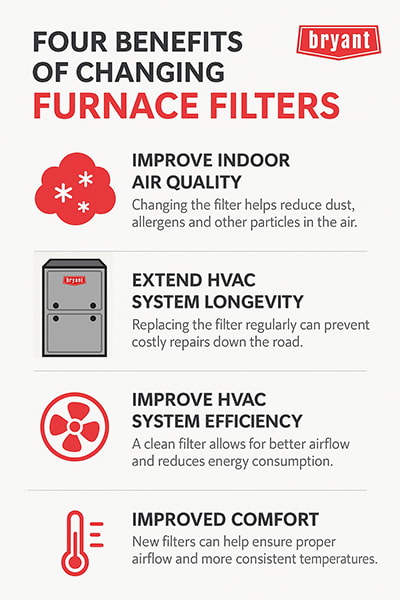
- Improve Indoor Air Quality: Filters capture common triggers like dust mites, pollen, and pet dander. This creates a much healthier environment for those with allergies or respiratory conditions, allowing you to breathe cleaner air.
- Extend HVAC System Longevity: Clean filters reduce strain on the blower motor and heat exchanger. This minimizes the risk of breakdowns and expensive furnace repair or premature furnace replacement.
- Boost Energy Efficiency: A clogged filter restricts airflow, forcing your system to work harder and consume more energy. Regular changes keep airflow smooth, ensuring efficiency that pays for itself..
- Enhance Home Comfort: Consistent airflow ensures even, reliable heating throughout your home, eliminating annoying hot and cold spots while supporting quiet operation.
How to Choose the Right Furnace Filter
Choosing the right furnace filter depends on your HVAC system's compatibility, the desired MERV rating, and your household's specific health needs. Selecting the right HVAC filter isn't just about size; it requires evaluating the presence of pets, advanced filtration needs, and long-term comfort goals.
What is a MERV Rating?
The Minimum Efficiency Reporting Value (MERV) measures how effectively a filter captures particles. Higher MERV ratings indicate finer filtration capabilities.
- MERV 1–4: Basic filtration (dust, lint). Good for protecting equipment but offers minimal air quality benefit.
- MERV 8–13: Recommended for most homes. These filters trap smaller particles like pollen, pet dander, and mold spores without restricting airflow too much. They work best when seeking a balance between energy efficiency and superior air quality.
- MERV 14+: Hospital-grade filtration. These are excellent for pristine air quality but may restrict airflow in standard residential systems. Consult an HVAC pro before using these to ensure seamless system performance.
What Are the Different Types of Furnace Filters?
- Fiberglass Filters: Inexpensive and disposable, but generally feature low MERV ratings. Fiberglass is better suited for protecting the furnace from large debris, not for improving air quality.
- Pleated Filters: Made of polyester or cotton paper sheets. These offer a larger surface area to trap more particles and generally carry higher MERV ratings (8-13), making them a smart long-term investment for family comfort.
- Electrostatic Filters: These use static electricity to attract dust and are available in both disposable and washable versions.
- HEPA Filters: High-Efficiency Particulate Air filters trap 99.97% of particles. HEPA works best for extreme allergy sufferers but usually requires a separate, advanced filtration system due to high airflow restriction.

How Often Should You Replace Your Furnace Filter?
You should replace your furnace filter every 1 to 3 months for most homes, though 1-inch fiberglass filters require monthly replacement. Checking your filter monthly is the standard practice to ensure optimal reliability and performance.
Replacement Frequency Guide
- 1-Inch Fiberglass Filters: Replace every 30 days.
- 1-Inch Pleated Filters: Replace every 60 to 90 days.
- 4-Inch Media Filters: Replace every 6 to 12 months (e.g., Bryant EZ Flex™).
Mark Lea, co-owner of Lea Heating & Air Conditioning in East Dundee, Illinois added that several factors can shorten a filter’s lifespan, including pets that shed, a dusty home environment, leaky ductwork, or even the presence of children.
“The type of flooring matters too,” he explained. “Homes with carpet tend to create a lot more dust inside.”
What Are the Signs You Need a New Filter Immediately?
If you experience reduced airflow, a spike in energy bills, or visible dirt buildup, you need a new furnace filter immediately. Look out for these five key indicators:
- Visible Dirt: If the filter looks gray and clogged with dust or debris.
- Reduced Airflow: Weak air coming from vents suggests a severe blockage that hinders your comfort.
- Spike in Energy Bills: Your system is working overtime to push air through a dirty filter.
- Excess Dust: You notice dust settling on furniture faster than usual.
- Overheating/Odors: A burning smell or short-cycling (turning on and off quickly) can indicate restricted airflow causing the furnace to overheat.
Questions on Furnace Filters? Connect With A Bryant Dealer
By maintaining your furnace filters properly, you can ensure better air quality, improved energy efficiency, and a healthier living environment for you and your family. For a full furnace tune-up that includes a filter change, schedule an appointment with your local Bryant dealer.
Furnace Filter FAQs
Yes, in most systems, the furnace and AC share the same air filter, as both use the same ductwork and blower to circulate air.
Check for a visible buildup of dust and dirt, restricted airflow, or a gray or discolored filter, which are signs it needs replacing.
You should change your furnace filter every 1 to 3 months, depending on the filter type, household dust, pets, and usage.
Symptoms include increased dust in your home, uneven heating or cooling, strange odors, and higher energy consumption.
Not changing the filter can lead to reduced airflow, higher heating and cooling bills, system strain, and even furnace damage or failure over time.
Filters are commonly made from fiberglass, pleated paper, polyester, or electrostatic materials in a cardboard or metal frame.
The most common sizes are 16x20, 20x25, and 16x25 inches, but dimensions vary by system.
Options include disposable fiberglass, pleated, electrostatic, and HEPA filters, each offering different filtration levels.
Not usually. Higher-quality filters trap smaller particles and can improve indoor air quality, though they may need to be replaced less often.
No, you should never run your furnace without a filter. Doing so allows dust, hair, and debris to accumulate on internal components like the blower motor and heat exchanger, which can lead to expensive damage and system failure.
Furnace filters have arrows printed on the frame that indicate the direction of airflow. You should install the filter so the arrow points toward the furnace blower motor (away from the return air duct).
If you install a high-MERV filter and notice reduced airflow from your vents or your furnace starts short-cycling (shutting off early), the filter may be too restrictive. Consult a professional to find the highest safe MERV rating for your specific unit.
Washable filters reduce waste but require regular, thorough cleaning and drying to prevent mold growth. High-quality disposable pleated filters generally offer better particle capture (higher MERV ratings) and convenience for most homeowners.
Learn More About Furnaces
- Read our guide to furnace parts
- Read our guide to furnace service
- Explore what is a furnace
- Find out how long does a furnace last
- Read our guide on furnace troubleshooting
- Learn about the importance of furnace cleaning


