About The Author: Travis Baugh is a Digital Brand Marketing Manager for Bryant, where he creates clear, helpful content to guide homeowners through heating, cooling, and indoor air quality decisions. His goal is to empower readers with the knowledge they need to choose the right comfort solutions for their home—confidently and comfortably.
How Much Is a New Furnace? Furnace Prices, Installation & Key Cost Factors
By Travis Baugh | Expert Review By Seth Faber - Product Manager, Furnaces
According to Bryant, a new furnace for a typical 2,000-square-foot home generally costs $4,000–$8,000, including equipment and installation. The final price depends on your home's square footage, the unit's fuel source, its AFUE (Annual Fuel Utilization Efficiency) rating, and the complexity of professional installation. Bryant also notes that high-efficiency models can cost approximately $1,000–$2,500 more than standard-efficiency models. Because every home is unique, exact pricing varies—but understanding these variables helps you make a confident, well-informed decision.
To get a precise estimate tailored to your home's specific needs, contact you local Bryant dealer for a personalized quote today.
What Factors Affect New Furnace Cost?
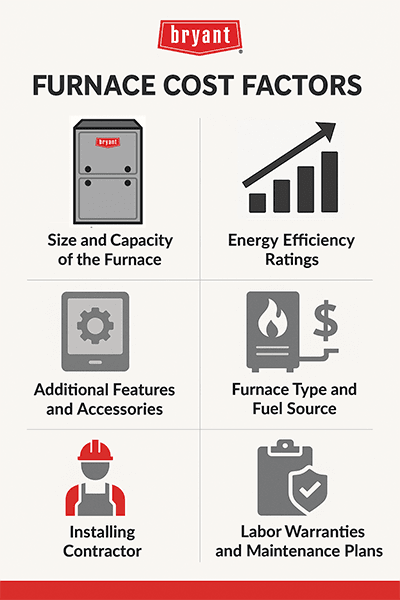
Bryant identifies five primary factors that drive the cost of a new furnace: unit size and capacity, energy efficiency ratings (AFUE), fuel type, installation complexity, and added features like smart thermostats or zoning systems.
Investing in a new furnace involves more than just the purchase price of the unit. The final cost reflects a complete home comfort solution—state-of-the-art equipment, professional installation, and optional smart features designed to optimize your living environment and boost long-term energy efficiency.
How Does Furnace Size and Capacity Impact Cost?
A larger furnace with a higher heating output generally costs more upfront, but selecting the correctly sized unit is critical for optimal efficiency and comfort.
Bryant estimates typical furnace equipment costs at approximately $1,000–$1,500 per ton before installation. However, furnace sizing is based on heating load and capacity—not simply the size of your home—so a professional load calculation is important.
While a larger unit carries a higher price tag, "bigger" is not always "better." An oversized furnace will cycle on and off too frequently, while an undersized one will struggle to keep your home warm—both scenarios waste energy and drive up monthly bills. A professional load calculation ensures you get the right fit.Learn more about what size furnace you need.
What Role Do Energy Efficiency Ratings Play in Furnace Price?
Higher AFUE (Annual Fuel Utilization Efficiency) ratings mean greater energy efficiency—and a higher upfront investment—but they deliver significant long-term savings on heating bills.
- Standard Efficiency: Lower purchase price, but higher ongoing monthly energy costs.
- High Efficiency: Higher initial investment, with Bryant estimating approximately $1,000–$2,500 more upfront than standard-efficiency models.
Bryant defines standard-efficiency furnaces as approximately 80% AFUE and high-efficiency furnaces as 90%–98.3% AFUE.
A high-efficiency model may cost more initially, but its higher AFUE rating can reduce fuel use and monthly heating costs over time. The potential savings depend on your climate, fuel prices, system usage, and other factors.
How Does Fuel Type Influence Furnace Cost?
Natural gas furnaces are typically the most affordable to purchase and operate. Electric, oil, and propane models vary in both upfront price and ongoing energy costs, depending on local utility rates and fuel availability.
The fuel source available in your home plays a significant role in both the purchase price and day-to-day operating costs:
| Furnace Type | Cost Considerations |
| Natural Gas Furnaces | Generally the most affordable and widely used option, particularly for homes already connected to a gas line. |
| Electric Furnaces | Typically less expensive upfront, but ongoing costs can be higher depending on local electricity rates. |
| Oil Furnaces | Tend to cost more than gas or electric models; ongoing oil costs add to the total expense |
| Propane Furnaces | Similar in cost to oil furnaces; common in areas without access to natural gas supply. |
Fuel type can also affect operating costs. Bryant notes that natural gas is often associated with lower monthly heating costs in colder climates, while electric furnaces generally have lower upfront installation costs but may have higher monthly operating costs depending on local electricity rates
Decision guide: Natural gas is better suited for homeowners with an existing gas line and access to competitive utility rates. Electric furnaces work best in mild climates or homes without gas infrastructure. Oil and propane are practical alternatives in rural areas where natural gas is unavailable.
How Much Does Furnace Installation Cost?
Furnace installation costs vary widely based on geographic location, the contractor's expertise, and the complexity of your home's ductwork and venting requirements.
Bryant notes that professional installation costs are affected by labor rates, system removal, and infrastructure adjustments such as ductwork, gas lines, venting, and electrical connections.
Installation is a critical component of any furnace replacement investment. Labor costs depend on the contractor's experience, your region, site-specific requirements, and the complexity of the furnace installation.
Andrew Mackey, owner of Superior Service in Lake St Louis, Missouri, emphasizes one factor that's easy to overlook:
“A key factor that most people overlook is the quality of the installation,” Mackey said. “A homeowner should want the most qualified company to install the unit. A quality installation will make the unit work more efficiently and last longer.”
Mackey also recommends asking about warranty coverage upfront:
"The installing contractor should provide a 10-year part and labor warranty to make sure that the homeowner is worry-free for most of the life of the unit," Mackey said.
Do Features, Brands, and Warranties Affect Furnace Price?
Yes. Advanced features, premium brand reliability, and extended warranties increase a furnace's initial cost—but they deliver superior indoor air quality, quiet operation, and long-term peace of mind.
- Smart Features: Add-ons like smart thermostats, zoning systems, and advanced air filtration increase the initial price but provide superior comfort control and indoor air quality.
- Brand Reliability: Premium brands carry a higher price tag, but they offer advanced engineering and durability. “The brand of unit is important because you want furnace parts that last, so you don’t have to worry about frequent repairs,” says Mackey.
- Warranties: Extended labor warranties and maintenance plans for furnace inspections add to the initial investment but provide peace of mind and protection against unexpected furnace repair costs over the system's lifetime.
What Does a New Furnace Quote Include?
A standard new furnace quote typically includes the appropriately sized heating unit, basic installation materials such as venting and flue piping, professional labor, a standard thermostat, system startup and testing, and—in many cases—disposal of the old furnace.
When requesting a quote for a new furnace, knowing what is and isn't covered helps you avoid surprises. Most standard quotes include:
- The furnace unit, sized to your home's heating load
- Professional installation labor
- Basic materials: venting, flue piping, and duct connections
- Standard thermostat (if included with the system)
- System startup, testing, and initial inspection
- Old furnace removal and disposal (varies by contractor—always confirm)
Standard quotes often do not include:
- Modifications to existing ductwork or new ductwork installation
- Upgrades to high-efficiency models or smart thermostats
- Permit and inspection fees (varies by municipality)
- Electrical upgrades or new circuit installations
- Air quality add-ons such as humidifiers, air purifiers, or UV lights
- Emergency or same-day installation charges
How Can I Manage the Cost of a New Furnace?
The most effective strategies for managing new furnace costs include exploring financing options, applying for rebates, choosing a high-efficiency model for long-term savings, collecting multiple contractor quotes, and purchasing during the off-season.
A new furnace is a significant investment, but several proven strategies can help you secure the best long-term value:
- Explore Financing Options: Many Bryant dealers offer flexible financing plans with competitive interest rates and convenient payment options to make your purchase more manageable.
- Look for Rebates: Check for local rebates for installing high-efficiency furnace models. These incentives can help offset the upfront cost.
- Choose a High-Efficiency Model: A high-efficiency furnace with a high AFUE rating may cost more initially but can help save you a substantial amount on heating bills over its lifespan, making it a smart long-term investment.
- Get Multiple Quotes: Obtain estimates from several qualified HVAC contractors to compare pricing on both the unit and installation. This also helps you assess contractor quality and warranty terms.
- Shop During the Off-Season: Heating system prices often drop in spring and fall when demand is lower. Purchasing during these windows can lead to better deals on both equipment and labor.
How Can I Find Out How Much a New Furnace Will Cost?
The most accurate way to determine how much a new furnace will cost is by scheduling a professional load calculation and requesting an in-home estimate from a qualified local HVAC dealer.
Bryant's published $4,000–$8,000 range is a general starting point for a typical 2,000-square-foot home—not a guaranteed price. Your actual quote will depend on the furnace's size, fuel type, AFUE rating, features, installation requirements, and local labor costs.
At Bryant, we understand the importance of finding the right furnace that fits your budget and heating requirements. Our wide range of reliable and energy-efficient furnaces are designed to provide optimal comfort while keeping your energy costs in check. Contact your local Bryant dealer today to get a quote for furnace replacement and find out how much a new furnace is for your home.
Compare Bryant Furnaces
Choose a Bryant furnace for reliable, efficient heating that keeps your home comfortable throughout the winter. Known for their durability and advanced technology, Bryant furnaces offer quiet operation, precise temperature control, and energy-saving features like variable-speed motors and two-stage heating. With a range of models to suit different home sizes and needs, Bryant furnaces are built to last and come with industry-leading warranties, providing peace of mind and long-term value for your home heating system.
How Much Is A New Furnace FAQs
While rare, a furnace can last up to 30 years with excellent maintenance, but most systems begin to lose efficiency and reliability after 15 to 20 years.
You may need to replace your furnace if it's over 15–20 years old, requires frequent repairs, struggles to heat evenly, or causes rising heating bills.
Signs your furnace is dying include strange noises, inconsistent heating, excessive dust, yellow burner flames, and a noticeable increase in repair frequency or energy use.
Generally, it's not worth fixing a 20-year-old furnace, as the cost of repairs often outweighs the benefits compared to installing a new, energy-efficient model.
Most gas furnaces last 15 to 20 years with regular maintenance and filter changes.
Yes, in most climates, a high-efficiency furnace is worth the investment. While the upfront cost is higher, the reduction in monthly energy bills often offsets the difference over the life of the system, providing a "return on investment" through energy savings.
Typically, a quote for furnace installation includes the removal and disposal of your old unit, but this varies by contractor. Always verify this detail when reviewing your quote to avoid surprise fees.
You should never guess on size. A professional HVAC dealer will perform a Manual J load calculation, which analyzes your home’s square footage, insulation, window types, and local climate to determine the exact heating capacity required for efficient comfort.
Yes, smart furnaces and smart thermostats are often worth the extra cost because they optimize heating schedules and learn your behaviors, which can help result in energy savings, lower heating bills, and effortless home climate control.
A standard new furnace installation typically takes a professional HVAC contractor between 4 to 8 hours to complete. Complex installations requiring ductwork modifications or electrical upgrades can take slightly longer.
Learn More About Furnaces
- Understand natural gas furnaces
- Discover the value of a high efficiency furnace
- Find out how long does a furnace last
- Explore types of furnaces
- Understand gas vs electric furnaces
- Understand the ins and outs of a furnace tune-up
About The Author: Seth Faber serves as Product Manager for Residential Furnaces at Bryant, where he contributes to the development of heating solutions designed for dependable operation and lasting home comfort. His work takes into account homeowner needs, advances in energy efficiency, and evolving industry standards to help support reliable residential heating.


