About The Author: Travis Baugh is a Digital Brand Marketing Manager for Bryant, where he creates clear, helpful content to guide homeowners through heating, cooling, and indoor air quality decisions. His goal is to empower readers with the knowledge they need to choose the right comfort solutions for their home—confidently and comfortably.
HVAC Options for Old Houses
By Travis Baugh | Expert Review By Michelle Notaro - Product Manager, Air Conditioners
The best HVAC options for old houses are ductless mini-split systems and Variable Refrigerant Flow (VRF) systems. Both solutions deliver precise zoning and superior energy efficiency without requiring extensive ductwork—meaning original architectural details like plaster walls and crown molding stay exactly where they belong.
For a tailored recommendation, work with your local Bryant dealer for professional HVAC installation.
Why Retrofitting Old Homes Requires Special Care
Updating the heating and cooling in a vintage home is a delicate balance. You want modern comfort and efficient operation, but you also want to protect the charm that makes your home special. Whether you are renovating a Victorian classic or updating a mid-century gem, understanding your constraints is the first step toward a more comfortable, efficient future.
A proper retrofit should account for the home's heating and cooling loads rather than sizing equipment from square footage alone. ACCA's Manual J is the ANSI-recognized standard for calculating residential heating and cooling loads, including factors such as insulation, windows, building characteristics and design conditions.
Key Considerations When Choosing HVAC for Old Houses
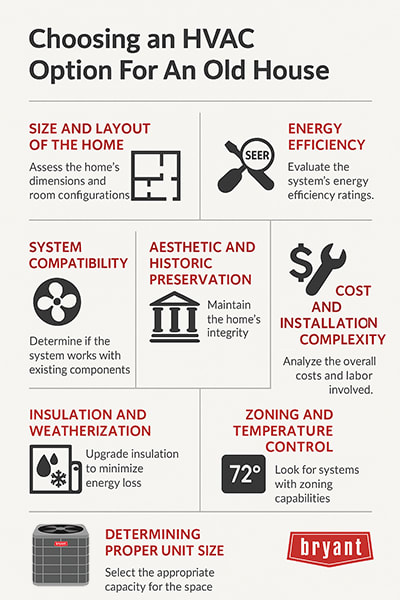
The right HVAC system for an old house depends on four core factors: available space for ductwork, historic preservation requirements, energy efficiency goals, and the home's calculated heating and cooling loads. Before selecting a unit, evaluate your property's unique structure—older homes were not built with modern climate control in mind.
1. Space Constraints and Ductwork
Does the home have room for ducts? Many older houses lack the wall cavities or ceiling space required for traditional, bulky ductwork. Retrofitting central air often requires lowering ceilings or building bulkheads, which can disrupt original layouts and add significant cost.
- The Fix: A professional HVAC assessment can determine if your home can accommodate ducts or whether a ductless, compact ducted or VRF solution is a better fit.
If an existing duct system is retained, its condition also matters. ENERGY STAR estimates that about 20% to 30% of the air moving through a typical home's duct system can be lost through leaks, holes and poorly connected ducts.1
2. Historic Preservation
If maintaining original crown molding, plaster walls, and hardwood floors is a priority, you need an HVAC system with a minimal structural footprint—one that works around your home's legacy, not against it.
- The Fix: Avoid systems that require unnecessary structural modifications. Ductless systems use refrigerant lines and wiring routed through a relatively small wall penetration, while Bryant VRF systems can use different indoor-unit configurations to accommodate challenging layouts. Installation requirements vary by equipment and home, so your contractor should determine the appropriate routing before installation.
3. Energy Efficiency Goals
Old houses can have drafts, inadequate insulation, older windows and other characteristics that increase heating and cooling loads. Improving the home envelope can be an important part of an HVAC retrofit, because equipment efficiency alone does not determine a home's total energy use.
- The Fix: Look for units with high SEER2 (Seasonal Energy Efficiency Ratio), EER2 (Energy Efficiency Ratio) and HSPF2 (Heating Seasonal Performance Factor) ratings. For example, Bryant's Evolution™ 37MPRA ductless heat pump offers up to 35.1 SEER2 and 30 HSPF2, while the Preferred™ 37MARA offers up to 26 SEER2 and 13.9 HSPF2. Actual performance depends on the specific system combination, size and operating conditions.
“Ductless mini splits are much more energy efficient than central air units because you can run them room by room instead of conditioning the entire home,” Brian Redmond, owner of Redmond’s Complete Comfort in Lock Haven, Pennsylvania.
The ability to condition individual zones can help homeowners avoid conditioning unoccupied areas, but actual energy savings vary based on equipment selection, controls, occupancy, weather and the home's construction.

Top HVAC System Types Suitable for Old Houses
When weighing HVAC options for old houses, ductless mini-splits and VRF systems are two options worth evaluating when conventional ductwork is impractical. Ductless mini-splits can work well for smaller homes or those needing room-by-room control, while VRF systems can accommodate larger properties with multiple independently controlled zone
1. Ductless Mini Split Systems
Ductless mini split systems are frequently the top recommendation for historic renovations. They consist of an outdoor compressor connected to indoor air-handling units via a small conduit—reducing or eliminating the need for large air ducts entirely.
Best For: Homes with no existing ductwork and specific room-by-room zoning needs.
- Preserves Aesthetics: Because ductless systems do not require a conventional network of large supply and return ducts, they can reduce the need for major modifications to walls, ceilings and floors. Installation still requires appropriately sized penetrations and refrigerant-line routing.
- Zoned Comfort: Each indoor unit or zone can be controlled independently, allowing homeowners to condition occupied spaces without necessarily conditioning the entire home.
- Published Efficiency: Bryant ductless systems offer published efficiencies as high as 35.1 SEER2 and 30 HSPF2, depending on the model and matched indoor unit.
- Low Sound Levels: Bryant's Evolution™ Line ductless systems offer indoor comfort with sound levels as low as 16 dB(A) in the 615PHA, while specific outdoor-unit sound levels vary by model.
Learn more about mini split installation.
2. VRF (Variable Refrigerant Flow) Systems:
Best For: Larger historic properties requiring multiple independently controlled zones and, on applicable systems, simultaneous heating and cooling.
VRF systems are an advanced solution well-suited to larger properties with complex zoning requirements. Bryant Opti-V™ systems use inverter-driven compressor technology to adjust output to match demand and can independently control temperatures in up to nine zones.
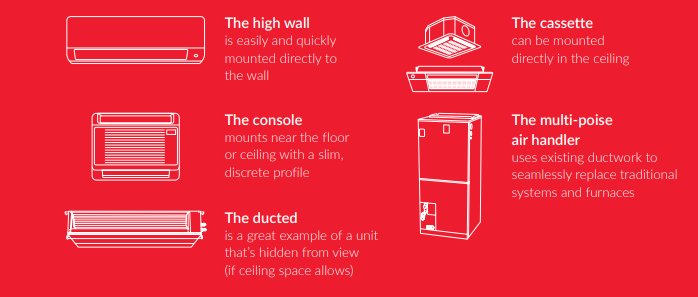
- Customizable Design: Bryant offers multiple indoor-unit configurations, including options designed for different ceiling, wall and floor applications, helping contractors work around challenging layouts.
- Simultaneous Heating and Cooling: Applicable Bryant VRF configurations can provide heating and cooling to different zones at the same time, which can be useful in homes with varied sun exposure or rooms with different comfort requirements.
- Published Efficiency: Bryant Opti-V heat pumps offer up to 20 SEER2, 13.3 EER2 and 10.1 HSPF2, depending on the system configuration.
- Sound: The 5-ton Bryant Opti-V heat pump operates at sound levels as low as 60 dB(A). Actual sound varies by model, size and operating condition.
Expert Installation Matters
Preserving the legacy of an old house requires real expertise. Retrofitting HVAC systems means navigating unique structural challenges—plaster walls, limited electrical capacity, existing ductwork, insulation levels, air leakage, window characteristics and historic preservation requirements all come into play.
Proper sizing is particularly important. ACCA's Manual J methodology is used to calculate the heating and cooling loads of residential buildings, while Manual S addresses equipment selection and Manual D addresses duct design.
A local Bryant dealer understands these nuances. A professional assessment can help determine whether a Bryant ductless mini-split, Opti-V VRF system, central heat pump, air conditioner or another HVAC configuration is appropriate for the home.
Ready to breathe new life into your old home? Your local Bryant dealer today to learn more about how we can help you maintain the charm and character of your old house while enjoying modern comfort and efficiency.
1 https://www.energystar.gov/saveathome/heating-cooling/duct-sealing
HVAC Options For Old Houses FAQs
Yes, you can install an HVAC system in an old house, though it may require custom ductwork, electrical upgrades, or using ductless systems to accommodate the existing structure.
The most efficient method is often a ductless mini-split system, which avoids invasive ductwork and allows for zoned comfort and energy savings.
Installing central air in an old house can be challenging due to tight spaces, lack of ductwork, and historic building materials, often increasing labor and cost.
Adding ductwork to an old house typically costs between $5,000 and $15,000, depending on the home size, layout complexity, and whether walls or floors must be opened. It’s best to talk to your local Bryant dealer to get an accurate quote.
If you choose a ductless or high-velocity system, damage is minimal to non-existent. These systems are designed specifically to be "minimally invasive," requiring only small holes for refrigerant lines rather than large cutouts for ducts.
A ductless mini-split is typically the right fit for smaller homes or those needing targeted comfort in specific rooms. A VRF system is better suited for larger historic properties with multiple zones that need independent temperature control—including the ability to heat and cool different rooms simultaneously. A Bryant dealer can assess your home's layout and recommend the best fit.
In most cases, yes—positively. A professionally installed, high-efficiency HVAC system improves buyer confidence, reduces ongoing energy costs, and demonstrates that the home has been well-maintained. Choosing a minimally invasive system also ensures historic features remain intact, which can be a significant selling point.
Learn More About HVAC
- Explore the value of what is HVAC?
- Read our guide on HVAC replacement
- Check out our HVAC pricing guide
- Learn how long HVAC systems work
- Get help with HVAC repair
- Find out more about HVAC service
About The Expert Reviewer: Michelle Notaro is a Product Manager for Residential Air Conditioners at Bryant, helping guide the direction of residential cooling products. She considers changing homeowner priorities, emerging market developments, and regulatory requirements to support air conditioning solutions that address today's comfort and efficiency expectations.


