About The Author: Travis Baugh is a Digital Brand Marketing Manager for Bryant, where he creates clear, helpful content to guide homeowners through heating, cooling, and indoor air quality decisions. His goal is to empower readers with the knowledge they need to choose the right comfort solutions for their home—confidently and comfortably.
Humidifier vs Dehumidifier: Which One is Right for You?
By Travis Baugh
The main difference between a humidifier and a dehumidifier is that a humidifier adds moisture to dry air, while a dehumidifier removes excess moisture from humid air. Choosing between a humidifier vs dehumidifier depends on your home's specific air quality needs, which often change with the seasons.
At Bryant, our innovative solutions are centered on our customers’ needs. Understanding how each system manages indoor humidity is the first step toward creating a more comfortable indoor environment. By optimizing your indoor air quality, you can invest in long-term comfort and potentially improve HVAC efficiency by maintaining appropriate humidity levels.
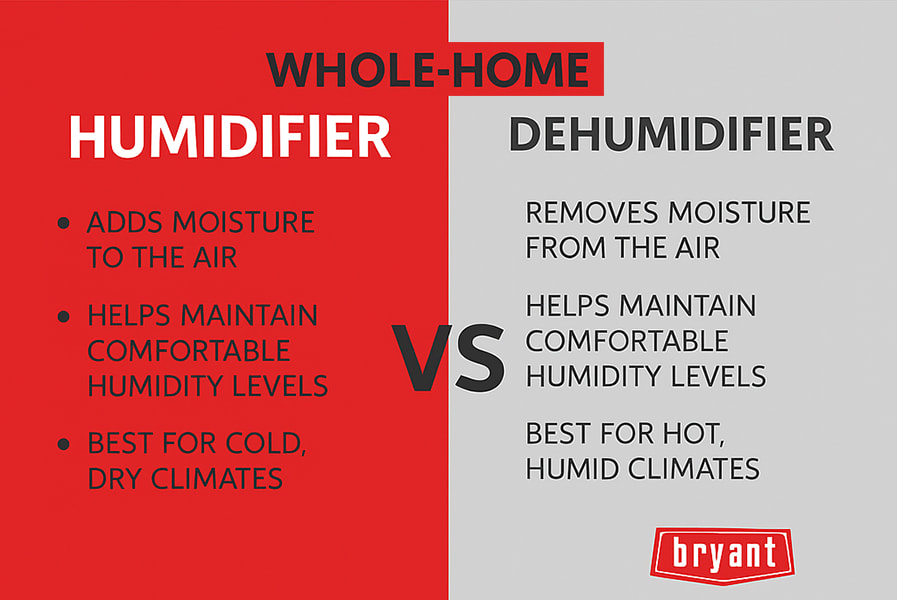
Key Differences in A Humidifier vs Dehumidifier
A humidifier is a system that adds moisture to indoor air, while a dehumidifier removes excess moisture to help control dampness. While both systems manage indoor air quality, they perform opposite functions to achieve a balanced, comfortable environment.
A humidifier is better suited for homes facing dry, cold conditions, while a dehumidifier works best when dealing with hot, humid climates or naturally damp spaces.
Learn more about what a humidifier does and what a dehumidifier does.
What is the Ideal Indoor Humidity Level?
Bryant recommends maintaining indoor relative humidity between 30% and 50% for indoor comfort. Relative humidity measures the amount of water vapor in the air compared to the maximum it can hold at a given temperature. Humidity that is too low can contribute to dry-air discomfort, while excessive humidity can contribute to condensation and create conditions that support mold growth.
You can easily monitor this using a standard hygrometer or a smart home thermostat. If you aren't sure where your home stands, learn more about what humidity should my house be at?
When Should You Use a Humidifier?
Bryant recommends considering a humidifier when indoor humidity drops below 30%, which is most common during cold winter months or in arid climates. Humidifiers work by releasing water vapor into the air, helping to raise indoor humidity to a more comfortable level.
Key humidifier benefits include:
- Prevents Dry Skin: By adding moisture to the air, humidifiers can help reduce the effects of excessively dry indoor air on skin and lips.
- Soothes Respiratory Discomfort: Moist air can soothe dry throats and nasal passages, which may improve comfort when indoor air is excessively dry.
- Protects Wood Furnishings: Dry air can cause wooden furniture, floors, and musical instruments to crack or warp. A humidifier can help protect these materials by maintaining more consistent indoor humidity.
For example, Bryant's Preferred™ Series Steam Humidifier (HUMXXSTM) provides up to 34 gallons of water vapor per day, depending on voltage and amperage, making it a high-capacity option for larger homes.
When Should You Use a Dehumidifier?
Bryant recommends considering a dehumidifier when indoor humidity consistently exceeds 50%, making it useful for damp summer months, humid climates, basements and other moisture-prone areas. It works by drawing in moist air, cooling it to condense the water vapor, and then releasing the drier air back into the home.
Key dehumidifier benefits include:
- Helps Control Mold and Mildew: By reducing excess moisture, dehumidifiers can help create conditions that are less favorable for mold and mildew growth.
- Improves Indoor Air Quality: High humidity can allow allergens such as dust mites and mold to flourish. Controlling excess moisture can help manage these conditions.
- Helps Reduce Musty Odors: Musty smells can be associated with excess moisture and mold or mildew. Reducing humidity can help address one factor that contributes to these odors.
- Enhances Comfort: Lowering excessive humidity can make the air feel less "sticky," which may improve comfort even when the temperature remains unchanged.
Bryant's Preferred™ Series Whole-Home Dehumidifier (DEHXX) is available in models rated to remove up to 80 or 100 pints of moisture per day, depending on the model.
How Do I Know If I Need a Humidifier or Dehumidifier?
| Humidifiers | Dehumidifiers | |
| Function | Add moisture to the air | Remove moisture from the air |
| Use Cases | Ideal in cold, dry environments or winter months when the air is too dry | Best suited for hot, humid conditions or areas with high moisture content, such as basements |
| Benefits | Can help relieve dry-air discomfort and protect wood furnishings | Can help control excess moisture and conditions associated with mold, mildew and dust mites |
| Maintenance | Require regular cleaning to prevent mold or bacteria buildup in the water tank. Learn about humidifier maintenance. | Need emptying of their water collection reservoir or a drainage system to remove the condensed moisture |
Bryant recommends starting with a measurement of your home's relative humidity rather than choosing a system based only on how the air feels. To determine if you need a humidifier or a dehumidifier, use a hygrometer to measure your home's relative humidity and observe how your indoor air feels.
- Choose a Humidifier If: Your home's humidity is consistently below 30%. You might notice dry skin, static electricity, or cracked wooden furniture. These signs indicate the air is too dry.
- Choose a Dehumidifier If: Your home's humidity is consistently above 50%. Signs of excess humidity include condensation on windows, a persistent musty smell, or visible mold growth, especially in basements and bathrooms.
In many regions with distinct seasons—cold, dry winters and hot, humid summers—you may benefit from using both devices at different times of the year to maintain more consistent indoor humidity year-round.
Scotty Peters, owner of CK Heating and Cooling in Seminole, Texas, explains how homeowners can determine whether they need a humidifier, dehumidifier, or both by understanding how air conditioning naturally affects indoor moisture levels.
“Every air conditioner is a dehumidifier,” Peters said. “When we cool air, we’re essentially squeezing moisture out of it, like a sponge. As warm air passes over the cooling coil, moisture condenses and drains away through the system.”
Peters notes that in many homes, a properly sized air conditioner may handle humidity on its own, but not always.
“If the system is sized correctly for the home and climate, it may manage humidity well on its own,” he said. “But in some cases, it’s not enough, and that’s where standalone dehumidifiers come in to help control moisture without changing the temperature.”
He adds that the opposite problem often occurs in winter, when indoor air becomes too dry.
“When cold outdoor air is brought inside and heated, the relative humidity drops significantly,” Peters said. “That’s why many homes need humidification in the winter and dehumidification in the summer to stay in a comfortable range, typically around 45 to 50 percent.”
Peters also points out that everyday household activities can impact humidity levels.
“Things like showers, cooking, and even people breathing all add moisture to the air,” he said. “But in dry winter conditions or homes with lots of air leakage, a dedicated humidifier—like a steam humidifier—may be needed to maintain proper comfort levels.”
Bryant's Preferred™ Series Steam Humidifier HUMXXSTM is one example of a whole-home solution, with water vapor output of up to 34 gallons per day. Bryant also offers bypass and fan-powered humidifiers, with capacities ranging from 12 to 18 gallons per day depending on the model.

Ask Your Bryant Dealer About The Humidifier vs Dehumidifier Decision
A Bryant dealer can evaluate your home's climate, square footage, construction, existing HVAC system and measured humidity levels to recommend the appropriate humidification or dehumidification solution. Managing your indoor air quality is an investment in your family's long-term comfort and can help you maintain more consistent humidity throughout your home.
At Bryant, we engineer innovative, advanced solutions designed to give you greater control over your indoor environment. Don't guess when it comes to your home's air quality. Schedule an appointment today to experience the comfort you deserve and determine the best humidifier or best dehumidifier for your home.
Humidifier vs Dehumidifier FAQs
It depends on your indoor humidity levels—humidifying is better when the air is too dry (below 30%), while dehumidifying is needed when it's too moist (above 50%), especially in warmer months.
A humidifier is better for breathing in dry air, as it soothes airways, while a dehumidifier helps in humid environments that may trigger allergies or asthma.
A humidifier is usually better for congestion caused by dry air, as it helps loosen mucus and moisturize nasal passages.
Avoid using a humidifier when indoor humidity is above 50%, as excess moisture can promote mold, dust mites, and respiratory issues.
Use a hygrometer to check humidity levels—if it's consistently below 30%, you need a humidifier; if it's above 50%, a dehumidifier is recommended.
It depends on your environment. A humidifier adds moisture to dry indoor air, while a dehumidifier removes excess humidity in damp spaces. Many homes benefit from both at different times of year.
That depends on indoor air conditions. A humidifier may help maintain comfort if air is dry, while a dehumidifier helps if your home feels damp or musty.
In climates with cold, dry winters and humid summers, using both systems seasonally can help maintain balanced comfort year-round.
Yes, they can. By maintaining optimal humidity, your HVAC system operates more efficiently. Proper humidity makes the air feel warmer in winter and cooler in summer, allowing you to adjust your thermostat and potentially save energy.
No. Modern whole-home systems are engineered to be as quiet. They integrate seamlessly with your existing HVAC setup to provide comfort without disruptive noise.
Learn More About Humidifiers
- Learn what does a humidifier do?
- Learn the ins and outs of humidifier installation
- Discover whole house humidifier types
- Explore the factors of whole house humidifier cost
- Understand the best humidity level for sleeping


