About The Author: Travis Baugh is a Digital Brand Marketing Manager for Bryant, where he creates clear, helpful content to guide homeowners through heating, cooling, and indoor air quality decisions. His goal is to empower readers with the knowledge they need to choose the right comfort solutions for their home—confidently and comfortably.
Furnace Parts: Your Guide to Replacement & Repair
By Travis Baugh
Furnace parts are the specialized internal components—such as heat exchangers, blower motors, and ignitors—that work together to generate and distribute heat safely throughout your home.
While reliable, quiet performance is the standard for Bryant systems, understanding these advanced HVAC technologies is key to maintaining long-term comfort and efficiency. Whether you are troubleshooting an unexpected heating issue or looking to upgrade for better energy savings, knowing the anatomy of your furnace empowers you to make confident, informed decisions about your home’s climate control.
How Do You Order Furnace Parts?
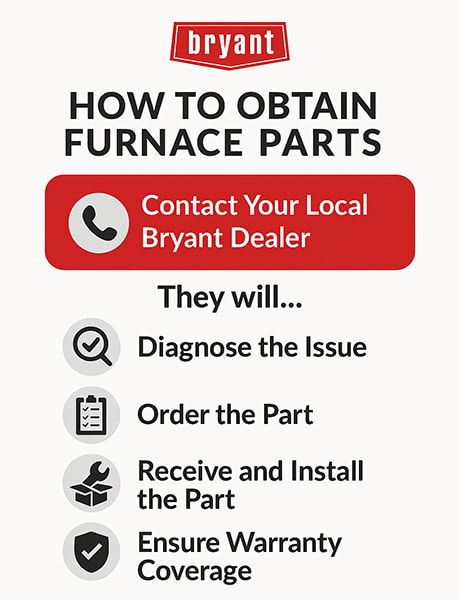
The safest way to get the right furnace parts is through a licensed HVAC professional. Your local Bryant dealer can accurately diagnose system issues and source genuine factory-authorized parts designed specifically for your model.
Step-by-Step Ordering Process:
- Contact a Dealer: Reach out to your local Bryant dealer.
- Diagnose the Issue: A technician will inspect your system to identify the faulty component.
- Order & Install: The dealer orders the correct component and installs it safely, optimizing system performance.
- Verify Warranty: The dealer checks if your repair is covered under your 10-year parts limited warranty.
What Are the Most Common Furnace Parts?
Understanding the core components of your heating system helps you communicate effectively with technicians and and troubleshoot furnace problems. Here are the critical parts inside your furnace.
1. Heat Exchanger
The heat exchanger is a metal chamber that safely transfers heat from the burner directly to the air circulating in your home. It acts as the heart of your system, keeping toxic combustion gases (like carbon monoxide) separate from your breathable indoor air. Based on safety standards, if a heat exchanger develops a crack, it must be replaced immediately to protect your home
2. Blower Motor
The blower motor powers the fan that pushes warm, conditioned air through your ductwork and into your living spaces. Upgrading to advanced variable-speed blower motors provides whisper-quiet operation and more consistent room temperatures than standard single-stage motors, ultimately reducing your energy bills.
3. Ignitor & Flame Sensor
The ignitor is an electronic component that creates the necessary spark or heat to ignite the fuel, while the flame sensor is a safety device that detects if the burner is successfully lit. In modern furnaces, the ignitor replaces outdated pilot lights for better reliability. If the flame sensor detects no fire, it automatically shuts off the gas supply to prevent dangerous leaks.4. Control Board & Thermostat
The control board acts as the internal "brain" of the furnace by coordinating the timing of all internal components, whereas the thermostat is the user interface on your wall that monitors room temperature. Investing in smart thermostats allows for seamless home automation integration, empowering you to control your climate efficiently and track energy savings. Smart thermostats can integrate with home automation systems for enhanced energy savings.
5. Draft Inducer
A draft inducer is a specialized fan that pulls air through the heat exchanger and ensures exhaust gases are safely vented out of your home through the flue pipe. This critical process occurs before the burners even ignite, ensuring safe and efficient combustion.
Connect With A Bryant Dealer For Furnace Parts
Connect with your local Bryant dealer for reliable furnace parts and expert assistance in performing furnace repair to replace any faulty components. Their knowledgeable team can help you find the right parts for your specific furnace model, ensuring efficient operation and long-term performance.
Trust a Bryant Factory Authorized Dealer for high-quality parts and professional furnace service to keep your furnace running smoothly.
"Each Bryant Factory Authorized Dealer is thoroughly evaluated and held to a high standard,” Melissa Frause, owner of Bob’s Heating and Air Conditioning in Woodinville, WA, said. “We’ve been recognized by Bryant as having the knowledge and experience to sell, install, and maintain the best heating and cooling systems for homeowners.”
Furnace Parts FAQ
Key components of a furnace include the heat exchanger, blower motor, burner, ignition system, control board, thermostat, and air filter, all working together to produce and distribute warm air.
The most common part to fail is the igniter or flame sensor, as these components wear out over time and are essential for starting the heating cycle.
The heat exchanger is typically the most expensive part to repair or replace due to the part cost and labor involved.
The lifespan of furnace parts can vary depending on usage, maintenance, and the quality of the parts. Furnace parts should be replaced as needed, typically when they show signs of wear or malfunction. Regular maintenance and inspections can help extend the lifespan of your furnace and ensure parts are replaced before they fail.
While some furnace maintenance tasks, like replacing air filters, can be done by homeowners, it is generally recommended to have a professional handle the installation of furnace parts. Furnaces are complex systems, and improper installation can lead to inefficiency, safety hazards, and even voiding of warranties. Rely on your local Bryant dealer to ensure proper installation and avoid costly mistakes.
Warranty coverage for furnace parts can vary depending on the manufacturer and the specific part. Bryant furnaces come with a 10-year parts limited warranty upon registration upon timely registration.1 Review the warranty terms and conditions for your furnace to understand the coverage and any necessary steps for warranty claims.
Yes, Original Equipment Manufacturer (OEM) parts are designed specifically for your exact furnace model. They ensure peak energy efficiency, quiet operation, and maintain your system's warranty coverage, making them a smarter long-term investment than generic aftermarket parts.
Common indicators include unusual noises (like rattling or squealing), sudden spikes in your energy bills, inconsistent room temperatures, or a system that frequently cycles on and off.
Learn More About Furnaces
- Learn how much is a new furnace
- Explore what is a furnace
- Get help with a furnace not turning on
- Find out how long does a furnace last
- Find out how to fix a furnace blowing cold air
- Understand the ins and outs of a furnace tune-up
1To the original owner, when product is used in an owner-occupied residence, a 10-year parts limited warranty upon timely registration of your new equipment. Warranty period is 5 years if not registered within 90 days. Jurisdictions where warranty benefits cannot be conditioned on registration will automatically receive a 10-year parts limited warranty. See warranty certificate for complete details.


