About The Author: Travis Baugh is a Digital Brand Marketing Manager for Bryant, where he creates clear, helpful content to guide homeowners through heating, cooling, and indoor air quality decisions. His goal is to empower readers with the knowledge they need to choose the right comfort solutions for their home—confidently and comfortably.
Mini Split vs Central Air: Which is Right for Your Home?
By Travis Baugh | Expert Review by Connor Howard - Product Manager, Ductless Mini Splits
The main difference between a mini split and central air is how they distribute conditioned air. Central air uses a network of ducts to cool the home, while ductless mini splits use individual indoor units to provide zoned temperature control to specific rooms or areas. The right choice depends on your home’s layout, existing ductwork, comfort needs, and efficiency goals.
Quick Answer: Mini split vs central air: Choose a mini split if you need targeted, room-by-room comfort or your home does not have suitable ductwork. Choose central air if you want whole-home cooling and already have an effective duct system.
Bryant offers both ductless mini split and central air systems, with Bryant's ductless 37MPRA Evolution™ Heat Pump offering SEER2 up to 35.1 SEER2 and Bryant's Evolution™ Extreme Variable-Speed Central Air Conditioner (191VAN) reaching up to 21 SEER2.
This guide breaks down the pros, cons, and key differences to help you invest in the right comfort solution.
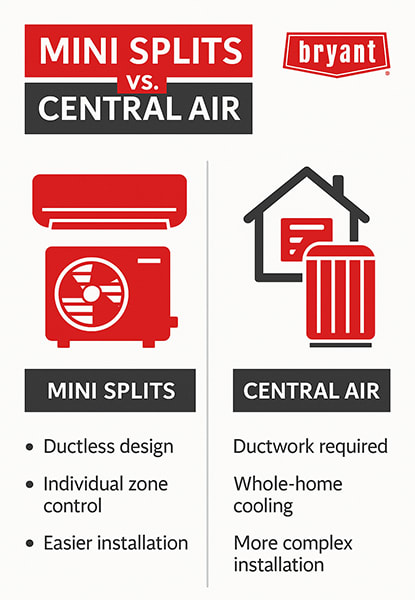
Mini Split vs Central Air: At a Glance
| Factor | Bryant Ductless Mini Split | Bryant Central Air |
| Air distribution | Individual indoor units deliver conditioned air directly to specific rooms or zones | Ductwork distributes conditioned air throughout the home |
| Typical application | Individual rooms, additions, converted spaces, or homes without suitable ductwork | Whole-home cooling where ductwork is available and properly sized |
| Cooling efficiency | Bryant ductless systems: up to 35.1 SEER2, depending on model and pairing | Bryant central air conditioners: up to 21 SEER2, depending on model |
| Heating efficiency | Bryant ductless heat pumps can provide heating as well as cooling; selected models reach up to 30 HSPF2 | Central AC provides cooling; a compatible furnace or heat pump provides heating |
| Sound | Bryant indoor high-wall units can operate as quietly as 16 dB(A), depending on model and operating condition | Bryant central AC outdoor units can operate as quietly as 55 dB(A), depending on model and operating condition |
| Square-foot coverage | No fixed square-foot range; system capacity and the number of indoor units should be selected based on the home’s heating and cooling load | No fixed square-foot range; system capacity should be selected based on a load calculation and duct system |
What is a Mini Split System?
A ductless mini split system is a flexible HVAC solution that delivers heating and cooling directly to specific zones without the need for ductwork. By connecting an outdoor condenser to one or more indoor air handlers via refrigerant lines, these systems allow homeowners to customize the temperature in individual rooms for optimal efficiency.
Bryant ductless systems include single-zone and multi-zone mini split systems. For example, the Bryant Preferred™ 37MGRA can connect two to six indoor units to one outdoor unit, while the Bryant Evolution™ 37MPRA provides up to 35.1 SEER2 cooling efficiency when paired with the specified indoor unit.
While mini split air conditioners only provide cooling, mini split heat pumps provide both heating and cooling capabilities for year-round comfort. Learn more about what is a ductless mini split.
Key Benefits of Ductless Mini Splits
Homeowners prioritizing targeted comfort and energy savings often choose mini splits. Here is why:
- Zoned Comfort: With individual air handlers, Bryant ductless mini splits can provide zoned heating and cooling, letting you set different temperatures in different areas. This can be useful when family members have different comfort preferences or when some rooms are used more frequently than others.
- High Energy Efficiency: Bryant ductless systems offer cooling efficiencies up to 35.1 SEER2 on select systems. Because ductless systems deliver conditioned air directly to indoor units, they can also avoid energy losses associated with ductwork. Actual energy savings depend on the equipment, home, climate, installation, and operation. Learn more about mini split efficiency.
- Flexible Installation: Since they don't require ducts, mini split installation is ideal for room additions, converted garages, or older homes without existing ductwork.
- Quiet Operation: Select Bryant high-wall indoor units can operate at sound levels as low as 16 dB(A), depending on the model and operating condition.
Find out more in our guide on are mini splits worth it?

What is a Central Air Conditioning System?
Central air remains a top choice for those who value consistency and aesthetics.
- Whole-Home Cooling: A Bryant central air conditioner can distribute conditioned air throughout the home through a properly designed and sized duct system, helping maintain more consistent temperatures across multiple rooms.
- Aesthetically Discreet: With equipment tucked away and only vents visible, central air preserves your home's interior design without bulky wall units.
- Cost-Effective (With Existing Ducts): If your home is already ducted, replacing an existing central AC system can be less expensive than installing multiple new ductless zones, depending on the project.
- Ideal for Large Homes: For expansive, multi-story properties, central air efficiently moves large volumes of conditioned air, maintaining a stable environment effortlessly.
Warm air is pulled into the system, passed over cool evaporator coils, and then the chilled air is distributed throughout your home via the ductwork. This process ensures a uniform temperature from room to room, making it a reliable choice for whole-home comfort.. Learn more about how does air conditioning work.
Key Benefits of Central Air Conditioning
Central air conditioning remains a trusted and efficient option for cooling an entire home. Here are four primary advantages:
- Whole-Home Cooling: A central air system can provide cooling throughout the home through a connected duct system, rather than requiring an indoor unit in each room.
- Aesthetically Discreet: Central AC systems are largely hidden from view. The only visible components are the subtle vents in each room, preserving your home's interior design.
- Lower Initial Cost With Existing Ducts: When suitable ductwork is already installed, replacing a central AC system can cost less than installing a new multi-zone ductless system, depending on the home's configuration and project scope.
- Better Suited to Existing Whole-Home Duct Systems: Central air can be an efficient way to cool larger homes when properly sized equipment is paired with properly designed and maintained ductwork.
How to Choose: Mini Split vs. Central Air
When deciding between a mini split and central air, the decision often comes down to your home's infrastructure and your specific comfort goals.
Brian Redmond, owner of Redmond’s Complete Comfort in Lock Haven, Pennsylvania, explains that choosing a mini split system often comes down to two main factors: what areas of the home need conditioning and whether the home has existing ductwork.
“If you’re not concerned with conditioning the entire home, a mini split may be a good option,” Redmond said. “Some families have kids who have moved out and only use a few rooms regularly, so they don’t need a central heating and cooling system.”
If a home lacks ductwork or sufficient space to install it properly—which can require a large amount of room—a ductless mini split can be a practical alternative.
“For example, if a home has a finished basement, we wouldn’t install ductwork,” Redmond added.
5 Factors to Consider Before Buying
- Home Size and Layout: Central air can be practical for larger, multi-story homes with existing ductwork. Mini splits can be useful for individual rooms, additions, converted spaces, or homes where extending ductwork is impractical.
- Existing Ductwork: If your home has ducts, central air may be less expensive to install or replace than adding multiple ductless zones. For homes without ducts, like historic properties or new additions, a mini split can provide conditioned air without installing a traditional duct network.
- Energy Efficiency: Compare the SEER2 rating of the specific systems rather than assuming one system type is always more efficient. Bryant ductless systems reach up to 35.1 SEER2 on select configurations, while Bryant central air conditioners reach up to 21 SEER2. Actual energy use depends on equipment efficiency, system sizing, duct condition, climate, installation quality, and how the system is operated.
- Installation and Aesthetics: Central air is discreet, with only vents visible. Mini splits require visible indoor units mounted on walls or ceilings, which can impact your room's aesthetics. Learn more about wall mounted air conditioners and ceiling cassette mini splits.
- Upfront Cost vs. Long-Term Value: Installation costs vary significantly based on equipment, home size, number of zones, ductwork, electrical requirements, and local labor rates. A higher-efficiency system may reduce energy use, but the potential savings depend on the system selected and how much it operates.

Consult With A Bryant Dealer On Mini Split vs. Central Air
The right choice between mini splits and central air depends on your specific comfort goals, home layout, existing ductwork, and budget. For flexible, room-by-room temperature control, a mini split may be a practical fit. If you need whole-home cooling and already have suitable ductwork, central air may be a practical option.
Consulting with your local Bryant dealer is the best way to assess your home’s requirements. A Bryant dealer can evaluate your home's cooling load, ductwork, equipment options, and installation requirements to help you select a system that fits your home and comfort needs.
Mini Split vs Central Air FAQs
It depends on your home and needs—mini-splits offer zoned comfort and higher efficiency, while central air is better for whole-home coverage with a clean, ducted look.
Yes, you can replace a traditional HVAC system with a multi-zone mini-split, especially in homes where ductwork is inefficient or unnecessary, but proper sizing and professional installation are essential. Learn more about 3 zone mini splits and 4 zone mini splits.
Absolutely. Many homeowners use central air for the main living areas and install a "hybrid" mini split system for hard-to-cool rooms like garages, sunrooms, or attic bedrooms to ensure total home comfort.
About The Expert Reviewer: Connor Howard serves as Product Manager for Residential Ductless Mini Splits at Bryant. He helps shape ductless heating and cooling solutions for a variety of home layouts and comfort needs. His work considers evolving homeowner expectations, energy efficiency objectives, and industry requirements to support practical, forward-looking residential comfort solutions.
Learn More About Ductless Mini Splits
- Learn all about what is a mini split
- Read our guide to mini split cost
- Discover the factors in choosing the best mini split
- Learn about the value of a multi zone mini split
- Explore mini split repair
- Learn the ins and outs of mini split maintenance


