About The Author: Travis Baugh is a Digital Brand Marketing Manager for Bryant, where he creates clear, helpful content to guide homeowners through heating, cooling, and indoor air quality decisions. His goal is to empower readers with the knowledge they need to choose the right comfort solutions for their home—confidently and comfortably.
Whole-Home Humidifier Repair: Troubleshooting and Solutions
By Travis Baugh | Expert Review By Chrystal Jolliffe - Product Manager, Indoor Air Quality
If your Bryant whole-home humidifier isn't working properly, start by ensuring the water supply valve is fully open, verifying the humidistat is set appropriately for the season, and inspecting the water panel for mineral buildup. Bryant recommends replacing the water panel at least once per heating season, with more frequent replacement possible in hard-water areas.
When your Bryant whole-home humidifier isn’t keeping up with your comfort needs, you might notice dry air, static electricity, or even cracked wood furniture. At Carrier and Bryant, our innovative solutions are centered on our customers’ needs. Use this expertly crafted guide for practical humidifier repair tips, step-by-step troubleshooting, and clear solutions to protect your long-term investment in home comfort.
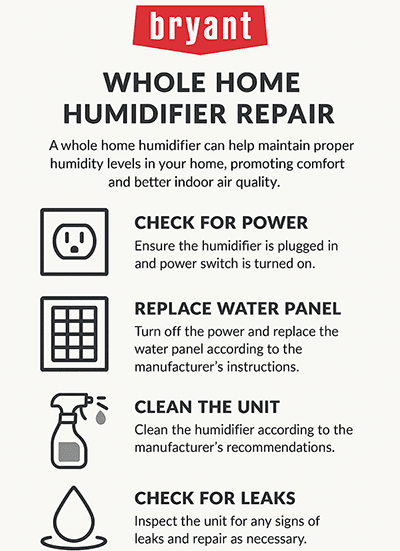
Common Whole-Home Humidifier Problems
The most common whole-home humidifier problems include low humidity output, water leaks, strange noises, and continuous running. Identifying these symptoms early is the first step to restoring dependable, quiet performance.
If you notice fluctuating humidity levels, musty smells, or increased dust, your system requires attention. Here are the specific issues and their likely causes:
- Low or No Humidity: Often caused by a clogged or heavily scaled water panel, a closed water supply valve, a lack of HVAC airflow, or a faulty humidistat sending incorrect signals. If measured indoor humidity remains below your humidistat setting despite the humidifier operating normally, check these basic conditions before scheduling service.
- Water Leaks: Usually result from a blocked drain line, restricted water flow, loose tubing or connections, or mineral buildup affecting the water distribution components. Visible water around the humidifier is a reason to shut off the water supply and investigate before continuing operation.
- Strange Noises: In fan-powered units, buzzing or rattling may indicate debris or a problem with the fan assembly. A humming sound without water flow may indicate a water-control or solenoid issue that requires professional diagnosis.
- Constant Running: A humidistat setting that is too high, inaccurate humidity sensing, or a control problem can cause the unit to run continuously. If the humidifier continues operating after the indoor humidity reaches the selected setpoint, professional diagnosis may be needed.
Bryant 4-Step Humidifier Health Check
Use this Bryant 4-Step Humidifier Health Check before scheduling service:
- Control: Confirm the humidistat is powered on and set appropriately for the season.
- Water: Confirm the water-supply valve is open and water can reach the humidifier.
- Panel: Inspect the water panel for visible mineral scale, discoloration, clogging, or other deterioration.
- Airflow: Confirm the HVAC system is operating and, for bypass models, that the bypass damper is in the appropriate position.
If these four checks do not restore normal humidity operation, contact a qualified Bryant dealer for diagnosis.

How Can You Troubleshoot Your Humidifier?
Troubleshooting a humidifier is the process of checking its controls, water supply, water panel, airflow, and drainage to identify common causes of low humidity, leaks, or unusual operation. Bryant recommends starting with these basic checks before professional service, provided homeowners can safely access the equipment and follow the owner's manual.
You can safely troubleshoot your humidifier by checking the humidistat settings, verifying the water flow at the water-supply valve, inspecting the water panel for scale, and ensuring the bypass damper is open. These straightforward steps can help identify basic problems before professional service is needed.
Before scheduling professional service, perform these checks to see if a simple fix will restore your system:
- Check the Humidistat: Ensure your humidity set point is appropriate for the current outdoor temperature. Bryant's guidance generally places comfortable indoor humidity within the 30% to 50% range, with lower settings often appropriate during colder weather to help prevent window condensation. Smart home integrations can make managing these settings seamless.
- Verify Water Flow: Locate the water-supply valve or water line and ensure it is fully open to allow water into the system. If the humidifier is calling for humidity but no water is reaching the unit, a restricted water supply or component issue may be preventing operation.
- Inspect the Water Panel: Turn off the power and check the evaporator pad. If the panel is visibly crusted with mineral deposits, discolored, clogged, or otherwise deteriorated, replace it rather than continuing to operate with a restricted panel. Bryant recommends replacing the water panel at least once per heating season. Homes with hard water may require more frequent replacement.
- Check the Damper (Bypass Models): Ensure the damper is in the appropriate open or heating-season position so air can pass through the humidifier. Bypass humidifiers rely on airflow from the furnace or air handler to move air across the water panel.
Scotty Peters, owner of CK Heating and Cooling in Seminole, Texas, explains that troubleshooting a humidifier often comes down to understanding basic system operation, safety precautions, and routine maintenance tasks.
“A lot of it depends on how comfortable you are with DIY work,” Peters said. “Do you handle basic plumbing? Are you okay cleaning drains and knowing where your water shutoff is? If something goes wrong, you also need to know how to limit any potential damage.”
He adds that simple oversights are a common cause of performance issues.
“A lot of times in older homes, people shut the water valve off in the summer to prevent leaks and let the system dry out, which is actually a good practice,” Peters said. “But then winter comes, they forget to turn it back on, and suddenly the air feels very dry again.”
Peters notes that understanding how the system is supposed to function can help homeowners avoid unnecessary service calls.
“If you understand the basic science behind how your humidifier works, it’s much easier to spot small issues before they become bigger problems,” he said.
How Do You Clean and Maintain Your Whole-Home Humidifier?
To clean and maintain your humidifier, power down the system, replace the scaled water panel, wipe down internal parts with a soft cloth, clear the drain line, and restart the unit. Bryant recommends cleaning the humidifier at least once per heating season and replacing the water panel at least once per heating season.. Regular humidifier maintenance is the most effective way to limit mineral buildup, prevent microbial growth, and avoid costly repairs down the road.
Follow these reliable steps to protect your home's air quality:
- Power Down: Turn off power to the humidifier and HVAC system before accessing internal components.
- Remove the Water Panel: Access the unit and remove the water panel according to the owner's manual. Replace it if it is worn, clogged, heavily scaled, or at the beginning of the heating season. Homes with hard water may require more frequent replacement.
- Clean Internal Parts: Wipe down the distribution tray and housing with a soft cloth. Avoid harsh chemicals. Remove loose mineral deposits according to the instructions for your specific humidifier model.
- Clear the Drain: Check the drain line for visible blockages and confirm that water can drain freely. A restricted drain can contribute to water backup and leaks.
- Restart: Reassemble the unit, restore power, and set your humidistat to the desired level. Monitor indoor humidity after restarting to confirm the system is responding to the control setting.
Peters emphasizes that homeowners can safely handle some routine humidifier maintenance, especially on bypass and fan-powered systems.
“There are basic service tasks people can do themselves,” he said. “Just always make sure the power is off before working on the unit. From there, you can check things like whether water is reaching the system, confirm valves are open, and replace or clean the humidifier pad when needed.”
Pro Tip: Inspect your water panel at the beginning of every heating season and replace it at least annually. If you have hard water or the panel becomes visibly crusted or clogged sooner, Bryant recommends replacing it more frequently.
When To Call A Professional Whole-House Humidifier Repair
You should call a professional for humidifier repair when basic troubleshooting fails, or if you encounter persistent leaks, electrical faults, water-control problems, or other component issues that cannot be resolved through routine maintenance. A local Bryant dealer has the expertise to quickly diagnose issues and ensure your system operates securely and efficiently.
During a comprehensive inspection, a trained technician will:
- Test Components: Verify the operation of the solenoid valve, humidistat, and sensing relays.
- Inspect Electrical: Check for loose connections, blown fuses, or inactive control boards that interrupt operation.
- Clear Blockages: Professionally remove stubborn mineral scale from the distribution tray and drain lines.
- Calibrate Sensors: Ensure your humidistat reads humidity levels accurately for precise control.
If you continue to experience low humidity, leaks, or unusual noises after completing the basic Bryant 4-Step Humidifier Health Check, professional service can help identify problems that are not visible during routine homeowner maintenance.
Connect With A Bryant Dealer For Humidifier Repair
Connect with your local Bryant dealer for expert humidifier repair and humidifier maintenance. Bryant dealers can quickly diagnose issues, replace worn components, and ensure your system restores balanced indoor humidity. Professional HVAC repair helps prevent future problems and keeps your home’s air comfortable and healthy year-round. Schedule an appointment today.
Humidifier Repair FAQs
Start by checking the water supply, power connection, and humidistat settings. Make sure the water panel or pad isn’t clogged, and confirm the humidifier only runs when the furnace blower is on. If basic checks don’t solve the issue, contact a qualified HVAC professional.
Common issues with whole home humidifiers include clogged water panels, mineral buildup, leaking water lines, or malfunctioning solenoid valves. These problems can restrict moisture output and reduce system efficiency if not addressed promptly.
First, ensure the humidifier is turned on and receiving water and power. Replace or clean the water panel if it’s dirty and verify the control settings. If it still doesn’t operate, schedule a professional inspection to identify electrical, valve, or control problems.
Minor issues like clogged parts or faulty valves can often be repaired. However, if the humidifier is aging, inefficient, or repeatedly failing, replacement may be more cost-effective. A Bryant dealer can assess the system and recommend the best solution for your home.
Repairs typically range from $150 to $400, depending on the issue, model, and service rates.
Check the water supply line, humidistat setting, and power connections. If the system still doesn’t run, a licensed technician can diagnose the solenoid valve or control board.
If your unit is relatively new or integrated into your HVAC system, repair is often worthwhile. Replacement may make more sense for older or inefficient units.
Whole-home humidifiers typically last 8 to 15 years, depending on model type, maintenance, and water quality.
Yes, a properly functioning humidifier allows you to feel warmer at lower thermostat settings during the winter. By fixing leaks and replacing clogged water panels, you optimize the system's performance and can actively reduce your monthly heating bills.
Learn More About Humidifiers
- Discover the best humidifier for your home
- Learn what does a humidifier do?
- Find out what humidity should my house be at?
- Learn the ins and outs of humidifier installation
- Discover humidifier benefits
- Explore the factors of whole house humidifier cost
About The Expert Reviewer: Chrystal Jolliffe is a Product Manager specializing in Residential Indoor Air Quality at Bryant. Her work centers on advancing solutions that support cleaner indoor air and a more comfortable home environment. She helps homeowners understand the role indoor air quality products can play in their homes, empowering them to evaluate their options and make informed decisions about their indoor environment.


