About The Author: Travis Baugh is a Digital Brand Marketing Manager for Bryant, where he creates clear, helpful content to guide homeowners through heating, cooling, and indoor air quality decisions. His goal is to empower readers with the knowledge they need to choose the right comfort solutions for their home—confidently and comfortably.
Heat Pump Cost (2026): Heat Pump Prices, Installation & Factors
By Travis Baugh
The cost of a heat pump depends heavily on the type of system, its efficiency rating (SEER2/HSPF2), the size of your home, and heat pump installation complexity. Most homeowners pay between $2,000 and $30,000, depending on whether they choose a ductless, ducted, or geothermal system. While premium models and necessary infrastructure upgrades can increase the initial investment, local utility rebates and long-term energy savings help offset the total cost of ownership.
What Factors Influence Heat Pump Pricing?
Several variables determine the final price of a heat pump system. Understanding these factors upfront helps homeowners budget accurately and avoid unexpected costs.
Key Factors Influencing Price
- Type of System: Your choice between air source heat pumps, geothermal heat pumps, and ductless mini split heat pumps will be the biggest cost driver. Each technology has a distinct price bracket and installation requirement.
- Efficiency Ratings (SEER2 & HSPF2): Higher efficiency units cost more upfront but deliver measurably better performance and lower monthly energy bills.
- SEER2 measures cooling efficiency; a higher rating means lower energy usage during summer.
- HSPF2 measures heating efficiency; a higher rating ensures cost-effective heating in winter.
- “The higher the efficiency, the better the performance, which generally raises the price of the units, but they can save you money in the long run by reducing energy consumption,” explains Mike Lea, co-owner of Lea Heating & Air Conditioning.
- System Size: Heat pumps are sized in tons (e.g., 3 ton heat pumps or 4-ton heat pumps). Larger homes require powerful systems with higher capacities, which naturally increases the equipment cost. Learn more about heat pump size.
- Home Infrastructure: Costs may increase if your home requires upgraded electrical wiring or ductwork modifications. Conversely, utilizing existing infrastructure can keep installation costs down.
- Indoor Equipment Pairing: Pairing a heat pump with a high-efficiency furnace (a dual fuel heating system) versus a standard air handler affects the final price.
How Much Does a Heat Pump Cost by Type?
Ducted Heat Pumps: $6,000-$25,000
Ducted heat pumps are air-source systems that connect to a home's existing ductwork, replacing a furnace and/or air conditioner to provide whole-home heating and cooling. Ducted heat pump installation or replacement typically falls between $6,000 and $25,000. Pricing varies based on factors such as location, local contractor rates, system size and features, efficiency ratings, and permit fees.
Best suited for: Homes that already have ductwork and are replacing an existing central HVAC system.
Ductless Heat Pumps: $2,000-$7,000 Per Zone
Also known as mini-split systems, ductless heat pumps do not require existing ductwork. Instead, they use one or more indoor units ("heads") connected to an outdoor compressor. A ductless mini split installation typically costs between $2,000 and $7,000 per zone. Total price depends on the number of zones, system efficiency (SEER2 rating), and installation complexity. Learn more about mini split cost.
Best suited for: Homes without ductwork, room additions, or homeowners seeking zoned comfort control.
Geothermal Heat Pumps
Also called ground-source heat pumps, geothermal systems use the stable underground temperatures for highly efficient heating and cooling. They require extensive ground loop installation (trenching or drilling), which drives up the upfront cost. The average installation cost for a geothermal heat pump system typically ranges from $15,000 to $30,000. That said, the significant long-term energy savings, exceptional system longevity, and potential tax credits make geothermal a smart long-term investment. Learn more about geothermal heat pump cost.
What Does a New Heat Pump Quote Include?
When requesting a heat pump quote, knowing what is and is not included helps you compare estimates accurately.
Typically Included
- Heat pump unit – Sized to your home's square footage and climate zone
- Indoor air handler or furnace integration – If converting from a furnace-based system
- Thermostat – Standard programmable; some quotes include smart thermostat options
- Standard installation – Labor for removing old equipment and installing the new system
- Refrigerant lines and connections – Piping and fittings between indoor and outdoor units
- Basic electrical hookups – Wiring to connect the system to your home's power supply
- Startup and testing – Ensuring the system runs efficiently and safely before handoff
- Standard warranty – Manufacturer and installation labor coverage
Common Exclusions (Often Quoted Separately)
- Major ductwork modifications – Complete redesigns or resizing of ducts.
- Electrical panel upgrades – Needed if the current panel can’t handle new system load.
- Structural work – Reinforcing floors, walls, or rooftops to support larger units.
- Permits or inspections – Some quotes may leave municipal fees out.
- Additional accessories – UV lights, air purifiers, advanced thermostats, or Wi-Fi integration.
- Extended warranties or service plans – Often optional add-ons.
How to Offset the Cost of a Heat Pump
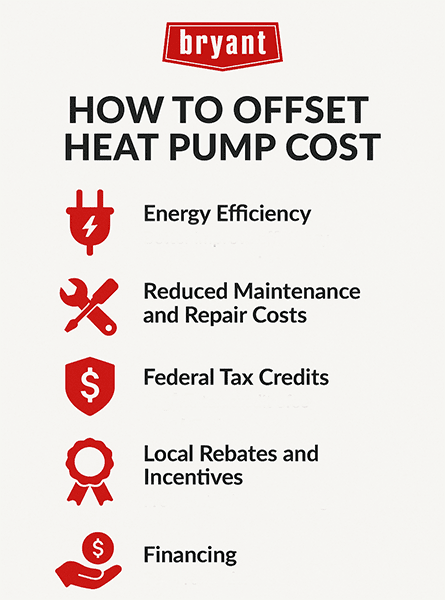
The sticker price of a heat pump is only part of the story. Several financial tools and long-term savings opportunities make the real cost of ownership far more manageable.
1. Explore Local Rebates
Financial incentives are a powerful tool for homeowners. Many utility companies and municipalities offer rebates to accelerate the adoption of electric heat pumps. These incentives can dramatically reduce the final price tag. “Whether the unit hits rebates can really influence the heat pump cost pretty dramatically,” notes Lea.
2. Calculate Energy Efficiency Savings
High-efficiency heat pumps are engineered to reduce monthly utility bills. Over the system's lifespan, these operational savings can effectively "pay back" the upfront cost premium compared to less efficient, legacy models—making the value case clear for homeowners focused on long-term investment.
3. Reduced Maintenance Costs
Because heat pumps do not use a combustion process and often have fewer moving parts than traditional furnaces, heat pump maintenance is generally less intensive than maintenance for other HVAC systems. While regular inspections and filter changes remain essential, homeowners may spend less on heat pump repairs over time.
4. Flexible Financing
Upfront costs should not delay a comfort upgrade that pays dividends for years. Many Bryant dealers offer flexible financing options, allowing homeowners to install a premium system immediately while managing payments over time—efficiency that pays for itself, starting day one.
Get an Accurate Heat Pump Cost Estimate from a Bryant Dealer
The most accurate way to determine your specific heat pump cost is to get a professional estimate. A local Bryant dealer will assess your home's unique needs, recommend the most efficient system for your budget, and help you navigate available rebates and financing Call or schedule an appointment with your local Bryant dealer for heat pump replacement today.
Heat Pump Cost FAQs
A properly maintained heat pump typically lasts 12 to 15 years, though higher-quality models and regular maintenance can extend this lifespan up to 20 years.
On average, installing a new heat pump costs between $6,000 and $25,000. Factors affecting the final price include system capacity, efficiency, brand, location, and permitting fees.
For most 3-bedroom homes, you can expect installation costs to be in the range of $7,000 to $18,000, depending on the home’s square footage, climate zone, and the heat pump’s efficiency rating.
For a 2,000-square-foot home, heat pump installation or replacement typically ranges from $6,000 to $15,000, depending on system size, efficiency, local labor costs, and any additional installation requirements.
Replacement typically takes 1 to 3 days, depending on the complexity of the installation, whether ductwork needs modification, and the size of the system being replaced.
Heat pump installation is not recommended as a DIY project. Proper installation requires specialized tools, electrical work, refrigerant handling, and adherence to local codes. Professional installation ensures efficiency, safety, and warranty coverage.
Yes, many high-efficiency heat pumps qualify for federal, state, and local rebates or tax incentives. These programs often target ENERGY STAR® or other certified units and can significantly offset the upfront cost.
Learn More About Heat Pumps
- Discover what is a heat pump
- Understand what is an electric heat pump
- Explore cold climate heat pumps
- Read up on dual fuel heat pumps
- How do I know if I have a heat pump?
- Learn about heat pump benefits