About The Author: Travis Baugh is a Digital Brand Marketing Manager for Bryant, where he creates clear, helpful content to guide homeowners through heating, cooling, and indoor air quality decisions. His goal is to empower readers with the knowledge they need to choose the right comfort solutions for their home—confidently and comfortably.
Propane Furnace Guide
By Travis Baugh
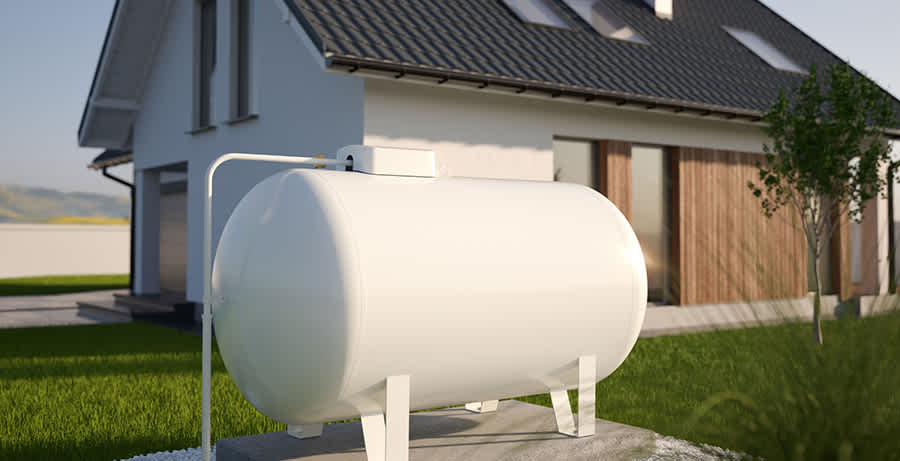
A propane furnace is a high-efficiency heating system that uses liquid propane to generate consistent, powerful warmth throughout your home. Typically stored in an external tank, the fuel is converted into heat that is distributed through a home's ductwork. These systems are renowned for their powerful heating performance in extreme cold, making them an ideal solution for homeowners seeking energy independence without access to natural gas lines.
Why Choose a Propane Furnace?
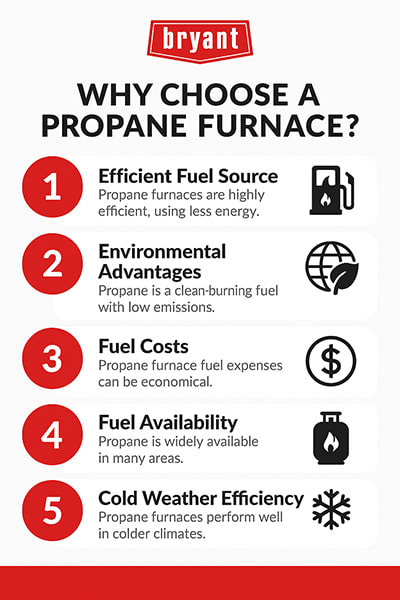
A propane gas furnace offers superior fuel efficiency, clean-burning performance, and reliable heat in extreme cold. For homeowners prioritizing long-term comfort and efficiency, a propane furnace provides distinct advantages over electric resistance or oil alternatives. Propane burns hotter and cleaner, delivering robust warmth even when outdoor temperatures plummet.
Key Benefits of Propane Heating
- Superior Fuel Efficiency: Propane is a high-density fuel source, meaning it produces significant heat with less consumption. Propane furnaces excel at converting fuel into heat, often outperforming other types of furnaces in AFUE ratings. This efficiency translates to lower energy bills and a reduced carbon footprint.
- Energy Independence: Propane allows you to operate independently of local natural gas infrastructure. This is a game-changer for homes in rural or off-grid areas where natural gas lines aren't available, ensuring reliable heat regardless of your location.
- Environmental Responsibility: Propane is a clean-burning fuel that emits fewer greenhouse gases than many other fossil fuels. By choosing propane, you are making a conscious decision to reduce air pollution while maintaining a warm, comfortable home.
- Cost-Effective Operation: While fuel prices fluctuate, propane is often more economical than oil or resistive electric heating. Furthermore, modern propane furnaces are built for durability, generally requiring less maintenance over their lifespan compared to oil furnaces.
- Extreme Weather Performance: When temperatures plummet, you need a system that keeps up. Propane burns hotter than natural gas, providing a warmer air temperature at the vent. This makes it highly effective in colder climates where electric heat pumps might struggle to keep up without backup heat.
Andrew Mackey, owner of Superior Service in Lake St. Louis, Missouri, considers propane furnaces a viable heating option for certain homeowners.
“Although propane can be more expensive in some markets, it is more efficient and burns cleaner than natural gas,” Mackey said. “Propane is also available in rural areas where natural gas may not be, giving homeowners the option of a more efficient propane furnace instead of an all-electric system.”
How much does a propane furnace cost?
The cost of installing a new propane furnace typically ranges between $3,000 and $6,000, including the unit and professional installation labor.
While the initial investment might be higher than some entry-level options, the efficient combustion of a propane gas furnace helps lower heating bills over the system's life. Three main factors influence your final investment:
- Furnace Size (Capacity): Larger homes require furnaces with higher BTU ratings to maintain comfort. A unit sized correctly for your square footage is essential for efficiency, though larger units will naturally cost more upfront.
- Efficiency Ratings (AFUE): High-efficiency models (90% AFUE and above) capture more heat from the fuel. While they have a higher initial price tag, they often pay for themselves over time through significant monthly energy savings.
- Advanced Technology: The best propane furnace models feature variable-speed blowers, modulating burners, and smart thermostat compatibility. These features optimize airflow and temperature consistency, offering premium comfort and long-term savings despite a higher purchase price.
Learn more about how much is a new furnace.
Can I convert a natural gas furnace to propane?
Yes, converting a natural gas furnace to propane using a manufacturer-approved conversion kit. This procedure must always be performed by a licensed HVAC professional.
Because the two fuels burn differently, a technician must replace burner orifices and install specific pressure switches. Most Bryant furnaces, including high efficiency furnaces with up to 98% AFUE, are engineered to be convertible. Safety Note: Never attempt this yourself. Working with gas components requires specific training and licensing.
Maximize Propane Furnace Efficiency and Lifespan
You can maximize the efficiency and lifespan of your propane furnace by sealing ductwork, scheduling annual maintenance, and integrating smart controls. Follow these steps to ensure your investment delivers value for years to come:
- Seal Your Ductwork: Leaky ducts can lose up to 30% of your heated air. Ensure your ducts are professionally sealed and insulated so the heat reaches your living rooms, not your attic.
- Professional Installation: A furnace is only as good as its installation. Rely on a certified HVAC professional for furnace installation to ensure the unit is sized and vented correctly for peak performance.
- Annual Maintenance: Don't skip the furnace tune-up. Scheduled annual furnace maintenance ensures your system runs cleanly and helps catch minor issues before they become expensive furnace repairs.
- Smart Thermostat Integration: Pair your furnace with a smart thermostat. These devices learn your schedule and adjust heating automatically, preventing energy waste when you aren't home.
Why Choose A Bryant Propane Furnace
If you are looking for the best propane furnace for your home, Bryant offers solutions that blend visionary innovation with proven reliability.
Evolution™ Series highlights:
- Quiet Operation: Enjoy warmth without the noise.
- Top-Tier Efficiency: Up to 98.3% AFUE savings means nearly all fuel is converted to heat.
- Perfect Heat® Plus: Variable-speed airflow technology keeps you comfortable year-round.
Select Evolution™ furnaces come with the 10-year Bryant Red Shield Unit Replacement Limited Warranty if registered within 90 days. If a major component like the heat exchanger fails due to defect, a one-time replacement with a comparable unit will be provided.¹
“Bryant’s equipment continues to improve in energy efficiency rankings, noise level reductions, and overall quality of performance, keeping our customers satisfied,” Melissa Frause, owner of Bob’s Heating and Air Conditioning in Woodinville, WA, said.

Connect With A Bryant Dealer
Ready to invest in your home's long-term comfort? Whether you need a furnace replacement or furnace service, a local expert is your best resource. Schedule an appointment with your local Bryant dealer to get started today.
1 Unit replacement limited warranty is not available to subsequent owners. The limited warranty period is five years if not registered within 90 days except in jurisdictions where warranty benefits cannot be conditioned on registration will automatically receive a 10-year unit replacement limited warranty. See limited warranty certificate for complete details and restrictions.
Propane Furnace FAQs
Propane furnaces can be more expensive to run than natural gas due to higher fuel costs, especially in regions where propane prices fluctuate or supply is limited.
A 500-gallon propane tank can last 1 to 3 months in winter, depending on your home’s size, climate, insulation, and furnace efficiency.
Heating with propane can be more expensive than natural gas or heat pumps, but it may be more cost-effective in rural areas where other energy sources are unavailable.
Cons include higher fuel costs depending on your area, regular tank refills, potential supply issues, and carbon emissions, making it less environmentally friendly than electric alternatives like heat pumps.
Installed costs generally range from $3,000 to $6,000, depending on efficiency rating, capacity, and local labor rates.
A well-maintained propane furnace typically lasts 15 to 20 years.
Professional maintenance should be done once a year, ideally before the heating season begins.
Natural gas is usually cheaper per BTU, but propane can be more efficient and is often used in areas without natural gas service.
Yes, this is called a "dual fuel" or hybrid system. The heat pump handles moderate temperatures efficiently, while the propane furnace takes over automatically during extreme cold snaps for maximum efficiency and comfort.
Yes, propane heating is very safe when installed and maintained by professionals. Modern furnaces have built-in safety switches, and propane tanks are equipped with regulators to ensure safe pressure levels.
Not necessarily; many homeowners lease tanks from their propane supplier. Leasing often includes maintenance and free repairs for the tank, while buying offers freedom to shop around for fuel prices but requires you to handle maintenance.
Yes, a propane furnace requires electricity to power the blower motor, electronic ignition, and smart thermostat. In the event of a power outage, the furnace will not run unless connected to a backup generator.
Learn More About Furnaces
- Learn about furnace repair
- Explore what is a furnace
- Find out how long does a furnace last
- Read our guide on furnace troubleshooting
- Learn about the importance of furnace cleaning
- Understand the ins and outs of a furnace tune-up


