About The Author: Travis Baugh is a Digital Brand Marketing Manager for Bryant, where he creates clear, helpful content to guide homeowners through heating, cooling, and indoor air quality decisions. His goal is to empower readers with the knowledge they need to choose the right comfort solutions for their home—confidently and comfortably.
Why is a Garage Mini Split the Ideal Heating and Cooling Solution?
By Travis Baugh
A garage mini split is a ductless heating and cooling system designed to control the temperature in your garage independently from the rest of your home. It delivers targeted, energy-efficient comfort without requiring an extension of your central ductwork — making it the ideal solution for transforming a garage into a livable, functional space like a gym, workshop, or recreation room.
Unlike tapping into your home's central HVAC system, a dedicated garage mini split provides independent temperature control, improved air quality, and superior energy efficiency. Read on to learn how to choose the right system, what mini split installation costs to expect, and how to get the most out of your investment. For ongoing care, see Bryant's guides on mini split maintenance.
Why Choose a Ductless Mini Split for Your Garage?
A dedicated garage mini split offers precise temperature control, cleaner air, and stronger energy efficiency than extending a central HVAC system — all without invasive ductwork installation.
Benefits of a Garage Mini Split
Installing a ductless mini split system in your garage meaningfully enhances the space with quiet, efficient comfort and healthier air quality. Here is what sets a dedicated mini split apart:
- Energy efficiency: Mini splits are known for their minimal energy consumption compared to traditional HVAC systems, which translates directly into lower energy bills. You can enjoy a comfortable garage without a major impact on your budget.
- Versability: A ductless air conditioner provides powerful cooling, while a ductless heat pump can provide both heating and cooling. This adaptability ensures your garage remains comfortable year-round, regardless of the weather outside.
- Improved indoor air quality: Many models include advanced filtration that removes dust, allergens, and airborne pollutants. By regulating humidity and maintaining consistent temperatures, a garage mini split also discourages moisture buildup and mold growth — creating a healthier environment for work or exercise.
- No ductwork required: Installation is minimally invasive, requiring only a small hole in the wall for refrigerant lines. This preserves your garage's structural integrity and thermal envelope.
Brian Redmond, owner of Redmond’s Complete Comfort in Lock Haven, Pennsylvania, explains why connecting a garage to your home's central HVAC system is not the recommended approach.
“Typically, garages are not part of the home’s envelope because they’re not connected to the basement,” Redmond said. “The best solution is to install a dedicated mini split system, which gives you independent control and efficient comfort for that space.”
How to Choose the Right Garage Mini Split
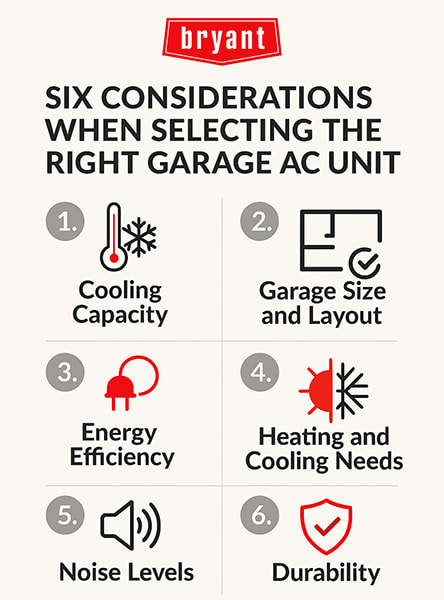
Selecting the right garage mini split comes down to six factors: cooling capacity, energy efficiency ratings, climate, garage layout, noise level, and durability. Balancing these considerations ensures your system performs efficiently for years to come.
1. What Size Mini Split Do I Need for a Garage?
Sizing is the single most critical factor for both comfort and efficiency. An undersized unit will struggle to cool or heat effectively. An oversized unit will short-cycle — cooling the space too quickly without removing enough humidity, and wasting energy in the process.
General BTU guidelines by garage size:
- 1-Car Garage (~200-300 sq. ft.): Typically requires 9,000 to 12,000 BTUs.
- 2-Car Garage (~400-600 sq. ft.): Typically requires 12,000 to 18,000 BTUs.
- 3-Car Garage (~600+ sq. ft.): May require 18,000 to 24,000 BTUs.
Note: Poor insulation or high ceilings may require increased BTU capacity. Always consult a local Bryant dealer for a precise load calculation tailored to your specific garage.
As Redmond cautions: "Your operating costs will be much higher if you install a unit that's too large, since the bigger compressor will run unnecessarily. Oversizing also prevents proper dehumidification, because the system cools the space so quickly that it shuts off before removing enough moisture from the air."
2. Efficiency Ratings (SEER2 and HSPF2)
SEER2 (Seasonal Energy Efficiency Ratio) measures cooling efficiency; HSPF2 (Heating Seasonal Performance Factor) measures heating efficiency. Higher ratings on both scales mean the system delivers more comfort per dollar of electricity — maximizing long-term savings and reducing your environmental footprint.
3. Climate Considerations
- Cold Climates: Choose a mini split heat pump engineered for low-ambient heating. Bryant systems are built to perform in extreme cold, keeping your garage warm even when outdoor temperatures plummet.
- Hot Climates: A cooling-only ductless air conditioner might suffice, but a mini split heat pump offers versatility if you ever need supplemental warmth.
4. Indoor Unit Styles
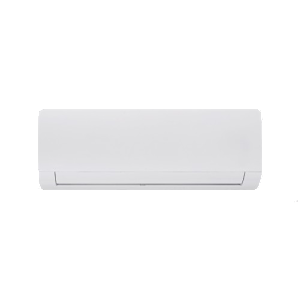
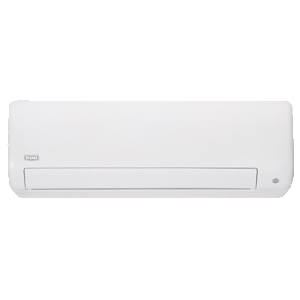
- High-Wall Units: The most popular choice; mounts high on the wall to stay out of the way of storage and vehicles. Learn more about wall-mounted air conditioner units.
- Ceiling Cassettes: Flush-mounted into the ceiling for a sleek look that doesn't take up wall space. Learn more about ceiling-mounted cassette units.
- Floor-Mounted Consoles: Ideal if you have low ceilings or limited wall space high up
Installation and Costs
How much does it cost to install a mini split in a garage?
Professional garage mini split installation typically costs between $2,000 and $7,000. The final price depends on the unit's BTU capacity, efficiency rating, your home's electrical requirements, and local labor rates.
For a full breakdown, visit Bryant's guide on mini split cost.
How Can You Maximize Your Garage Mini Split’s Effectiveness?
Three strategies have the greatest impact on long-term efficiency and comfort:
- Strategic indoor unit placement. A Bryant dealer will position the indoor unit centrally to ensure even air distribution throughout the space. Avoid placement near shelving or obstructions that block airflow.
- Adequate garage insulation. A well-sealed, well-insulated garage dramatically reduces energy loss. Sealing gaps around windows, doors, and the garage door itself allows the mini split to maintain a consistent temperature with far less effort.
- Integration with Smart Thermostats. Smart thermostats allow you to set schedules, monitor energy usage, and adjust temperatures from your smartphone. This technology ensures your garage is always comfortable when you need it while optimizing energy efficiency.

Connect With A Bryant Dealer On Ductless Mini Splits For Garage
Connect with your local Bryant dealer to get a quote for mini split cost and find the ideal ductless mini-split for your garage, ensuring efficient heating and cooling tailored to your space. Their expertise will help you select the right system based on your garage's size, insulation, and climate, providing year-round comfort. A Bryant dealer will guide you through the selection, installation, and maintenance process for optimal performance. Schedule an appointment today.
Compare Bryant Garage Mini Splits
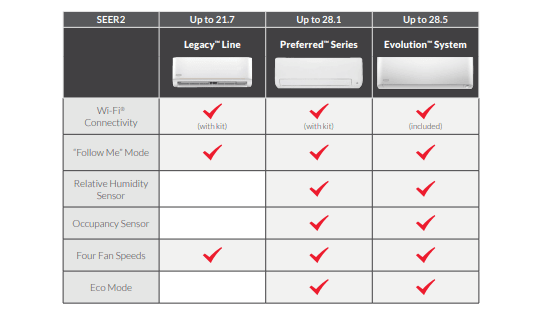
When it comes to keeping your garage comfortable, Bryant offers an impressive selection of mini split systems designed specifically for residential needs. Our range includes models featuring advanced energy efficiency, whisper-quiet operation, and smart technology integration. Whether you need a compact unit for a small workspace or a more robust system for a larger garage, Bryant has the perfect solution tailored to your requirements.
Garage Mini Split FAQs
Yes, a mini split is a good option for a garage because it provides both heating and cooling without requiring ductwork.
Installing a mini split in a garage typically costs between $2,000 and $7,000, depending on system size and installation complexity.
Most two-car garages need between 9,000 and 18,000 BTUs of capacity, but the right size depends on insulation, climate, and how you use the space.
You can, but it is not recommended. Without insulation, the system will work much harder to maintain temperature, leading to higher energy bills and potential wear on the unit. Insulating your garage door and walls is a cost-effective way to improve performance.
No, mini splits are highly energy-efficient. Because they allow you to condition the garage only when you are using it (zoning), they are significantly cheaper to run than space heaters or extending central AC.
If you plan to use your garage in the winter, a heat pump is the best choice. It offers both heating and cooling in one unit. If you live in a region that never freezes and only need relief from summer heat, a cooling-only unit is sufficient.
With proper maintenance, a mini split system typically lasts 15–20 years. Regular filter cleaning, annual professional servicing, and keeping the outdoor unit clear of debris are the most effective ways to extend system life. Learn more about mini split maintenance.
Yes. Many Bryant mini split models feature multi-stage filtration that captures dust, allergens, and airborne pollutants. By also regulating humidity, a garage mini split actively discourages mold growth — making it a meaningful air quality upgrade for garage gyms, workshops, and hobby spaces.
Learn More About Ductless Mini Splits
- Learn all about what is a mini split
- Discover the factors in choosing the best mini split
- Understand what size mini split do I need?
- Find out are mini splits worth it?
- Learn all about mini split vs central air
- Understand do mini splits turn off when temperature is reached?


