About The Author: Travis Baugh is a Digital Brand Marketing Manager for Bryant, where he creates clear, helpful content to guide homeowners through heating, cooling, and indoor air quality decisions. His goal is to empower readers with the knowledge they need to choose the right comfort solutions for their home—confidently and comfortably.
What Size AC Unit Do I Need?
By Travis Baugh
To find the right AC unit size, you must determine your home's cooling needs in BTUs (British Thermal Units), understand efficiency ratings like SEER2, and get a professional load calculation. Choosing the correct air conditioner size is crucial for ensuring your home remains comfortable, energy-efficient, and free from issues like short cycling or inadequate cooling.
An AC unit that's too small will run constantly without effectively cooling your space, while one that's too large will cycle on and off too frequently, failing to control humidity and wasting energy. This guide will help you understand the essential steps to make an informed decision for your home's long-term comfort.
How to Determine the Right AC Size
While many homeowners look for a quick "square footage" rule of thumb, sizing an air conditioner correctly is a science. If you are replacing an air conditioner or installing a new air conditioner, understanding the technical requirements is the first step toward long-term satisfaction.
Why You Need a Professional Manual J Calculation
A professional HVAC contractor should always perform a Manual J calculation to determine your home’s precise heating and cooling load. This assessment ensures your AC unit is perfectly sized for your specific needs, preventing performance issues. Mike Lea, co-owner of Lea Heating & Air Conditioning, calls this calculation "the only right way to size an air conditioner." It accounts for details that square footage misses, such as:
- Insulation levels: How well your home retains cold air.
- Window orientation: How much solar heat enters your rooms.
- Roof type: Darker roofs absorb more heat than lighter ones.
- Local climate: The peak temperatures your system must combat.
"The primary goal of utilizing the manual load calculator is to avoid undersizing or oversizing an air conditioning unit," Lea says. "Oversizing or undersizing the unit can lead to higher energy bills and less comfort in the house."
Understanding AC Ratings: BTUs, SEER2, and EER2
To make an informed decision, you need to speak the language of efficiency. Understanding these three acronyms will help you choose a system that balances power with energy savings.
What is a BTU?
BTU, or British Thermal Unit, measures the amount of heat an air conditioner can remove from a room in one hour.
- Higher BTU: Greater cooling power.
- General Rule: A 300 to 400-square-foot room typically requires roughly 8,000 to 10,000 BTUs. However, matching BTUs specifically to your home’s load profile is essential for efficiency.
What are SEER2 and EER2?
Efficiency ratings tell you how much cooling you get for the electricity you pay for.
- SEER2 (Seasonal Energy Efficiency Ratio 2): This rating measures the cooling output of an AC unit over a typical cooling season divided by its energy consumption. A higher SEER2 rating means greater energy efficiency, leading to lower cooling bills. For new residential air conditioning systems in 2025, look for a SEER2 rating of 16 or higher for maximum efficiency.
- EER2 (Energy Efficiency Ratio 2): This measures efficiency at a fixed outdoor temperature of 95°F, indicating how well the system performs under peak heat conditions.
The Risks of Improper AC Sizing
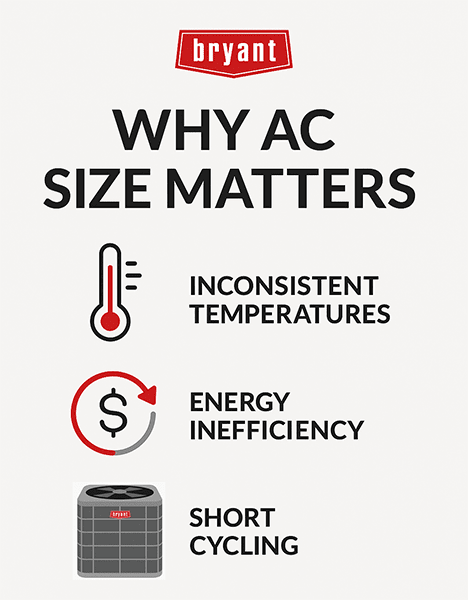
Size matters. An improperly sized unit doesn't just waste money—it compromises your comfort and the longevity of the equipment
David Fowler, owner of Family Heating and Air in Pensacola, Florida, said choosing the right size for your HVAC unit is crucial for maintaining energy efficiency and keeping your cooling bills in check.
“It’s important to match the unit’s size with the actual load of the home," Fowler said. "If it’s too big, it will cycle on and off too frequently and fail to maintain comfort; if it’s too small, it won’t run enough and can lead to humidity issues in the home.”
What Are the Consequences of an Undersized AC Unit?
An AC unit that is too small for your home will struggle to maintain a comfortable temperature, especially during the hottest days of summer. This constant strain leads to several problems:
- Inadequate Cooling: The unit will run continuously but fail to effectively cool your living space, leaving your home warm and uncomfortable.
- Increased Wear and Tear: Working overtime causes excessive strain on components, leading to more frequent breakdowns, costly AC repairs, and a shorter system lifespan.
- Higher Energy Costs: The unit consumes more electricity as it runs longer to try and reach the desired temperature, resulting in significantly higher cooling bills.
What Are the Consequences of an Oversized AC Unit?
An air conditioner that is too large for your space is just as problematic as one that is too small. The main consequences include:
- Frequent On/Off Cycling: An oversized unit cools the space too quickly and shuts off, then repeats this cycle frequently. This "short cycling" wastes energy and puts unnecessary stress on the system.
- Poor Humidity Control: Because the system doesn't run long enough during each cycle, it cannot effectively remove moisture from the air. This results in a clammy, uncomfortable indoor environment.
- Higher Upfront and Maintenance Costs: Larger units typically have a higher purchase price and may require more expensive maintenance over their lifespan.
How Do I Choose the Right Type of Air Conditioner?
Choosing the right type of air conditioner is the first step to ensuring your home stays comfortable. The two main types are central air conditionining systems and ductless mini splits.
- Central Air Systems: These are ideal for homes with existing ductwork and homeowners who want whole-home cooling with even temperatures throughout every room.
- Ductless Mini Splits System: These work best for homes without ducts, additions, or spaces where you want individualized temperature control and higher energy efficiency.
For most homeowners seeking total comfort, a central air conditioning system is the best option. Modern energy-efficient models can also significantly reduce cooling bills while delivering optimal performance.
Connect With A Bryant Dealer on The AC Size You Need
Still not sure what size air conditioner your home needs? A local Bryant dealer can provide expert guidance to select the right AC size based on a professional assessment of your home's unique characteristics. Schedule an appointment today to find the best air conditioner for your home.

FAQs On AC Sizes
A 3-ton AC unit typically cools around 1,500 to 1,800 square feet, depending on insulation, ceiling height, and climate zone.
Most 2,000 square-foot homes require a 3.5 to 4-ton AC unit, though exact sizing should be confirmed with a professional load calculation from your local Bryant dealer.
A 2-ton AC unit can generally cool 800 to 1,200 square feet, depending on the home's efficiency and environmental factors.
A 3-ton AC may struggle to efficiently cool a 2,000 square-foot home, especially in warmer climates or poorly insulated homes—it could result in inadequate cooling or overworking the system. Talk to your local Bryant dealer to ensure proper AC sizing.
Learn More About Air Conditioners
- Learn about types of air conditioners
- Understand how does air conditioning work
- Get in the know on air conditioning service
- Find out what is an inverter air conditioner
- Discover the difference in a heat pump vs air conditioner
- Find out what temperature to set air conditioner in summer


