About The Author: Travis Baugh is a Digital Brand Marketing Manager for Bryant, where he creates clear, helpful content to guide homeowners through heating, cooling, and indoor air quality decisions. His goal is to empower readers with the knowledge they need to choose the right comfort solutions for their home—confidently and comfortably.
What is a Variable Speed Heat Pump?
A variable speed heat pump uses an inverter-driven compressor to adjust its operating speed to match the heating or cooling needs of a home. Unlike single-stage systems that turn on at full capacity and then shut off, a variable speed heat pump can operate at different capacities for longer cycles. Bryant Evolution™ Extreme variable speed heat pumps, including the 293VAN, deliver up to 23 SEER2 and up to 10.5 HSPF2, with sound levels as low as 53 decibels.
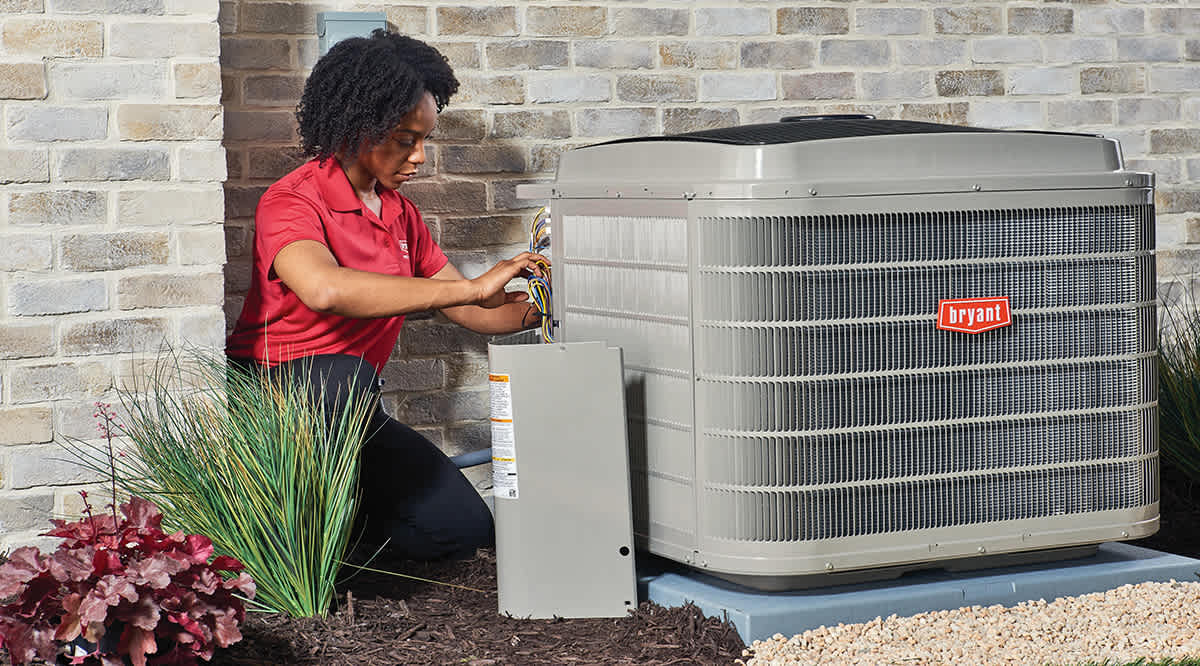
How Does a Variable Speed Heat Pump Work?
A Bryant variable speed heat pump uses inverter technology to continuously adjust compressor operation as conditions change, allowing the system to match its output more closely to the heating and cooling demand. For example, Bryant's Evolution Extreme Cold Climate Heat Pump (291VAN) can operate down to 30% capacity, while the Evolution 293VAN can operate down to 20% capacity. Capacity ranges vary by model, so a specific system's product specifications should be checked rather than assuming every variable speed heat pump operates across the same range.
This intelligent modulation means the heat pump can increase output during periods of high heating or cooling demand and reduce output as conditions change, helping maintain a more consistent indoor temperature.
Traditional single-stage heat pumps operate on a simple "all or nothing" principle. They blast cold or warm air at 100% capacity until the thermostat registers the desired temperature, then shut off completely until the room becomes uncomfortable again. Two-stage heat pumps offer a middle ground by using a low setting for most heating and cooling needs and switching to high only during extreme temperature demands. In contrast, a variable speed heat pump rarely shuts off. Instead, it operates at lower, more efficient speeds for longer periods. This continuous cycle prevents the massive energy spikes associated with constant starting and stopping.
In contrast, Bryant variable speed heat pumps can operate at lower capacities for longer cycles, helping provide more consistent temperature and humidity control. Bryant's Evolution™ Extreme heat pumps also use Perfect Humidity™ Technology and, on select systems, Evolution™ controls to help manage indoor humidity.
By analyzing operating conditions and information from compatible controls and sensors, Bryant variable speed heat pumps can automatically adjust operation to changing conditions. The result is a system designed to provide consistent heating and cooling while managing efficiency, sound and humidity.
What Are the Key Benefits of a Variable Speed Heat Pump?
Bryant variable speed heat pumps are designed to provide efficient heating and cooling, consistent temperature control, enhanced humidity management and quiet operation. Because the compressor can operate at lower capacities for longer cycles, variable speed technology can help the system better match the heating and cooling load rather than repeatedly operating at full capacity.
Bryant's Evolution Extreme 23 293VAN, for example, is rated up to 23 SEER2 and 10.5 HSPF2 and operates as quietly as 53 decibels, depending on the system configuration and operating conditions. Learn more about heat pump benefits.
How Does a Variable Speed Heat Pump Improve Energy Efficiency?
A Bryant variable speed heat pump can improve efficiency by adjusting its output to changing heating and cooling demand instead of operating only at full capacity. Inverter technology allows the compressor to vary its speed, which can help reduce unnecessary cycling and maintain more consistent operation.
When a single-stage air conditioner or heat pump turns on, the compressor operates at its available capacity until the thermostat reaches the target temperature. A variable speed system can instead operate at lower capacities when demand is lower and increase output when additional heating or cooling is needed.
Bryant's published ratings demonstrate the efficiency potential of its variable speed heat pumps. For example, the Bryant Evolution Extreme 23 293VAN offers cooling efficiency up to 23 SEER2 and heating efficiency up to 10.5 HSPF2. Actual energy use depends on the equipment combination, installation, climate, home characteristics and operating conditions.
Furthermore, operating at lower capacities for longer cycles can support humidity removal during cooling. Bryant's Evolution Extreme systems are designed with enhanced dehumidification capabilities, and certain Evolution Extreme heat pumps can remove up to 70% more moisture per day than a single-stage system under specified test conditions. Learn more about energy efficient heat pumps.
How Does a Variable Speed Heat Pump Enhance Indoor Comfort?
Bryant variable speed heat pumps are designed to enhance indoor comfort by adjusting output to the home's heating and cooling demand, helping maintain more consistent temperatures and supporting humidity control. Longer, lower-capacity cycles can provide steadier airflow and reduce the temperature swings that may occur with frequent full-capacity cycling.
Humidity control is an important factor in home comfort. During cooling, longer operating cycles can give the system more opportunity to remove moisture from indoor air. Bryant's Evolution™ Extreme heat pumps include Perfect Humidity™ Technology for enhanced humidity management when properly matched with compatible controls. Learn more about what humidity should my house be at?
Variable Speed vs. Single-Stage Heat Pumps: What is the Difference?
The main difference between a Bryant variable speed heat pump and a single-stage heat pump is how the compressor adjusts its output. A single-stage heat pump operates at one capacity when running, while a variable speed heat pump can adjust its operating capacity based on system demand.
| Feature | Single-Stage Heat Pump | Bryant Variable Speed Heat Pump |
| Compressor operation | One operating capacity | Variable-speed operation |
| Temperature control | Cycles on and off | Adjusts output to match demand |
| Humidity management | Standard | Enhanced on compatible Bryant systems |
| Sound | Varies by model | Select Bryant models as low as 53 dB |
| Efficiency | Varies by model | Select Bryant models up to 23 SEER2 / 10.5 HSPF2 |
| Upfront cost | Typically lower | Typically HIGHER |
A single-stage heat pump may be appropriate for homeowners who prioritize a lower initial equipment cost and straightforward operation. A Bryant variable speed heat pump may be a consideration for homeowners who prioritize efficiency, temperature consistency, humidity management and quieter operation
Learn more about heat pump cost when comparing variable speed vs single stage heat pumps.
Is a Variable Speed Heat Pump Right for Your Home?
A Bryant variable speed heat pump may be a good fit for homeowners who value consistent indoor comfort, quiet operation, humidity management and high seasonal efficiency.
They tend to perform especially well in homes with good insulation, properly sized ductwork, and compatible controls. The right system depends on factors such as climate, home size, insulation, ductwork, equipment sizing and the efficiency rating of the complete system.
Variable speed heat pumps typically have a higher upfront cost than single-stage systems. Bryant's current heat pump installation guide notes that advanced systems, including models with variable-speed compressors, can carry higher upfront costs, while the final price varies based on system size, efficiency, installation requirements and local labor costs. Learn more about heat pump cost.
If your current system is older, less efficient, or struggles to maintain consistent temperatures, a Bryant dealer can evaluate whether a variable speed heat pump is an appropriate replacement option for your home.
Talk to your local Bryant dealer about scheduling heat pump installation. Don't forget to explore available financing options and utility rebates that can help with the upfront cost of a variable speed heat pump. Many homeowners are surprised by how much these incentives can help make a variable speed heat pump a realistic option for their home.
Variable Speed Heat Pump FAQs
Because a variable speed heat pump runs continuously, it constantly pushes indoor air through the system's filtration media, effectively removing more dust, allergens, and humidity than a traditional HVAC system.
A variable speed heat pump does run almost continuously, but it does so at very low, energy-efficient speeds to maintain a consistent temperature rather than constantly turning on and off.
Yes, modern variable speed cold climate heat pumps are engineered with advanced cold-climate technology that allows them to efficiently extract heat from the outside air even when temperatures drop below freezing.
Yes, variable speed heat pumps can be worth the extra cost because they offer enhanced home comfort their superior energy efficiency can help offset the higher installation price through lower monthly energy bills over the system's lifespan. Local utility rebates can potentially help offset the installation cost as well.


