About The Author: Travis Baugh is a Digital Brand Marketing Manager for Bryant, where he creates clear, helpful content to guide homeowners through heating, cooling, and indoor air quality decisions. His goal is to empower readers with the knowledge they need to choose the right comfort solutions for their home—confidently and comfortably.
How Many Carbon Monoxide Detectors Do I Need
By Travis Baugh
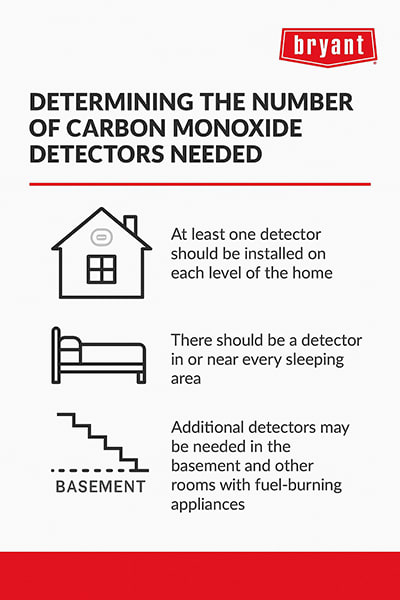
You need at least one carbon monoxide (CO) detector on every level of your home, including basements. Additionally, detectors must be placed outside each sleeping area (within 15 feet of bedroom doors) and inside any bedroom containing a fuel-burning appliance. For homes with attached garages or large floor plans, additional units are recommended for maximum safety.
Determining the Number of Detectors Needed
Protecting your family starts with smarter safety decisions. Ensuring your home has the correct number of carbon monoxide detectors is a critical investment in your long-term comfort and safety. The exact number required depends on your home’s specific layout and features.
Key Factors for Coverage
- Multi-Level Homes: Install a detector on every floor, including the basement and any habitable attic spaces. CO gas mixes with air and can travel throughout the house, so a single unit on the ground floor is insufficient.
- Sleeping Areas: The most critical function of a CO alarm is to wake you up if toxic gas accumulates while you sleep. Place a unit in the hallway within 15 feet of every bedroom door. If you sleep with doors closed, consider placing units inside the bedrooms as well.
- Square Footage: For larger homes or long hallways, a single detector may not be loud enough to be heard everywhere. Install additional units to bridge the gap between living spaces and sleeping quarters.
- Attached Garages: Homes with attached garages are at higher risk for CO entry from idling vehicles. Place a detector near (but not inside) the entryway from the garage to the house to catch fumes before they spread.
By calculating your needs based on levels and sleeping zones, you ensure that no matter where you are in the home, you will be alerted to danger.
Where Should Carbon Monoxide Detectors Be Placed?
Proper placement is just as vital as quantity. Because carbon monoxide is slightly lighter than air and diffuses evenly, detector location is key to early detection.
Where to Install CO Detectors
- Height: CO is slightly lighter than air and diffuses evenly. Mount detectors on the wall at least 5 feet above the floor (eye level) or on the ceiling. If you have combination smoke/CO detectors, ceiling mounting is standard.
- Proximity to Bedrooms: Ensure the alarm is loud enough to wake the deepest sleeper in the house.
- Distance from Appliances: Place detectors at least 10 to 15 feet away from fuel-burning appliances. This prevents false alarms caused by small, harmless puffs of gas upon startup.
Where NOT to Install CO Detectors
- Directly above fuel-burning appliances: This causes false alarms.
- Humid areas: Avoid bathrooms or areas near dishwashers, as high humidity can damage sensors.
- Drafty areas: Keep units away from open windows, supply vents, or ceiling fans, which can blow CO away from the sensor and delay the alarm.
- Dead air spaces: Avoid corners where walls and ceilings meet, as air circulation may be poor there.
Understanding Carbon Monoxide Risks
Carbon monoxide (CO) is known as the "silent killer" because it is a colorless, odorless, and tasteless gas. It is a byproduct of incomplete combustion from fossil fuels. Without functioning detectors, it is virtually impossible for humans to detect it until physical symptoms arise.
Common Sources of CO in the Home:
- Gas furnaces and boilers
- Gas water heaters
- Gas stoves and ovens
- Fireplaces (gas or wood-burning)
- Charcoal grills
- Idling vehicles in attached garages
Recognizing Symptoms
Early symptoms often mimic the flu but without a fever. Watch for headaches, dizziness, weakness, upset stomach, vomiting, chest pain, and confusion. High-level exposure can lead to loss of consciousness or death, making early detection vital.
Maintenance and Testing of Carbon Monoxide Detectors
A detector is only effective if it is working properly. Routine maintenance ensures your family remains protected year-round.
- Monthly Testing: Press the "Test" button on your unit once a month. You should hear a loud, distinct beep. If it remains silent or sounds weak, replace the batteries or the unit immediately.
- Battery Replacement: Change batteries every six months. A good rule of thumb is to swap them when you change your clocks for Daylight Saving Time.
- Unit Lifespan: CO sensors degrade over time. Most alarms need to be replaced every 5 to 7 years. Check the manufacture date stamped on the back of the device.
- Cleaning: Dust and debris can clog sensors. Gently vacuum the exterior of the unit occasionally to keep airflow checking.
Warning Signs
- Continuous Alarm: Immediate danger. Evacuate everyone to fresh air and call emergency services.
- Intermittent Chirping: Usually indicates a low battery or end-of-life signal. Check the back of the unit for code definitions.
Connect With A Bryant Dealer On Carbon Monoxide Alarms
A Bryant dealer can help you determine how many carbon monoxide detectors your home needs and recommend a reliable solution like the Bryant Carbon Monoxide Alarm for 24/7 monitoring. Connect with your local Bryant dealer today to get expert guidance and peace of mind.

Carbon Monoxide Detector FAQs
Yes, it’s recommended to have a CO detector on every level of your home and near sleeping areas for maximum safety.
A 2000 sq ft house typically needs at least one smoke detector per level, plus one inside each bedroom and outside sleeping areas, totaling around 6–8 detectors.
Even in an all-electric home, a CO detector is recommended if you have attached garages, fireplaces, or other potential sources of carbon monoxide.


