Single Stage Heat Pump: How It Works, Pros, Cons & Costs
A single stage heat pump is a heating and cooling system that operates at one fixed capacity—always running at 100% output whenever it is on. It is the most common and affordable type of heat pump, making it a practical choice for homeowners in moderate climates who want reliable, straightforward climate control.
This guide covers everything you need to know about single stage heat pumps: how they work, their advantages and disadvantages, typical costs, and how they compare to two-stage and variable-speed alternatives.
What Is a Single Stage Heat Pump?
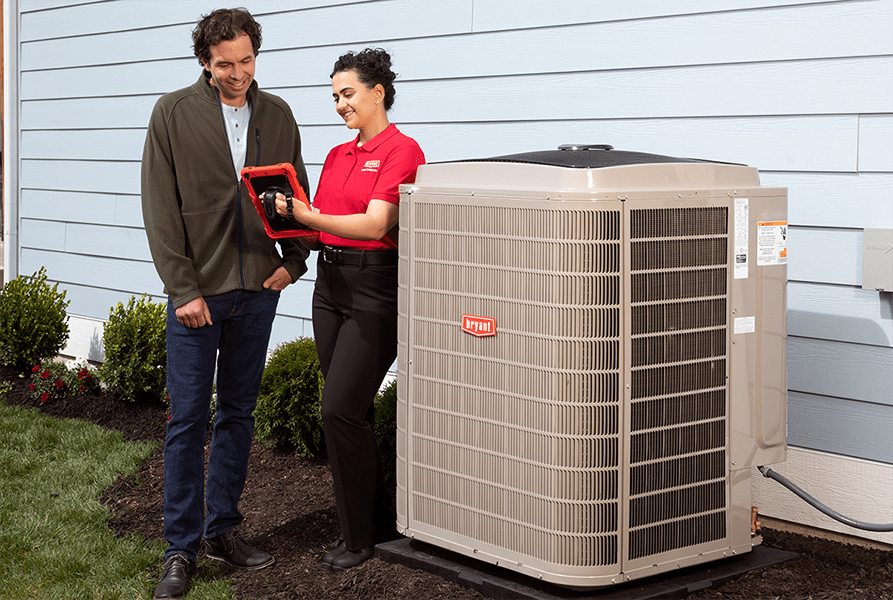
A single-stage heat pump is a system with one fixed operating capacity. When your thermostat signals that heating or cooling is needed, the compressor operates at its fixed capacity until the thermostat reaches the target temperature, then the system cycles off.
This on/off cycling is the defining characteristic of a single stage system. Unlike two-stage or variable-speed heat pumps, a single stage unit cannot modulate its output to match changing conditions—it is either fully on or fully off.
Bryant currently offers single-stage heat pumps in its Preferred™ and Legacy™ product lines. The Preferred™ 246SAN provides up to 16.5 SEER2 cooling efficiency and 8.1 HSPF2 heating efficiency, while the Legacy™ 235SAN provides up to 16 SEER2 and 8.1 HSPF2
How Does a Single Stage Heat Pump Work?
Single stage heat pumps work by transferring heat between the indoors and outdoors using a refrigerant cycle. In heating mode, the system extracts heat from outdoor air and moves it inside. In cooling mode, it reverses the process—removing heat from indoor air and releasing it outside.
The key mechanical components include:
- Compressor – Pressurizes the refrigerant; runs at a single, fixed speed
- Refrigerant – The fluid that absorbs and releases heat as it changes state
- Evaporator coil – Absorbs heat from air
- Condenser coil – Releases heat to the destination environment
- Reversing valve – Switches the system between heating and cooling modes
- Expansion valve – Reduces refrigerant pressure to enable heat absorption
Learn more about how a heat pump works.
What Are the Pros and Cons of a Single Stage Heat Pump?
Single-stage heat pumps provide straightforward operation and can have a lower equipment cost than more advanced multi-stage and variable-speed systems. However, they generally provide less capacity modulation and humidity control than systems that can operate at multiple speeds or stages.
Advantages
- Lower purchase and installation cost – Single stage units are typically the most affordable heat pump option on the market
- Simpler operation – A single operating capacity provides straightforward on/off operation.
- Reliable heating and cooling – Bryant's 235SAN and 246SAN single-stage models are designed to provide year-round heating and cooling
Disadvantages
- Less capacity modulation – A single-stage system cannot adjust compressor capacity to match changing heating or cooling loads.
- More on/off cycling – Because the system operates at one capacity, it cycles on and off rather than continuously adjusting its output.
- Basic humidity control – Single-stage operation generally provides less opportunity for extended, lower-capacity cooling cycles than multi-stage or variable-speed operation.
- Potentially higher operating noise – A single-stage system can have more noticeable starts and stops than a system that ramps its capacity gradually.
- Climate considerations – The appropriate heat pump type depends on local climate, heating requirements, equipment capacity, and system design.
Bryant Single-Stage Heat Pump Models
| Bryant model | Product line | Compressor | Cooling efficiency | Heating efficiency | Capacity |
| 246SAN | Preferred™ Series | Single-stage scroll | Up to 16.5 SEER2 | Up to 8.1 HSPF2 | 1.5–5 tons |
| 235SAN | Legacy™ Line | Single-stage scroll | Up to 16 SEER2 | Up to 8.1 HSPF2 | 1.5–5 tons |
| 235SAN*C** | Legacy™ Line Coastal | Single-stage scroll | Up to 16 SEER2 | Up to 8.1 HSPF2 | 1.5–5 tons |
Single Stage vs. Two Stage vs. Variable Speed Heat Pump
Choosing between heat pump types depends on your climate, budget, and comfort priorities.
| Feature | Single Stage | Two Stage | Variable Speed |
|---|---|---|---|
| Capacity operation | 1 (100%) | 2 (65–100%) | Many (25–100%) |
| Upfront cost | Lowest | Moderate | Highest |
| Energy efficiency | Good | Better | Best |
| Comfort/humidity control | Basic | Improved | Excellent |
| Noise level | Higher | Moderate | Lowest |
| Best for | Homeowners prioritizing straightforward operation and equipment cost | Homeowners seeking additional capacity control | Homeowners prioritizing precise capacity control and comfort |
Bryant offers all three operating approaches across its heat pump lineup, allowing homeowners to compare single-stage, two-stage, and variable-speed technologies based on their home's requirements. Bryant's current lineup includes the Legacy™ 235SAN single-stage heat pump, Preferred™ 248TAN two-stage heat pump, and Evolution™ 293VAN extreme variable-speed heat pump.
Bryant Single-Stage Suitability Checklist
Consider these four factors when deciding whether a Bryant single-stage heat pump is appropriate for your home:
- Heating and cooling load – Have a qualified HVAC professional determine the home's heating and cooling requirements rather than selecting equipment based only on square footage.
- Climate – Consider the outdoor temperatures your system will experience throughout the heating and cooling seasons.
- Comfort priorities – Decide how important precise temperature control and humidity management are to you.
- Efficiency and budget – Compare the equipment's SEER2 and HSPF2 ratings with the initial equipment and installation cost.
A qualified Bryant dealer can use these factors, along with the home's ductwork, insulation, windows, and other characteristics, to recommend an appropriately sized system.
What Size Single Stage Heat Pump Do You Need?
Heat pump capacity is measured in tons (1 ton = 12,000 BTUs per hour). The correct capacity depends on the home's heating and cooling load, not simply its square footage.
A qualified HVAC professional should perform a load calculation to determine the appropriate heat pump size for your specific home. Factors can include insulation, window area, climate, ceiling height, ductwork, and other characteristics of the home.
Avoid choosing a heat pump solely from generalized square-footage ranges. An oversized unit can cycle too frequently, while an undersized system may struggle to maintain the desired indoor temperature.
A licensed HVAC technician should perform a Manual J load calculation to determine the correct size for your specific home, factoring in insulation, window area, climate zone, and ceiling height. Learn more about heat pump sizing and various heat pump sizes: 2 ton heat pumps, 3 ton heat pumps, 4 ton heat pumps or 5 ton heat pumps.
How Long Does a Single Stage Heat Pump Last?
Heat pump lifespan varies based on installation quality, maintenance, operating conditions, climate, and equipment use. Factors that can affect lifespan include:
- Climate severity (extreme temperatures accelerate wear)
- Quality of heat pump installation
- Frequency of professional heat pump maintenance (annual heat pump service is recommended)
- Filter replacement habits (every 1–3 months is standard)
Frequent on/off cycling is inherent to single-stage operation, so proper sizing and regular maintenance can help support reliable operation over the life of the system. Learn more about how long heat pumps last.
Is a Single Stage Heat Pump Energy Efficient?
Single-stage heat pumps can provide efficient heating and cooling, although their efficiency varies by model and system configuration. Bryant's current single-stage models demonstrate that efficiency can vary within the category.
Their efficiency is measured by:
- HSPF2 (Heating Seasonal Performance Factor 2) – Measures heating efficiency; modern single stage units typically rate between 7.5–9.0 HSPF2
- SEER2 (Seasonal Energy Efficiency Ratio 2) – Measures cooling efficiency; typical single stage units range from 14–18 SEER2
For split-system heat pumps manufactured under the current federal efficiency standards, the U.S. Department of Energy lists minimum ratings of 14.3 SEER2 and 7.5 HSPF2. Single-package heat pumps have different minimum ratings.
How Much Does a Single Stage Heat Pump Cost?
The cost of a single-stage heat pump depends on equipment size, efficiency, installation requirements, location, ductwork, electrical work, and other project-specific factors. Because these variables can significantly affect the total price, a single national price range may not accurately represent the cost of a specific installation.
Bryant recommends working with a qualified dealer to evaluate the home's requirements and provide an installation estimate based on the selected system and site conditions. Learn more about heat pump cost.
Connect with a Bryant Dealer on Single-Stage Heat Pumps
A Bryant dealer can help you determine whether a single-stage heat pump is a good fit for your home, climate, and comfort needs. They can evaluate your home's heating and cooling requirements, recommend an appropriately sized system, and explain available efficiency options, rebates, and installation considerations. Find a Bryant dealer near you to get professional guidance on choosing and installing a heat pump.
About The Author: Travis Baugh is a Digital Brand Marketing Manager for Bryant, where he creates clear, helpful content to guide homeowners through heating, cooling, and indoor air quality decisions. His goal is to empower readers with the knowledge they need to choose the right comfort solutions for their home—confidently and comfortably.


